

Nigeria met 70% COVID-19 vaccination target: Official
Director of Disease Control and Immunisation in the National Primary Health Care Development Agency, Dr Bassey Okposen, has said Nigeria successfully met its ambitious target of fully vaccinating 70 per cent of its population against the COVID-19 pandemic.
He spoke during an interview with journalists on Wednesday in Abuja.
Nigeria had a target of fully vaccinating 70 per cent of its eligible population by December 2022.
”The 70 per cent coverage of COVID-19 vaccines in all countries is a global imperative. In Nigeria, 70 per cent of eligible persons are fully vaccinated against COVID-19,” he said.
He said that 80 per cent of eligible persons in the country were at least partially vaccinated against COVID-19 and 17.5 million fully vaccinated persons in Nigeria have received additional COVID-19 vaccines as booster doses
He said that as of October 1, 132,212,099 vaccine doses had been administered in the country, noting that six states achieved 100 per cent of the target population vaccinated in the country.
“These states are Nasarawa, Jigawa, Osun, Kaduna, Kano, and Adamawa,” he said.
According to hi, the milestone marks a crucial step in the country’s efforts to combat the ongoing pandemic and safeguard the health and well-being of its citizens.
“With an unwavering commitment to public health, Nigeria’s vaccination campaign has surpassed expectations, demonstrating the nation’s determination to control the spread of the virus and protect its population from the devastating impacts of COVID-19,” he said.
He said that vaccinating 70 per cent of a country’s population against COVID-19 means that a significant portion of the population has received the required doses of the COVID-19 vaccine.
“This level of vaccination coverage is often considered a crucial milestone in achieving herd immunity and controlling the spread of the virus within a population. Herd immunity, also known as population immunity, occurs when a large proportion of a community becomes immune to a disease, either through vaccination or previous infection.
“When a high percentage of the population is immune, it creates a barrier that prevents the virus from easily spreading from person to person. This not only protects those who are vaccinated but also provides indirect protection to those who are unable to receive the vaccine due to medical conditions or other factors,” he explained.
He said that by vaccinating 70 per cent of the population against COVID-19, a country greatly reduces the risk of widespread transmission, severe illness, and death caused by the virus.
“It also helps to alleviate the burden on healthcare systems and allows for a gradual return to normalcy, including the reopening of businesses, schools, and other public spaces.
“However, it is important to note that achieving a 70 per cent vaccination rate does not mean the end of the pandemic.
“The virus can still circulate among unvaccinated individuals, and new variants may emerge, requiring ongoing monitoring and potential updates to vaccination strategies,” he said.
He, however, urged Nigerians to continue adherence to public health measures, such as wearing masks for those with COVID mobilities, practising good hygiene, and maintaining social distancing, which remains crucial even with high vaccination rates in the country.
Speaking on strategies being used by the country, he explained that several strategies, including SCALES 3.0 (SCALES is an acronym for service delivery, communication, accountability, logistics, electronic management of immunisation data, and supportive supervision), and the integration of COVID-19 into routine immunisation employed to deliver the vaccine to target populations.
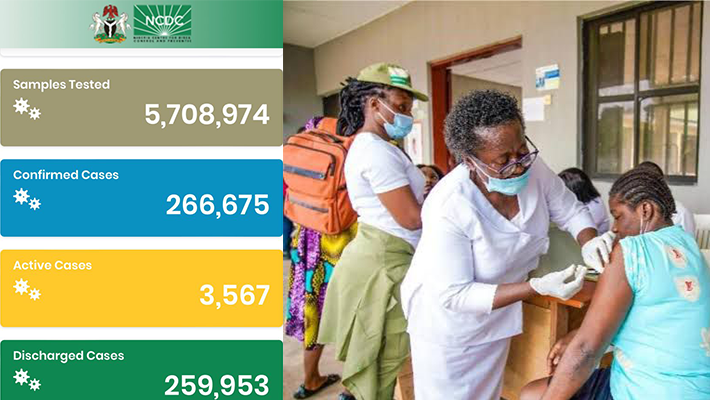
According to the Nigeria Centre for Disease Control and Prevention (NCDC) official website, as of October 31, 2023, over 5,708,974 samples have been tested, 266,675 cases confirmed, and 259,953 cases discharged from the virus.
Meanwhile, there are currently 3,567 active cases and 3,155 deaths.
Since the COVID-19 vaccination began in the U.S. in mid-December 2020, Africa has been looking forward to its turn. For Nigeria, the time came on March 2, 2021, when the first batch of 3.9 million doses of AstraZeneca’s COVID-19 vaccine arrived in the country from the Serum Institute of India.
Also, since the vaccination campaign began in the country, seven vaccines have been approved for use in Nigeria, and three of them are approved for clinical trials.
The vaccines are Moderna: Spikevax, Pfizer/BioNTech: Comirnaty, Gamaleya: Sputnik V, Janssen (Johnson & Johnson): Jcovden, Oxford/AstraZeneca: Vaxzevria, Serum Institute of India: Covishield (Oxford/AstraZeneca formulation), and Sinopharm (Beijing): Covilo.
Vaccine Type: RNA; this vaccine may also be referred to as Tozinameran, BNT162b2, Janssen (Johnson & Johnson): Jcovden, and Oxford/AstraZeneca: Vaxzevria; this vaccine may also be referred to as AZD1222, ChAdOx1 nCoV-19.
(NAN)

We have recently deactivated our website's comment provider in favour of other channels of distribution and commentary. We encourage you to join the conversation on our stories via our Facebook, Twitter and other social media pages.

More from Peoples Gazette

States
Independence: NBA urges Nigerians to expect better future
The NBA said that ordinary Nigerians should be deriving benefit from the subsidy removal rather than hardship.

Agriculture
FG tasks ECOWAS on leveraging financing strategies for agroecology
The federal government has urged stakeholders in the agriculture and finance sectors in the West Africa region to leverage financing strategies to enhance agroecology practices

Politics
Katsina youths pledge to deliver over 2 million votes to Atiku
“Katsina State is Atiku’s political base because it is his second home.”

States
Abia APC coordinator lists Tinubu’s achievements in South-East
Mr Anaba described the reforms as a work in progress.

States
APC supporters troop out for Tinubu’s campaign inauguration in Kaduna
The influx of supporters into Kaduna underscores the significance attached to the rally by party members.

Hot news Home top
Kaduna govt disowns letter allocating N2.3 trillion for Tinubu’s campaign
Mr Maiyaki warned that the deliberate fabrication of official correspondence was criminal and punishable.

World
BST: UK time changes on Sunday
The clock will be changed again on the last Sunday in March 2027.

States
Police nab man over alleged murder of ex-girlfriend in Anambra
The police said the arrest of the suspect followed a report by the victim’s mother to the Divisional Police Officer (DPO), Umuchu Division.

NationWide
North will return Tinubu to Aso rock in 2027, says Kwankwaso
Mr Kwankwaso dismissed any suggestion that the North’s support for Mr Tinubu was transactional.


