

Increase in prices of tomatoes, other perishable hit Abuja markets
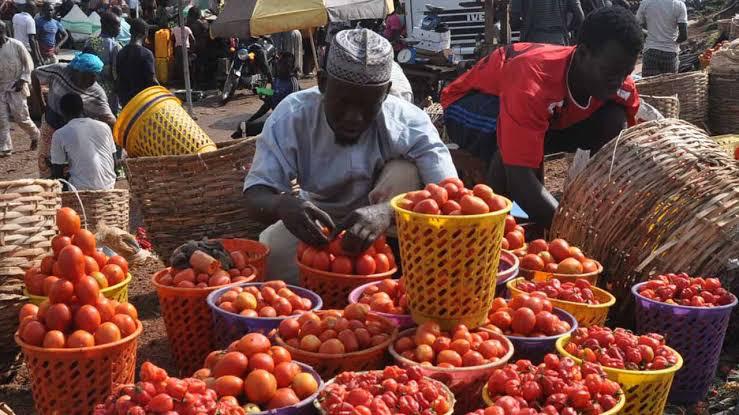
The prices of tomatoes and other perishable in Abuja markets have continued to soar despite the items being in their seasons.
Surveys of Dei-dei, Bwari and Gwagwalada markets in Abuja on Thursday showed slight or no reduction in the prices of the items.
At Dei-dei market, a big basket of tomatoes that was sold in January between N20,000 and N22,000 is now sold for N18,000 to N19,000, while a dustbin basket of peppers that was earlier sold between N3,000 and N4,000 has remained unchanged.
Similarly, in the Bwari market, a big basket of tomatoes that previously sold between N22,000 and N23,000 now sells between N24,000 and N25,000.
A dustbin basket of tomatoes previously sold for N3,000 now sells for N4,000, while a small paint bucket now sells for N2,500.
The price of pepper has remained stable since January, as a small bowl still costs between N700 and N800.
A dustbin basket of onions previously sold between N2,500 and N3,000 has been reduced to N2,000 and below, depending on how one bargains.
Similarly, at Gwagwalada market, NAN reports that the price of a basket of tomatoes fluctuates between N35,000 and N30,000.
A trader, Shuaibu Aliyu, listed factors responsible for the price fluctuation, including transportation and other logistics costs.
Mr Aliyu said, “Four days ago, we sold tomatoes between N22,000 and N25,000. But today, that same basket is sold for N18,000. The variation in prices also depends on the market forces, from the chain of production to the market. The price can also increase by tomorrow or next week.’’
He also said a dustbin basket of pepper was now sold between N3,000 and N3,200, compared to its previous price of N2,500 and N2,800.
According to Mr Aliyu, a dustbin basket of Cayenne pepper, called ‘Shombo’, that cost between N3,000 and N3,500, now sells for N2,300 or N2,500.
He said onions, previously sold for N2,000, could now be bought between N2,200 to N2,500 per dustbin basket.
Meanwhile, residents have continued to groan over the high cost of perishables, saying that previously, tomatoes were cheap to buy from December until the rains began in March.
Hannatu Musa, a public servant in Bwari, said the cost of the items, among other essential food ingredients, was becoming unaffordable and unbearable.
She said she initially used to make large purchases of the perishables when they were cheaper and stored them, but she had not been able to do so because of their high price.
“In the past, I buy tomatoes in big baskets in December when they are in season and as cheap as N7,000 or less. I will grind them and put them in containers in my refrigerator, which I use until March.
“Now, I cannot afford a basket. I recently bought a basket that I shared with my friend for N18,000, but it didn’t even last for me and my household for a month.
“The price of pepper is worse. It is very expensive and not peppery as it used to be,’’ she said.
Another resident, Obiageli Godswill, attributed the high prices to the Ramadan season and preparations for Easter and Sallah.
However, she said these items were available but expensive, and their prices have not dropped as expected in the past year.
Ms Godswill said Nigerians would appreciate the government’s policies more, especially on economic growth, when it begins to take effect on the prices of food.
“It is good that the Central Bank of Nigeria has continued to make relentless efforts toward bringing down the price of dollar and strengthen the naira, which is responsible for these price hikes.
“However, whatever they do, let the impact be felt on the cost of food in the country; that is how the people will know the government is truly working because food is paramount.
“We must not get to the point where we cannot afford a bag of rice, tomatoes and pepper as well. This will be bad,’’ Ms Godswill said.
(NAN)

We have recently deactivated our website's comment provider in favour of other channels of distribution and commentary. We encourage you to join the conversation on our stories via our Facebook, Twitter and other social media pages.

More from Peoples Gazette

States
Independence: NBA urges Nigerians to expect better future
The NBA said that ordinary Nigerians should be deriving benefit from the subsidy removal rather than hardship.

Agriculture
FG tasks ECOWAS on leveraging financing strategies for agroecology
The federal government has urged stakeholders in the agriculture and finance sectors in the West Africa region to leverage financing strategies to enhance agroecology practices

Politics
Katsina youths pledge to deliver over 2 million votes to Atiku
“Katsina State is Atiku’s political base because it is his second home.”

Anti-Corruption
Court dismisses Sanwo-Olu’s paramour Aisha Achimugu’s N10 billion suit against EFCC
The judge ruled EFCC had no basis to restrain it from carrying out its statutory duties and dismissed her claim for damages, calling the suit “frivolous and brought in bad faith”.

Economy
IMF warns collateral-backed financing can deepen liquidity risks for African borrowers
IMF warned African borrowers that securing private credit from direct lenders with high-value collateral could increase default and liquidation risk.

NationWide
APC won’t dishonour Atiku despite disrespecting Tinubu, presidency, says campaign council
The campaign council said its presidential campaign would focus on issues important to Nigerians.

Economy
UN chief urges overhaul of global debt architecture as developing countries meet
United Nations chief António Guterres stressed the need to correct power imbalances in the global debt architecture.

Anti-Corruption
Trump considering firing U.S. ambassador to Greece Kimberly Guilfoyle over bribery allegation
Eric Deters, a Trump donor, exposed Ms Guilfoyle asking him to pay her outstanding $100,000 American Express bill before her 2025 Senate confirmation hearing.

Health
UN assembly backs global action on sea level rise, racism, pandemic preparedness
The United Nations General Assembly endorsed landmark declarations on sea-level rise, combating racial discrimination, and preparing for pandemics globally.


