

Top cement manufacturer Holcim exits Nigeria after $1 billion sell-off, laments stagnant economy under Tinubu

Swiss cement maker Holcim is set to exit Nigeria over unfavourable economic conditions under the Bola Tinubu administration.
The company, which owned an 84 per cent stake in Lafarge Africa (WAPCO.LG), disclosed on Sunday that it has sold its stake to China’s Huaxin Cement for $1 billion, as reported by Reuters.
According to Holcim, the deal, projected to be sealed by 2025, is subject to regulatory approvals. The transaction is geared towards streamlining its portfolio by targeting high-growth regions like North America, with a U.S. listing in 2025.
The company is said to be focused on sustainable growth in its core markets, higher-margin products and strategic infrastructure investments.
The development comes after the company acquired a stake in Sublime Systems, a U.S. tech start-up dealing in low-carbon cement, in September, as it plans to improve its environmental credentials.
In October, the building materials company reported a slightly better-than-expected recurring operating profit of 1.67 billion Swiss francs ($1.90 billion) for the third quarter of 2024.
Lafarge had, in February 2024, announced an 8.6 per cent revenue growth from N373.25 billion to N405.50 billion and declared a N51.14 billion profit after tax (PAT) in 2023, which represented a 4.7 per cent drop year on year while also recording N21 billion Foreign exchange losses in 2023.
The company attributed its PAT decline to the higher effective tax rate and the pressures from FX losses due to the naira’s steady loss of value, with the local currency currently trading for N1,700 to a dollar from N700 in 2023 when Mr Tinubu assumed office.
Aside from the FX, Mr Tinubu’s removal of the fuel subsidy has also been a major factor contributing to the steady increases in the prices of raw materials and other products, including cement.
Meanwhile, in October 2024, the company, in its unaudited condensed financial statements for the period ending September 30, 2024, announced that its PAT rose by 53 per cent to N60.08 billion after the first nine months of 2024 compared to N39.31billion at the end of the same period in 2023.
Other companies that exited Nigeria in 2024 include Pick n Pay, Microsoft Nigeria, Total Energies Nigeria, PZ Cussons Nigeria PLC, Kimberly-Clark Nigeria, and Diageo PLC. Sanofi pharmaceutical multinational and GlaxoSmithKline Consumer Nigeria Plc exited in 2023 after the president assumed office.

We have recently deactivated our website's comment provider in favour of other channels of distribution and commentary. We encourage you to join the conversation on our stories via our Facebook, Twitter and other social media pages.

More from Peoples Gazette

Agriculture
FG tasks ECOWAS on leveraging financing strategies for agroecology
The federal government has urged stakeholders in the agriculture and finance sectors in the West Africa region to leverage financing strategies to enhance agroecology practices

Politics
Katsina youths pledge to deliver over 2 million votes to Atiku
“Katsina State is Atiku’s political base because it is his second home.”

Health
WHO recommends more birth control options
According to WHO, the guideline also supports the use of contraceptive implants for up to five years.
States
Oyo women farmers demand implementation of agricultural budgets
SWOFON said allocations in the state’s budget to agriculture between 2021 and 2025 never exceeded 4.31 per cent.

Education
NUC approves 30 new programmes for Federal University Dutse
Mr Yahaya-Bello said the approval was contained in a letter dated September 11.
Hot news Home top
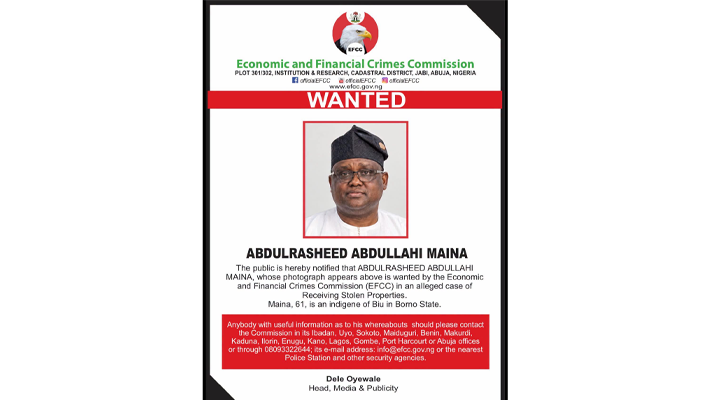
EFCC declares convicted ex-pension boss Maina wanted
The commission said the ex-chairman of PTFPR is 61-year-old and an indigene of Biu in Borno State.

States
Two men, pharmaceutical firm arraigned over fake Coartem tablets: NAFDAC
The agency said the defendants were arrested following an operation conducted by the Investigation.
States
NAFDAC raises alarm over counterfeit medicines, bottled water, other products
Dosunmu expressed delight at the number of participants.


