

Nobel Prize in economics awarded to Mokyr, Aghion, Howitt
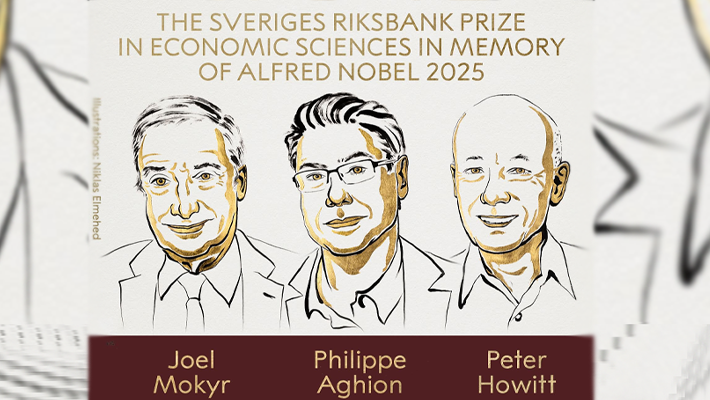
On Monday, the Royal Swedish Academy of Sciences awarded the 2025 Sveriges Riksbank Prize in Economic Sciences to Joel Mokyr, Philippe Aghion, and Peter Howitt for analysing how new technology can drive sustained economic growth.
The award-giving body stated that the three economists were recognised for explaining “innovation-driven economic growth”, identifying “the prerequisites for sustained growth through technological progress”, and for analysing “the theory of sustained growth through creative destruction.”
The academy stated, “Over the last two centuries, for the first time in history, the world has seen sustained economic growth. This has lifted vast numbers of people out of poverty and laid the foundation of our prosperity. This year’s laureates in economic sciences, Joel Mokyr, Philippe Aghion, and Peter Howitt, explain how innovation provides the impetus for further progress.”
The academy explained that Mr Mokyr “used historical sources as one means to uncover the causes of sustained growth becoming the new normal”.
“He demonstrated that if innovations are to succeed one another in a self-generating process, we not only need to know that something works, but we also need to have scientific explanations for why. The latter was often lacking prior to the industrial revolution, which made it difficult to build upon new discoveries and inventions,” the body stated.
Commenting, John Hassler, a member of the Nobel Committee, noted, “Joel Mokyr used historical observations to identify the factors necessary for sustained growth based on technological innovations”.
He added that Messrs Aghion and Howitt jointly studied the mechanisms behind sustained growth, demonstrating how creative destruction leads to conflicts that must be managed constructively.
“Philippe Aghion and Peter Howitt produced a mathematical model of creative destruction, an endless process in which new and better products replace the old,” Mr Hassler said. “In an article from 1992, they constructed a mathematical model for what is called creative destruction: when a new and better product enters the market, the companies selling the older products lose out. The innovation represents something new and is thus creative. However, it is also destructive, as the company whose technology becomes passé is outcompeted.”

We have recently deactivated our website's comment provider in favour of other channels of distribution and commentary. We encourage you to join the conversation on our stories via our Facebook, Twitter and other social media pages.

More from Peoples Gazette

Agriculture
FG tasks ECOWAS on leveraging financing strategies for agroecology
The federal government has urged stakeholders in the agriculture and finance sectors in the West Africa region to leverage financing strategies to enhance agroecology practices

Politics
Katsina youths pledge to deliver over 2 million votes to Atiku
“Katsina State is Atiku’s political base because it is his second home.”

Economy
South-South residents seek revamping of moribund state-owned industries
South-South residents have urged the governments of Rivers, Akwa Ibom, and Cross River to take deliberate steps to revamp moribund public industries in their states.

States
Osun’s Spring Valley Estate hit by blaze
A blaze has gutted a multimillion-naira property worth N50 million at Spring Valley Estate, Oranmiyan, beside the Arts and Culture Centre, Osogbo.

Economy
Delay in 6GHz allocation, stalling mobile network infrastructure: GSMA
GSMA has warned that delays in decisions on the 6GHz spectrum band are stalling essential mobile network infrastructure as the world transitions from 5G to early 6G networks.

Health
Alleged collusion with PoS scandal rocks customs, Bwari, Kubwa hospitals over cash payments
“This is the trend here. Even if somebody is dying, the relative must bring cash to pay for any services rendered here,” said a staff member of Nyanya General Hospital.
Education
Ogun releases 2026/2027 screening results for ‘flagship schools’, how to check
Parents and guardians can check the performance and admission status of candidates on https://diper.ogunstate.gov.ng by clicking on ‘Screening Result’.
Economy
Several people killed in Amazon cargo plane crash at Miami airport
Five people died, and five more were injured after an Amazon cargo plane overran a runway at Miami International Airport, crashing into vehicles and disrupting air travel.


