

FG, ASUU sign long-awaited renegotiated agreement to revive tertiary education

The Federal Government has unveiled a renegotiated agreement with the Academic Staff Union of Universities (ASUU), describing it as a turning point in restoring stability, trust and quality in Nigeria’s tertiary education system.
The Minister of Education, Dr Tunji Alausa, at the presentation of the agreement in Abuja on Wednesday, said it reflected the commitment of President Bola Tinubu to accessible, quality and uninterrupted academic calendars.
According to the minister, the President took personal ownership of resolving long-standing disputes that had affected the university system for decades.
He said, “For decades, unresolved remuneration concerns, welfare gaps, and recurring industrial disputes disrupted academic calendars, undermined staff morale, and threatened the future of our young people.
“Under the leadership of President Bola Tinubu, we deliberately chose dialogue over discord, reform over delay, and resolution over rhetoric.”
He explained that a key provision of the agreement was the review of the remuneration package of academic staff in federal tertiary institutions, as approved by the National Salaries, Income and Wages Commission, with effect from January 1, 2026.
He said the emoluments of university academic staff had been reviewed upward by 40 per cent to improve morale, enhance service delivery, boost global competitiveness and curb brain drain.
According to him, the 40 per cent review is represented through a consolidated academic tools allowance, which is peculiar to university academic staff and forms part of the salary structure.
The minister said the consolidated academic tools allowance would cover journal publications, conference participation, internet access, learned society membership and book allowances.
He described this as essential for effective teaching, research and global academic competitiveness.
He added that nine hitherto earned academic allowances had been clearly structured, made transparent and tied strictly to duties performed to promote productivity, accountability and fairness.
He also announced the introduction of a new professorial credit allowance, describing it as the first of its kind approved by the federal government.
According to him, the allowance applies strictly to full-time professors and academic readers in universities, in recognition of their heavy scholarly, administrative and research responsibilities.
He explained that under the new structure, professors would receive an additional N1.8 million per annum, amounting to about N140,000 monthly, while academic readers would receive N840,000 per annum, or N70,000 monthly.
The minister said the allowance was designed to support research coordination, academic documentation, correspondence and administrative efficiency, enabling senior academics to focus more on teaching, mentorship, innovation and knowledge production.
The minister said the government had already commenced implementation of the agreement, noting that a circular directing the full implementation of the wages component had been issued by the National Salaries, Income and Wages Commission.
According to him, the circular, dated December 30, 2025, was released to ensure the agreement took effect from January 1, 2026, in line with the government’s commitment.
Also speaking, ASUU President, Prof. Chris Pinuwa, recalled that the 2009 agreement, which was due for renegotiation in 2012, experienced prolonged delays.
Mr Pinuwa said that the 2025 agreement was the outcome of a renegotiation process initiated in 2017 to revitalise Nigeria’s university system.
According to him, several renegotiation committees were constituted between 2017 and 2022 under successive administrations, including those chaired by Wale Babalakin, Munzali Jibrin and Nimi Briggs, but none produced a collective bargaining agreement.
He said the current administration inaugurated a new renegotiation committee chaired by Yayale Ahmed in October 2024, noting that an agreement was reached about 14 months later.
He said the agreement focused on conditions of service, funding, university autonomy and academic freedom, as well as other systemic reforms aimed at reversing decay, curbing brain drain and repositioning universities for national development.
He commended Mr Ahmed and members of the renegotiation team, Mr Alausa, and President Bola Tinubu for their commitment to concluding the renegotiation process.
Expressing satisfaction with the successful collective bargaining process, Mr Pinuwa said there were still unresolved issues affecting the university system, particularly persistent government interference in university autonomy.
Mr Pinuwa stated, “As we are here with joy for a successful collective bargaining between ASUU and the federal government, we need to note that there are still pending issues, which are more of internal.
“This issue is dragging the progress and survival of the university system: government persistent encroachment into the autonomy of the universities.
“University autonomy is universally recognised as a cornerstone of a functional higher education system. In Nigeria, although university autonomy is recognised in principle and partially entrenched in law, its practical implementation remains weak.”
(NAN)

We have recently deactivated our website's comment provider in favour of other channels of distribution and commentary. We encourage you to join the conversation on our stories via our Facebook, Twitter and other social media pages.

More from Peoples Gazette

States
Independence: NBA urges Nigerians to expect better future
The NBA said that ordinary Nigerians should be deriving benefit from the subsidy removal rather than hardship.

Agriculture
FG tasks ECOWAS on leveraging financing strategies for agroecology
The federal government has urged stakeholders in the agriculture and finance sectors in the West Africa region to leverage financing strategies to enhance agroecology practices

Politics
Katsina youths pledge to deliver over 2 million votes to Atiku
“Katsina State is Atiku’s political base because it is his second home.”

Lagos
Lagos assembly to regulate artisans, adopts bill for Sanwo-Olu’s assent
The Lagos State House of Assembly has adopted a bill seeking to regulate the activities of artisans.

States
Makinde blames FG, NYSC as Oyo corps members lament delayed October allowance
The corps members lamented the delay, stating that the non-payment caused inconvenience and financial difficulties.

Anti-Corruption
NDIC vows to block diversion of liquidated banks’ recovered assets, funds
NDIC says there is zero tolerance for diverting funds realised from the sale or recovery of failed banks’ assets.
Health
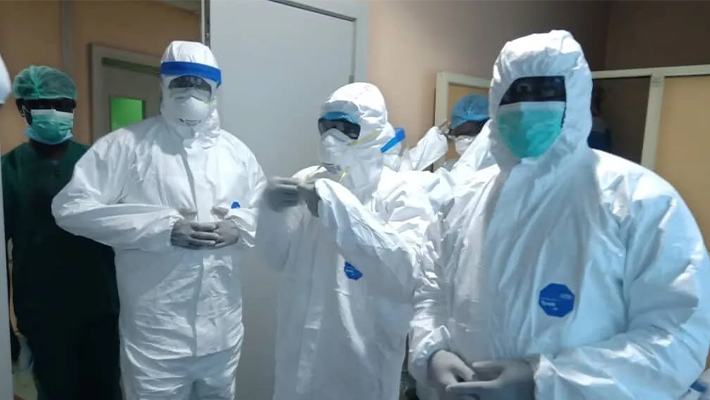
Suspected Ebola cases negative as Adamawa establishes 18 border screening points
Adamawa government established 18 screening points across nine local government areas bordering Cameroon.

Africa
NTAC DG tasks volunteers on greater impact in Sierra Leone
Mr Yakub said the corps has deployed over 1,500 volunteers to African countries, the Caribbean and the Pacific (ACP) over time.
NationWide
FG targets 20,000MW power generation, promises stable electricity within five years
Mr Tegbe said the government was pursuing a long-term strategy to expand generation capacity.


