

FRSC goes tough on fuel tanker operators

The Federal Road Safety Corps (FRSC) has said vehicles that fail to meet safe-to-load standards will no longer be allowed to load petroleum products.
The corps marshal, Shehu Mohammed, made the declaration on Thursday in Abuja at the inauguration of the 2026 technical training for safe-to-load desk officers and marshals deployed to petroleum depots and terminals nationwide.
Mr Mohammed said the corps would ensure that all tanker-related crashes were subjected to comprehensive investigations, with accountability extended across the entire value chain, including inspecting officers, depot managers, drivers and vehicle owners.
The FRSC boss, who was represented by the zonal commanding officer (ZCO), Comfort Asom, warned that tampering with speed-limiting devices and other critical safety systems would attract strict enforcement actions, including prosecution.
“The era of impunity on our highways is over. Compliance with safety regulations must be absolute, and accountability must be enforced at all levels,” he said.
The corps marshal noted that road transportation accounts for over 95 per cent of petroleum product distribution in Nigeria, describing it as a high-risk operation requiring strict regulatory oversight.
He said the Safe-to-Load Programme, introduced in 2015 alongside Nigeria’s accession to the 1957 United Nations Agreement on the International Carriage of Dangerous Goods by Road (ADR), had significantly improved safety standards.
According to him, compliance with a valid Class G driver licence rose to 99.4 per cent in 2025, up from 58.2 per cent at the programme’s inception.
He added that installation of API-standard leak-proof systems and manhole covers had reached 98.3 per cent compliance nationwide.
Mr Mohammed disclosed that 268 tanker-related crashes were recorded in 2025, while fatality and severity indices dropped by 61.29 per cent and 15.53 per cent, respectively, compared to 2024.
Despite these gains, he expressed concern over recurring tanker explosions at Majia, Dikko Junction and Indorama, stressing the need for sustained vigilance and stronger enforcement amid prevailing socio-economic challenges affecting truck operations.
He described the training as a strategic intervention designed to strengthen the competence, professionalism and leadership capacity of officers responsible for enforcing compliance at depots and terminals.
“At the core of our aspiration to achieve zero crashes and fatalities is our personnel. This training is therefore not routine but a strategic investment,” he said.
Mr Mohammed said the corps would intensify monitoring through physical inspections and deployment of technology-driven compliance systems across depots and transit corridors.
He also directed operators to strictly adhere to maintenance schedules for safety-critical components, particularly API-standard manhole covers and valves.
The corps marshal charged participating officers and marshals to approach the training with seriousness and dedication, noting that their duties directly impact road safety, environmental protection and system integrity.
He commended the Nigerian Midstream and Downstream Petroleum Regulatory Authority (NMDPRA) and stakeholders, including MEMAN, DAPPMAN, NARTO, NUPENG and IPMAN, for sustained collaboration in improving safety in petroleum transportation.
Mr Mohammed also acknowledged the support of the Major Energy Marketers Association of Nigeria and TotalEnergies Nigeria Plc towards the training programme.
Mr Mohammed urged all stakeholders to remain committed to ensuring safety on Nigerian roads, expressing confidence that the training would enhance professionalism, vigilance, and compliance in the transportation of petroleum products.
In his remarks, the sector commander, FRSC FCT Command, Tijjani Iliyasu, said petroleum product transportation by road remained critical to Nigeria’s energy supply chain and required strict safety management to protect lives, investments and the environment.
He said the programme was introduced through collaboration between industry stakeholders and government regulatory agencies to improve safety compliance.
“This initiative underscores our commitment to ensuring that every truck journey is conducted with the highest standards of safety, efficiency and sustainability,” he said.
Also speaking, Moses Oko, a representative of the Major Energy Marketers Association of Nigeria (MEMAN), called for stronger collaboration among stakeholders in the petroleum transportation value chain to achieve zero crashes.
Mr Oko said effective road safety required the active participation of town planners, engineers, road users and emergency responders, noting that each group had a critical role in preventing road traffic crashes.
He added that town planners must integrate safety into community design, while engineers must ensure road infrastructure meets safety standards.
“Road users, including drivers, pedestrians and neighbouring communities, must also adhere strictly to safety rules,” he said.
Mr Oko expressed optimism that sustained collaboration would help Nigeria achieve zero tanker-related crashes.
Similarly, the representative of TotalEnergies, Oyedeji Ifeoluwa, called for stronger capacity building, regulatory compliance and deployment of technology-driven solutions to improve safety in petroleum transportation.
He said the company’s partnership with FRSC had a long-standing history, recalling that in 2012 it sponsored 40 FRSC officers for training in France and in 2019 trained 157 operators.
He added that TotalEnergies recently concluded another training session for 155 officers held on April 9 to reinforce knowledge and align operations with evolving standards.
Mr Ifeoluwa reaffirmed TotalEnergies’ commitment, alongside industry partners, to supporting FRSC in building a safer and more responsible petroleum distribution system in Nigeria.
(NAN)

We have recently deactivated our website's comment provider in favour of other channels of distribution and commentary. We encourage you to join the conversation on our stories via our Facebook, Twitter and other social media pages.

More from Peoples Gazette

Agriculture
FG tasks ECOWAS on leveraging financing strategies for agroecology
The federal government has urged stakeholders in the agriculture and finance sectors in the West Africa region to leverage financing strategies to enhance agroecology practices

Politics
Katsina youths pledge to deliver over 2 million votes to Atiku
“Katsina State is Atiku’s political base because it is his second home.”

Diaspora
Top five crimes that land Nigerians in U.S. prisons
At the top of the list of crimes for which the 3,968 Nigerians were jailed was fraud, bribery and extortion, the document stated.

States
Two suspects in Oyo-Iwo Expressway armed robbery nabbed: Police
The police command in Oyo state said it has arrested two suspected armed robbers and recovered a firearm linked to a robbery along the Oyo-Iwo Expressway in Afijio.

Heading 4
Done Global CEO Ruthia He sentenced to 72 months, fined $90 million for distributing millions of Adderall pills
As the investigation closed in, Ms He continued to move assets and company operations abroad. She researched non-extradition countries on her MacBook and saved a screenshot of the results.
Africa
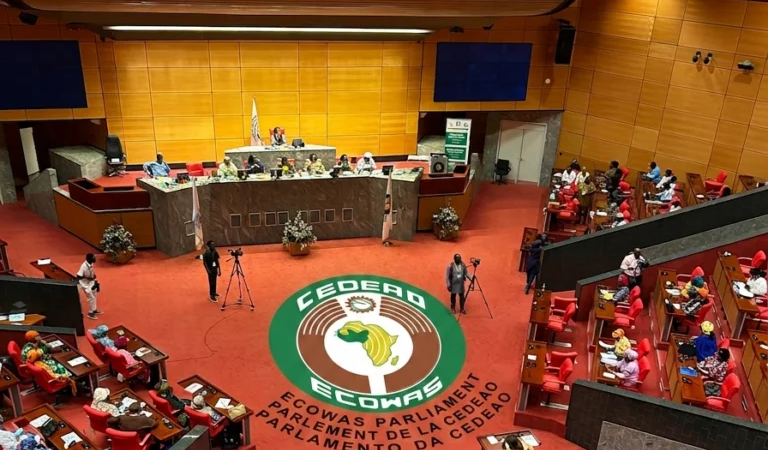
Grassroots support crucial to fighting irregular migration, says ECOWAS parliament
The ECOWAS Parliament says grassroots engagement is crucial to developing more effective regional policies to address the growing menace of irregular migration across West Africa.

Enugu
Enugu: Police impound 195 vehicles for registration, number plate violations
The police command in Enugu has impounded 195 vehicles for registration and number plate violations.

Africa
Nigeria-South Africa relations must be anchored on respect, protection of citizens: APC Governors
The Forum of First-Term Governors under the Progressives Governors’ Forum has condemned attacks on Nigerians and other nationals in South Africa.


