


Trump, Xi consider tariff cuts on $30 billion worth of goods

The U.S. and China are expected to inch toward a managed trade mechanism for non-sensitive goods this week.
Each side will possibly identify some 30 billion dollars worth of goods on which they could reduce tariffs and sell to each other without crossing national security red lines.
The so-called “Board of Trade” was first broached by U.S. Trade Representative Jamieson Greer in March as a key “deliverable” agreement for this week’s high-stakes summit between U.S.
President Donald Trump and Chinese President Xi Jinping.
The contours of the plan remain sketchy, but a key shift from past dialogues is clear: Washington is no longer demanding that Beijing change its state-directed, export-driven economic model to become more like the U.S. consumer-driven, market-oriented model.
Instead, the effort is focused on numerical trading targets in non-strategic sectors while keeping in place broad tariffs and export controls on national security-sensitive technologies.
“It’s not really a situation where we go and get China to change the way they govern, the way they manage their economy,” Greer told Fox Business Network last week.
“That’s all baked into their system, but I think there is a world where we find out where we can optimize trade between China and the United States to achieve more balance.”
He likened the mechanism to a plug “adapter” that can help connect two incompatible economic systems.
The U.S. Treasury Secretary Scott Bessent and Chinese Vice Premier He Lifeng met on Wednesday for three hours in Incheon, South Korea, to lay the final groundwork on economic proposals for Trump and Xi to discuss in Beijing.
But the two top economic officials did not issue any statements about their preliminary meeting.
Four people familiar with the Trump administration’s objectives said they expected a 30-billion-dollar-for-30-billion-dollar trade-barrier reduction framework arrangement to launch the new mechanism.
But it’s unclear whether any specific goods will be defined by Messrs Trump and Xi or if that will be achieved in subsequent meetings.
A former USTR negotiator, Wendy Cutler, who heads the Asia Society Policy Centre in Washington, said both sides “are coalescing around” a 30-dollar to 50-billion basket of goods for reduced tariffs or other barriers.
“The non-sensitive basket is just such a small part now of our overall trade with China. So maybe this Board of Trade, maybe it starts with that,” and expands in the future, Cutler told a virtual Asia Society forum on Tuesday.
U.S.-China two-way goods trade shrank by 29 per cent to 415 billion dollars from 582 billion dollars in 2024, with the U.S. trade deficit falling nearly 32 per cent to 202 billion dollars in 2025, its lowest in two decades, according to U.S. Census Bureau data.
The U.S. Trade Representative’s office and the U.S. Treasury declined to comment further on the proposed mechanism ahead of the Beijing summit.
China has refrained from using the Board of Trade moniker and said in March that the two sides had “agreed to explore the establishment of working mechanisms to expand economic and trade cooperation” with no further details.
With the U.S. aiming to increase sales of energy and agricultural products to China, Beijing’s disruptive tariffs on these commodities are one possibility.
China maintains a general extra 10 per cent tariff on all U.S. imports, matching the current 10 per cent U.S. temporary tariff on Chinese goods.
In addition to this and pre-existing “most favoured nation” tariffs, Beijing imposes retaliatory duties on imports from the U.S., 10 per cent on crude oil, 15 per cent on liquefied natural gas, 15 per cent on coal and up to 55 per cent on beef.
The U.S. maintains tariffs of 7.5 per cent on a raft of Chinese consumer products imposed in 2019 at the height of Mr Trump’s first-term trade war with China.
These include flat-panel television sets, flash memory devices, smart speakers, Bluetooth headphones, bed linens, multifunction printers and many types of footwear.
The 10 per cent temporary global U.S. tariff, set to expire in July, stacks on top of these duties.
The U.S. also could resurrect some of the more than 2,200 product-specific exclusions from the China tariffs granted during Mr Trump’s first term, but which have since largely expired.
In November 2025, Mr Trump extended for one-year temporary tariff exclusions on solar product manufacturing equipment and 164 categories of industrial and medical products from printed circuit boards to electric motors and blood pressure monitoring equipment.
Some of these could be made permanent.
The two sides are also expected to discuss the less-developed concept of a “Board of Investment” to deal with investment issues, but Greer told the Hudson Institute last month: “I don’t think we’re at the point in our relationship with the Chinese where we want to talk about big investment programs either way.”
U.S. lawmakers, automotive, steel and tech groups have warned Mr Trump against any deal that opens the door to Chinese investment in the U.S. vehicle sector, arguing that this would hollow out the core of U.S. manufacturing.
(Reuters/NAN)

We have recently deactivated our website's comment provider in favour of other channels of distribution and commentary. We encourage you to join the conversation on our stories via our Facebook, Twitter and other social media pages.

More from Peoples Gazette

Agriculture
FG tasks ECOWAS on leveraging financing strategies for agroecology
The federal government has urged stakeholders in the agriculture and finance sectors in the West Africa region to leverage financing strategies to enhance agroecology practices

Politics
Katsina youths pledge to deliver over 2 million votes to Atiku
“Katsina State is Atiku’s political base because it is his second home.”

Heading 3
Those planning to rig elections in 2027 will be resisted by Nigerians, Obi warns
The NDC presidential candidate said he and his running mate were out to engage with the electorate.
World
Nigeria, others back creation of new UN learning institute under UN80 reforms
UN General Assembly has approved the merger of two United Nations learning and training bodies, creating a new institution.
Rights
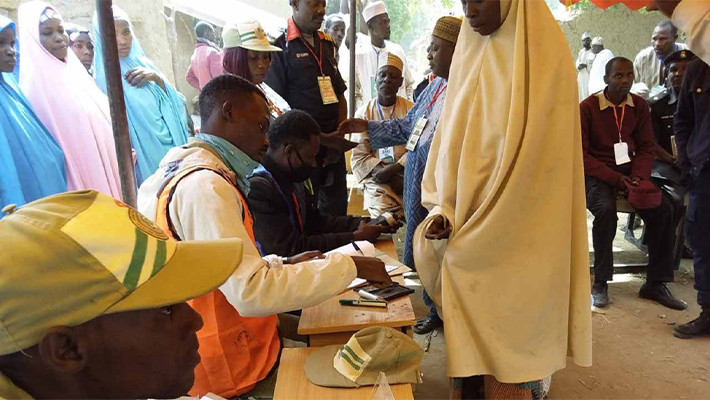
NOA initiates five-month voter education in Bauchi
The National Orientation Agency in Bauchi says it will conduct a five-month voter education exercise to mobilise participation in the 2027 elections.
Economy
Achebe Airport MD urges operators to address discriminatory ticket pricing
Martin Nwafor, the managing director of Chinua Achebe Airport, Umueri, Anambra, has called on airline operators using the airport to reconsider ticket pricing on the route.

NationWide
NIA inaugurates committees on agriculture, reinsurance
The DG urged members of both committees to contribute meaningfully towards strengthening technical standards.
World
Man arrested for killing two sisters in UAE
The police said that the suspect confessed to committing the crime.


