

Senate urges ban on textile imports, calls for revival of local mills
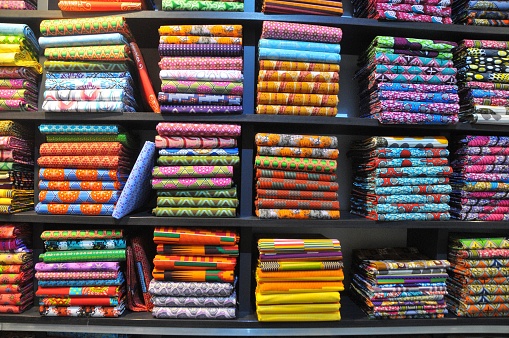
The Senate on Tuesday urged the federal government to ban the importation of textile materials and revive Nigeria’s textile industry to create jobs for the growing unemployed population.
The resolution followed a motion sponsored by Senator Sunday Katung (Kaduna South) on the urgent need to revive Nigeria’s textile industry and restore its contribution to economic growth.
The motion was co-sponsored by senators Suleiman Abdurrahman (Kano South), Simon Lalong (Plateau South), Aminu Tambuwal (Sokoto South), Hussaini Uba (Jigawa Northwest) and Mohammed Muntari (Katsina South).
Mr Katung, while moving the motion, said that the first large-scale textile manufacturing mill in Nigeria was established in 1957 in Kaduna and later replicated across the regions.
He recalled that Nigeria’s textile industry flourished in the 1960s and 1970s due to strong government intervention, including import restrictions that attracted investors.
According to him, by the late 1970s and 1980s, Nigeria had about 167 textile mills employing more than 500,000 workers directly.
He said the sector became the country’s second-largest employer of labour after the federal government, contributing significantly to industrialisation, commerce and economic development.
Mr Katung noted that Kaduna earned the title of “Textile City” because it hosted major integrated mills and the headquarters of the Nigerian Textile Manufacturers Association.
“Kaduna once had about 11 textile companies operating optimally, including Arewa Textiles Plc, Finetex Nigeria Limited, Nortex Nigeria Limited and United Nigerian Textiles Limited.
“By 1997, Kaduna Textile Limited, Arewa Textiles and United Nigerian Textiles Limited were barely functioning due to obsolete equipment and inadequate capital,” he said.
Mr Katung lamented that by 2007, the three major mills had shut down completely, leaving more than 7,000 workers unemployed and facilities abandoned.
The lawmaker said there were currently no significant new investments in the sector, while Nigeria depended on imports for more than 99 per cent of its textile needs.
He noted that Nigeria’s textile industry was once the third-largest in Africa, generating about $ 2 billion annually from a range of products.
According to him, the industry produced more than 1.4 billion pieces of textiles annually, including African prints, bed sheets, towels, and furnishing fabrics.
Mr Katung also identified the influx of foreign textile products into the country as one of the most serious threats confronting local manufacturers.
He further observed that since the lifting of the textile import ban in 2010, about 80 per cent of textiles consumed in Nigeria were imported.
Senator Mohammed Monguno also stated that Nigeria’s textile industry, once vibrant and economically significant, was now struggling due to imported products and rising production costs.
Mr Monguno proposed a ban on textile imports and the establishment of a special intervention fund by the Central Bank of Nigeria (CBN) to revive the sector, and the lawmakers adopted the proposal.
Contributing, Senator Natasha Akpoti-Uduaghan called for greater attention to cotton cultivation, describing it as the primary raw material required to revive Nigeria’s textile industry.
She cited the contributions of cotton to economies such as the United States and Ethiopia, urging strategic collaboration among ministries to restore Nigeria’s competitiveness.
Senator Adams Oshiomhole blamed the collapse of Nigeria’s textile industry on poorly conceived trade policies and urged the Senate to ensure the motion does not suffer the fate of previous resolutions.
The Senate thereafter adopted additional prayers urging the federal government to provide special intervention funds through the Bank of Industry to support the revival of the textile industry.
The Senate also urged the federal government, the Ministry of Agriculture and the Ministry of Industry, Trade and Investment to revive textile industries nationwide.
According to the lawmakers, reviving textile factories in Nigeria will create jobs, reduce youth restiveness, and address growing insecurity challenges.
(NAN)

We have recently deactivated our website's comment provider in favour of other channels of distribution and commentary. We encourage you to join the conversation on our stories via our Facebook, Twitter and other social media pages.

More from Peoples Gazette

States
Independence: NBA urges Nigerians to expect better future
The NBA said that ordinary Nigerians should be deriving benefit from the subsidy removal rather than hardship.

Agriculture
FG tasks ECOWAS on leveraging financing strategies for agroecology
The federal government has urged stakeholders in the agriculture and finance sectors in the West Africa region to leverage financing strategies to enhance agroecology practices

Politics
Katsina youths pledge to deliver over 2 million votes to Atiku
“Katsina State is Atiku’s political base because it is his second home.”

Economy
Nigeria needs $7.1 billion investment for sugar self-sufficiency, says council
Mr Bakrin said the investment would support existing sugar estates.

Politics
2027: I’m not intimidated by Tinubu, Atiku, Obi, says NRM presidential candidate
Ms Okereke expressed confidence in her capacity and the party’s vision to rebuild the country.

Hot news Home top
Ladi Adebutu assures supporters of contesting 2027 election, says APC influenced INEC omission
INEC removed the name of Mr Adebutu from its final list of governorship candidates published on Saturday.
Heading 2
2027: 241 candidates to contest 36 positions in Cross River
According to INEC’s final list of candidates, eight candidates are vying for the governorship seat.

Heading 4
NSDC targets over two million tonnes of sugar production through 13 projects
The projects comprised three existing operators and 10 proposed new sugar estates across eight states.

Heading 5
2027: APC chieftain urges Atiku, Obi to make realistic campaign promises
He said the promise by Mr Abubakar and Mr Obi to restore fuel subsidy was unrealistic.


