

Nigeria, other African countries can turn geopolitical disruptions into growth: Afreximbank Report
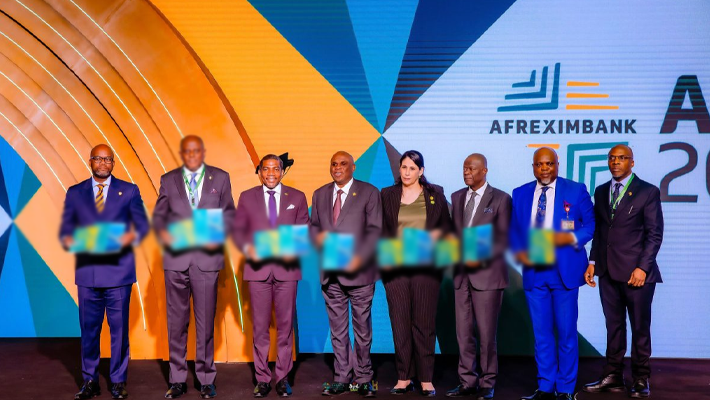
African Export-Import Bank (Afreximbank) has launched the 2026 edition of its flagship African Trade Report, ‘Leveraging Geopolitics for Trade and Industrialisation in Global Africa’.
The report presents a comprehensive review of trade and economic developments across Africa and globally in the context of the 2025 operating environment, while outlining available strategic options for Africa to transform ongoing geopolitical tensions and associated supply chain disruptions into long-term resilience for growth and shared prosperity across the continent.
The report highlights Africa’s continued growth resilience despite significant headwinds occasioned by escalating geopolitical tensions and ensuing economic shifts.
Reflecting the continent’s growth resilience, the report shows that while global economic growth slowed to 3.4 per cent in 2025 and is projected to further ease to 3.1 per cent in 2026, Africa’s real GDP growth strengthened from 3.4 per cent in 2024 to 4.5 per cent in 2025.
This performance not only surpasses the global average but also highlights the continent’s improving economic fundamentals in a fractured world economic order.
Africa’s merchandise trade also delivered a strong performance, expanding by 6.1 per cent to reach approximately $1.5 trillion, while aggregate inflation declined sharply from 21.6 per cent in 2024 to 13.1 per cent in 2025.
These outcomes reflect the stabilising effects of prudent macroeconomic management, ongoing policy and institutional reforms, and the countercyclical interventions of development finance institutions across the continent.
Commenting on the Africa Trade Report’s findings, Yemi Kale, Group Chief Economist and Managing Director of Research and Trade Intelligence at Afreximbank, said, “Africa stands at a critical juncture. Geopolitical tensions and economic fragmentation are reshaping global trade patterns, but they also present a historic opportunity for the continent. By strategically leveraging these shifts, Africa can build a more resilient, competitive, and inclusive economic future.
“It is imperative for the continent to act decisively to strengthen regional value chains, deepen industrial capacity, expand access to trade finance, and accelerate continental integration. Through coordinated policy action, strategic infrastructure investment, and stronger development finance institutions, Africa can build a more resilient, inclusive, and value-added trade ecosystem. Africa cannot afford to delay.”
The report further highlights that Africa’s export performance remains constrained by a persistent trade finance gap, estimated at approximately $74 billion in 2025. The challenge is exacerbated by limited foreign exchange liquidity and the continued decline in correspondent banking relationships, factors that restrict the continent’s capacity to fully realise its trade and industrial potential.
At the same time, evolving shipping routes and prolonged disruptions to global logistics networks continue to extend delivery timelines and increase freight and trading costs.
These pressures are particularly acute for African economies that remain heavily reliant on imported inputs and external markets, even as global supply chains increasingly reconfigure toward resilience, diversification, and the emergence of alternative production hubs.
The report also outlines several strategic priorities, including the accelerated implementation of the African Continental Free Trade Area (AfCFTA), the expansion of digital payments infrastructure through the Pan-African Payment and Settlement System (PAPSS), and coordinated reforms to the global financial architecture.
It further underscores the growing role of African financial institutions in strengthening economic resilience. Afreximbank, a founding member of the Alliance of African Multilateral Financial Institutions (AAMFI), disbursed $17.5 billion in 2024 and is working to double intra-African trade finance by 2026.
Meanwhile, Pan African Payment and Settlement System (PAPSS) is already helping to reduce transaction costs and lessen reliance on foreign currencies across the continent.

We have recently deactivated our website's comment provider in favour of other channels of distribution and commentary. We encourage you to join the conversation on our stories via our Facebook, Twitter and other social media pages.

More from Peoples Gazette

Agriculture
FG tasks ECOWAS on leveraging financing strategies for agroecology
The federal government has urged stakeholders in the agriculture and finance sectors in the West Africa region to leverage financing strategies to enhance agroecology practices

Politics
Katsina youths pledge to deliver over 2 million votes to Atiku
“Katsina State is Atiku’s political base because it is his second home.”

States
Police nab four suspects for alleged child trafficking in Abia
Ms Chinaka said the suspects allegedly conspired to steal a four-day-old baby from her mentally unstable mother.
Agriculture
Enugu hires over 160 professionals to revive livestock production
Mr Ubru said the recruitment was in fulfilment of Governor Peter Mbah’s vision to revamp the agricultural sector.

Heading 2
Plateau government disburses N1.5 billion intervention funds to attack victims
Governor Caleb Mutfwang formally inaugurated the disbursement of the funds on Monday in Jos.

Heading 5
Don’t destroy APC like you did PDP, group warns Wike
Mr Wike has insisted that his major political priority remained securing the re-election of Mr Tinubu in 2027.

Heading 1
Atiku condemns Tinubu’s prolonged vacation abroad, says Nigeria can’t be governed on autopilot
Mr Onanuga said that the president would return to the country at the weekend.
Economy
ECOWAS to honour 60 West African start-ups
The top three start-ups will receive $30,000, $20,000 and $15,000 respectively in seed funding.


