

UN special agent briefs Security Council on insecurity in Nigeria
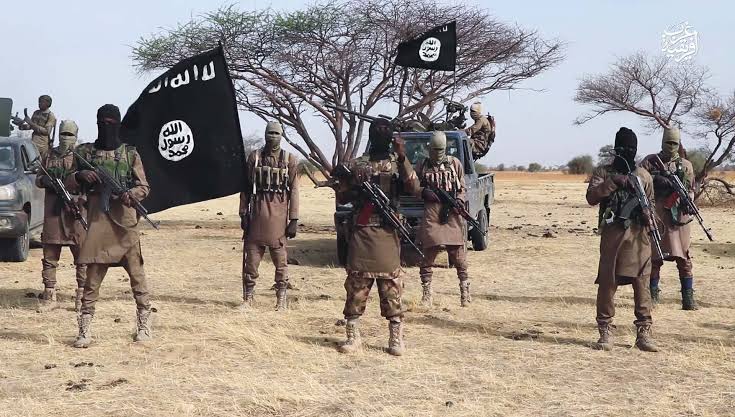
Special representative and head of the UN Office for West Africa and the Sahel (UNOWAS), Leonardo Simão, on Tuesday briefed the Security Council on political and security developments in Nigeria, West Africa, and the Sahel.
Mr Simão briefed the council on the secretary-general’s latest report (S/2026/537), which was circulated to council members on June 30 and covers developments from November 29, 2025, to June 30, 2026.
The secretary-general’s report described the regional security landscape as being characterised by interstate tensions, terrorist and insurgent attacks, and transnational organised crime.
Mr Simão said three broad trends stand out in the region: the concerning security situation, the renewed momentum for dialogue and cooperation, and, finally, the democratic developments occurring in the region.
He said the threat posed by terrorists and other non-state armed groups remains acute, especially in the central Sahel and northern Nigeria.
In Nigeria, he said, insecurity persists in the North and Middle Belt regions, where terrorist attacks, kidnappings, and intercommunal violence continue to result in high levels of civilian casualties.
Between January 1 and February 10 alone, 1,258 civilians were killed, including 170 in a February 3 attack in Kwara by a Boko Haram splinter group, according to the report. He added that these groups are adapting their tactics and increasingly using advanced technologies, such as drones and cryptocurrencies.
Their attacks are coordinated across multiple fronts, including across countries, and their actions intersect with transnational organised crime.
The human cost of the violence is devastating, the special representative said, adding that regional actors are working hard to find solutions. He told council members the region was also experiencing a renewed momentum for dialogue and noted that on issues related to the Sahel.
He said there’s a shift from confrontation toward collaboration and constructive engagement that is beginning to produce concrete results.
Mr Simao flagged peaceful elections in Benin, Cabo Verde, Côte d’Ivoire and Guinea, as well as reforms and continued steps towards accountable governance in the region.
Some council members who spoke reiterated the need to pay closer attention to West Africa and the Sahel, expressing concern about the continued deterioration of the security situation across the region.
They stressed the importance of strengthening regional cooperation to address cross-border threats posed by terrorism and transnational organised crime.
They also underscore the important role of UNOWAS in advancing preventive diplomacy and fostering regional dialogue.
U.S. representative for UN Management and Reform, Jeffrey Bartos, thanked Simão for his leadership and engagement across the region. The envoy said he was looking forward to receiving the United Nations strategic assessment of the mission in the coming months. He said terrorism continued to fundamentally disrupt and shatter the lives of millions of people across the Sahel and West Africa.
“The latest attacks are more sophisticated, more coordinated, and are escalating in intensity. The United States condemns in the strongest terms all terrorist attacks, including the April 25 terrorist attack in Mali and the June 18 attack on the airport in Niamey, Niger.
“We express our deepest condolences to the families of those who were killed. There must be accountability for the attacks perpetrated by al-Qa’ida-affiliated JNIM, ISIS-Sahel, ISIS-West Africa, Boko Haram, and all other terrorist groups operating across the region,” stated Mr Bartos.
Mr Bartos said the Council should encourage greater coordination between the states of the Alliance of Sahel (AES) and their coastal neighbours, noting that “the current lack of coordination serves only the interests of the terrorist organisations operating in the region, as they eagerly exploit these political fractures”.
Mr Bartos said the U.S. “remains committed to engaging constructively with all countries in the region”.
Earlier this month, the U.S. deputy secretary of state met with the ambassadors of Burkina Faso, Mali, and Niger in Washington to reaffirm the U.S. commitment to working with these countries based on respect for sovereignty and the advancement of mutual interests.
The envoy further urged the Sahelian States and their Coastal West African neighbours to set aside their differences and seek a unified, coordinated response to terrorism; one that respects the rule of law and human rights, including military cooperation and intelligence sharing.
“African ownership of the regional security situation, with a coordinated response among all countries in the region, is critical. The United States, in turn, will continue to work with our regional partners to counter these common threats,’’ he said.
(NAN)

We have recently deactivated our website's comment provider in favour of other channels of distribution and commentary. We encourage you to join the conversation on our stories via our Facebook, Twitter and other social media pages.

More from Peoples Gazette

Agriculture
FG tasks ECOWAS on leveraging financing strategies for agroecology
The federal government has urged stakeholders in the agriculture and finance sectors in the West Africa region to leverage financing strategies to enhance agroecology practices

Politics
Katsina youths pledge to deliver over 2 million votes to Atiku
“Katsina State is Atiku’s political base because it is his second home.”
States
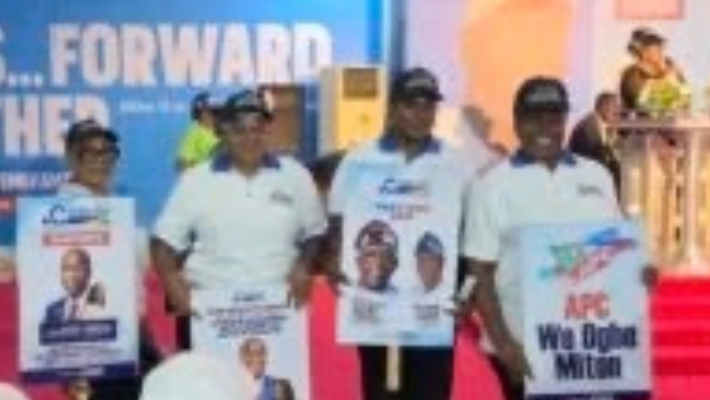
Lagos APC governorship candidate Hamzat rallies voters for 2027
Mr Hamzat expressed concern about declining voter participation, noting that of the 6.2 million registered voters in Lagos in the last election, only about 1.2 million voted.
Economy
NMDPRA begins consultations on anti-competition regulations in petroleum sector
The proposed regulations are designed to address abuse of dominance and promote fair, non-discriminatory access to essential petroleum infrastructure.
States
Gov Bago inaugurates nine-member judicial commission to probe 37 miners’ deaths in NSCDC custody
The commission is mandated to investigate the circumstances surrounding the arrest and the legality of the deceased’s custody, and their condition and treatment while in custody.
Economy
Nigeria, Norway deepen partnership on aquaculture, seafood trade
The Norwegian Ambassador to Nigeria, Svein Bæra, said the partnership would strengthen the long-standing stockfish trade between the two countries and promote knowledge exchange.
NationWide
Umahi promises pedestrian bridges, improved road access to tertiary institutions
Mr Umahi said the government had taken special note of the need to incorporate access routes to campuses into future road construction projects where possible.
States
Gov Alia inaugurates peace committee to monitor natural resources sharing agreement
Mr Alia said it is an important step from signing a peace agreement to practical implementation.


