

Uba Sani and the making of history
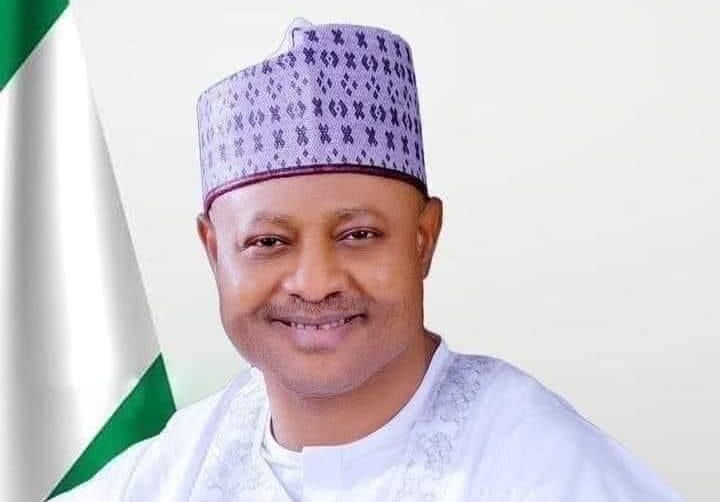
Some management and development experts often posit that the accountability expected of leaders does not just stop at minding and dispensing the public till. It also entails living up to their words with action to fulfil their covenant with the public, especially for politicians. Governor Uba Sani, since assuming office, has been matching his campaign promises with deeds.
As a candidate, he had sought the people’s mandate, promising a seven-point development programme tagged ‘SUSTAIN Agenda’. When implemented religiously, he had argued, the acronym would serve as a reliable road to prosperity for rural and urban communities in Kaduna State. In summary, SUSTAIN stands for Safety and security (foremost), Upgrade of Infrastructure, Strengthening Institutions, Trade and Investment, Investment in Human Capital and Nurturing Citizens’ Engagement.
On Saturday, 25th July, the governor flagged off the distribution of 500 trucks of free fertilisers and agricultural mechanisation equipment to 150,000 smallholder farmers across the 23 local government areas of the state. The distribution of that largesse was not the first time that the Governor doled out free farm inputs to smallholder farmers.
In 2024, 500 trucks of fertiliser were also distributed to farmers free and in 2025, 400 trucks were similarly delivered to them at no cost. With the rise in Agriculture’s budget this year to over N100bn from a paltry N1.48 billion in 2023, the distribution of free fertiliser, complemented with the provision of some agricultural mechanisation, shows that Sani’s administration is a farmer-friendly government. Ultimately, his plan is to revolutionise agriculture and empower smallholder farmers, as well as uplift the standard of living of rural communities.
Besides agriculture, the Kaduna governor has earned a pride of place in Nigeria’s history in the last three years, especially in his financial inclusion drive, revenue generation, investment and job creation, security, infrastructural development, education, health and social welfare, among others. However, the Kaduna Peace Model of using non-kinetic means to tackle the security challenges in the state has remained a reference point amongst security experts.
Starting with his recruitment of 7,000 youth into the State Vigilante Service (KADVIS) early in the life of the administration, to boosting the capabilities of security agencies with 150 patrol vehicles and 500 motorcycles, his active liaison with federal security agencies and the local communities in policing, the administration has indeed succeeded in making Kaduna State appreciably safe.
Birnin-Gwari and Giwa LGAs were no-go areas due to the unchecked activities of bandits and other non-state actors in the past. Their famous cattle markets, which were closed for a long time, have now returned to full-scale operation. Likewise, the popular grains markets are now in full swing, as truckloads of grains are being transported across neighbouring states and down to far-flung places in the south of Nigeria with ease.
In addition, over 500,000 hectares of land which insurgency had denied farmers access to have now been reclaimed. Indeed, insurgency and banditry have not been banished; pockets of abductions and sundry crimes are still being reported mostly in the remote rural areas, but the Kaduna Peace Model, which involves all stakeholders in the management of the peace, has drastically minimised the incidents.
Likewise, the favourable investment climate, induced by a secure environment, has resulted in over $2 billion garnered in various investment portfolios from both foreign and local sources. Jobs are expected to be created in the wake of the coming to fruition of some of the ventures. Projects such as Sunagrow Soya Oil Refinery Plant, Lithium Processing Plant, Ming Xin Mineral Separation Plant, the multibillion-naira Kaduna Bus Rapid Transit (KBRT) project, being undertaken jointly with France, as well as a host of mining companies that are ready to go full swing, are some of the investments that are in the offing.
Specifically, the governor has been executing projects, improving existing infrastructure and paying off debts in the last three years without borrowing a dime.
“In the last 3 years, we have been able to pay over N90 billion of the debt we inherited, and since we came into government, we have not taken any loans. We have also generated $2.5 billion in investment for our state,” the Kaduna governor stated.
This speaks to his versatile financial management.
Indeed, he has constructed a total of 150 road projects covering more than 1,355 kilometres across the 23 LGAs in the last three years. This is unprecedented in Kaduna state, within the time span. The good road networks have improved transportation, boosted the economy, and enhanced access to schools, health care facilities and markets.
Besides, the roads have stimulated local trade between communities, with attendant emerging new businesses, timely evacuation of agricultural produce, which reduces post-harvest losses, attracted investors willing to be involved in business development, and eased access to essential services, with the resultant increase in public confidence in government.
Equally, education and the health sectors, as well as staff welfare, have received commensurate government attention over the years. The administration, which had earlier reduced tuition fees in state-owned higher institutions by about 40 per cent, injected funds into them to ensure that their academic programs measure up to standard.
In addition, the government is focused on skills acquisition and to this end, it has constructed three Skills Acquisition Centres at Soba, Rigachukun and Samarun Kataf, representing the Northern, Central and Southern senatorial districts respectively. The administration also came to the rescue of its students abroad by approving N407 million to offset outstanding school fees.
The lower level of education has also received an unprecedented boost in both infrastructural development, students’ enrolment and retention. At the last count, 62 new secondary schools have been constructed, 100 others built in partnership with the Kuwait Fund for Arab Development, while over 2,300 new classrooms have been built to complement the 707 others that have been renovated across the state. Plans are also said to be afoot for the construction of an additional 55 secondary schools.
These efforts, together with improved welfare for teachers, have resulted in improved learning outcomes, with, for instance, WAEC, NECO, and NABTEB posting remarkable improvement. This rose from 54 per cent maximum passes recorded before this administration to 65 per cent in the most recent results. The positive outcome is attributed to the promotion of evidence-based education planning through the use of reliable data for policy formulation and decision-making.
In addition, the health sector has received a new lease of life. This administration recruited 89 medical doctors into the system, employed 1,800 other categories of health personnel and empowered its 290 primary healthcare centres (PHCs) with necessary equipment and drugs.
Currently, it is rehabilitating and upgrading 255 of the centres to level two facilities, thus reducing long journeys in search of health care facilities and access to medical care, especially in remote areas. At the same time, the government is refurbishing and remodelling 16 general hospitals across the state, some of which had not been renovated since their commissioning decades ago.
The icing on the cake is the commissioning of the 300-bed specialist hospital, which had been abandoned for decades by successive administrations. The hospital is now functional. Government’s approval of the CONMESS and CONHESS salary structure in the health sector and other welfare packages has meant that there have been very few labour-induced interruptions in the health sector over the three years.
Indeed, the welfare of civil servants and pensioners has attracted a lot of accolades for the Sani administration. The recent payment of about N4 billion brings the total payments to the pensioners and families of deceased civil servants in the last three years to over N17billion. The governor’s feat has been acknowledged by an avalanche of awards from professional bodies. The Nigerian Union of Journalists (NUJ) has given him an award for Good Governance and Peacebuilding, citing the Governor’s commitment to peace and even development.
The free 100 Compressed Natural Gas (CNG) powered buses have been a blessing for commuters in Kaduna metropolis. They have ferried 3.2 million people across their designated routes in the city, with civil servants, students, security agents, among others as the main beneficiaries.
Cumulatively, the free transport services have saved commuters a total of N3.5 billion in fares. As a whole, the transportation sector is being overhauled with the construction of three terminals which will revolutionise public transportation.
The facility, touted as the largest in West Africa on completion, apart from accommodating all unions in one place, will feature ticketing halls, passenger waiting lounges, a hotel, restaurants, CNG filling stations, among others. In the end, they are capable of generating over 20,000 jobs. Besides, such facilities align with the KBRT and the upcoming Kaduna light rail project.
All these developments would not have been possible without the strengthening of institutions and enhancing the human capital that drives development. With the deliberate and faithful implementation of the SUSTAIN agenda, the Kaduna Peace Model, inclusive governance, fairness, and equity, Kaduna State is now a beacon of hope and progress.
Waziri Garba, a public affairs analyst, was managing editor of the Kaduna-based New Nigerian

We have recently deactivated our website's comment provider in favour of other channels of distribution and commentary. We encourage you to join the conversation on our stories via our Facebook, Twitter and other social media pages.

More from Peoples Gazette

States
Independence: NBA urges Nigerians to expect better future
The NBA said that ordinary Nigerians should be deriving benefit from the subsidy removal rather than hardship.

Agriculture
FG tasks ECOWAS on leveraging financing strategies for agroecology
The federal government has urged stakeholders in the agriculture and finance sectors in the West Africa region to leverage financing strategies to enhance agroecology practices

Politics
Katsina youths pledge to deliver over 2 million votes to Atiku
“Katsina State is Atiku’s political base because it is his second home.”

Economy
Lagos butchers seek land for Eko Ranches, plan pilot scheme
The Lagos State Butchers Association says it is seeking approval to begin a pilot ranching scheme at Oko-Oba Abattoir while awaiting land for Eko Ranches.

World
Five Nigerians appointed to UN information system consultation group
Five Nigerians have been appointed to the 92-member Multistakeholder Consultation Group of the United Nations Group on the Information Society.
States
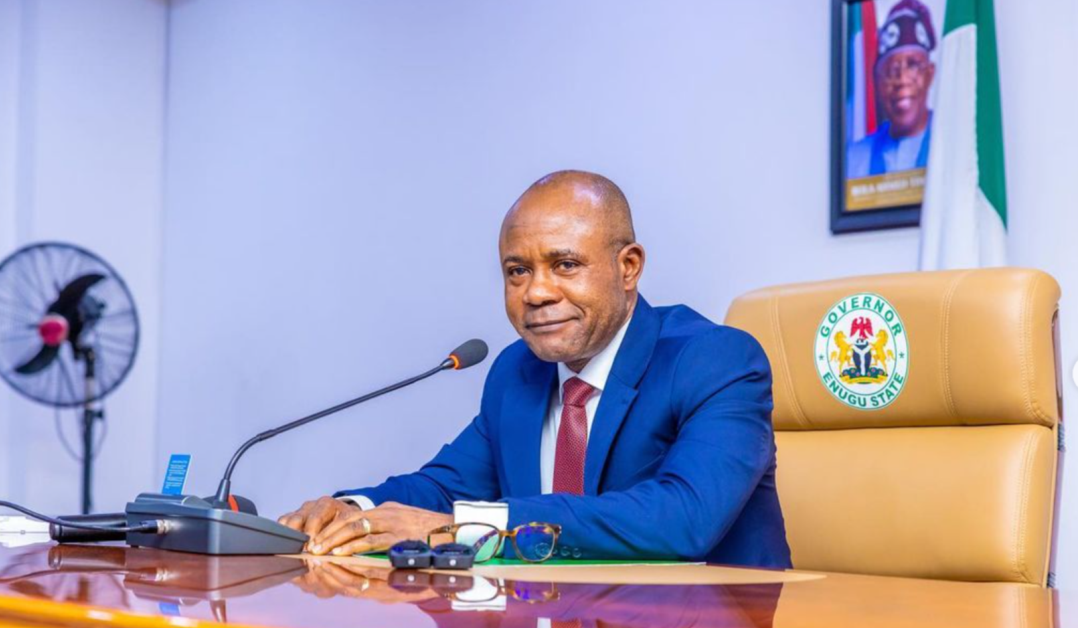
Mbah inaugurates multibillion-naira pharmaceutical company in Enugu
Governor Peter Mbah has inaugurated Anchorage Pharmaceutical Industries Limited, a multibillion-naira pharmaceutical company in Trans-Ekulu, Enugu.

Maiduguri
Shettima arrives in Maiduguri to inaugurate projects
Vice-President Kashim Shettima has arrived in Maiduguri, Borno, to inaugurate Kashim Ibrahim University Teaching Hospital, a hostel, and 104 staff housing units.
Abuja
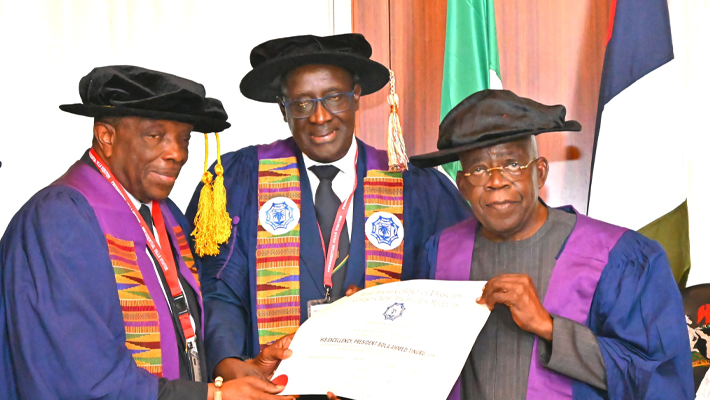
Tinubu receives medical fellowship from WACP
Mr Tinubu said his government was committed to championing comprehensive health sector reforms to make healthcare delivery more accessible and affordable.
Economy
Women-led businesses targeted as DBN, AfDB sign $61 million financing agreement
The Development Bank of Nigeria has signed a $61 million gender-focused financing agreement with the African Development Bank to support women-led businesses.


