

ASUU commends Kaduna govt for funding, tackling KASU’s challenges
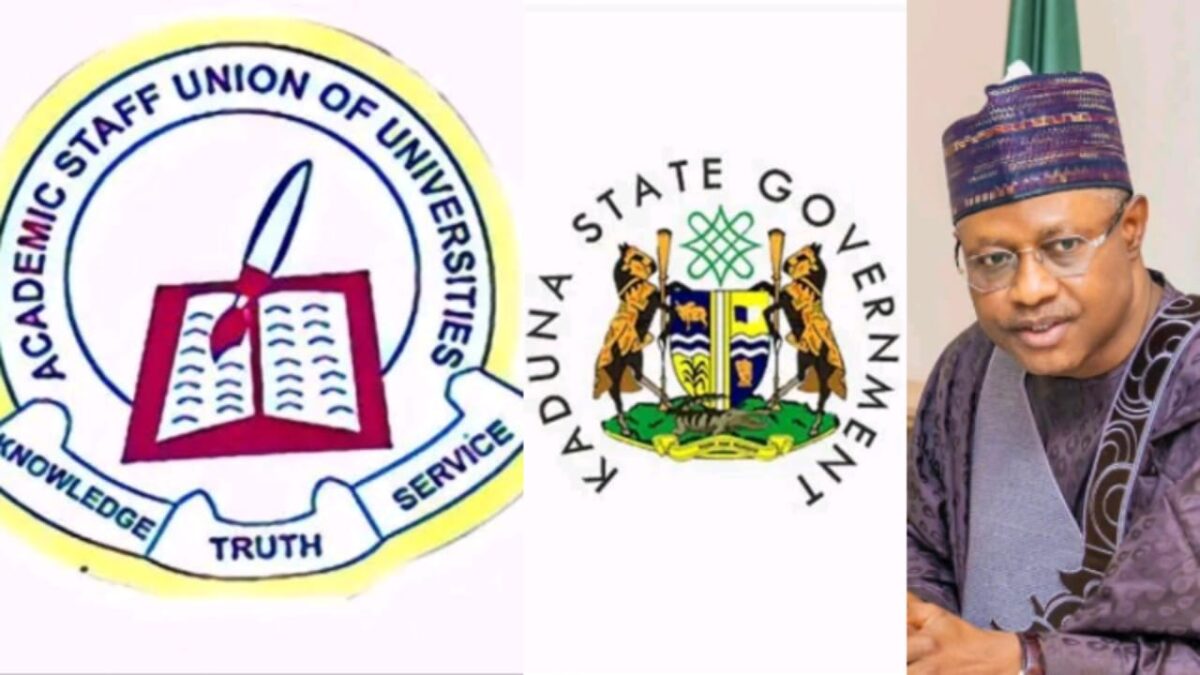
The Academic Staff Union of Universities (ASUU), Kaduna State University (KASU) chapter, has commended the Kaduna State Government for addressing some of the longstanding challenges confronting the institution.
The chairman of ASUU-KASU, Dr Abubakar Abdullahi, made the remarks at a press briefing in Kaduna on the union’s ultimatum to the state government over what it described as poor working conditions and other challenges affecting the university.
Mr Abdullahi said the union’s position was not intended to castigate the government, but to draw its attention to areas requiring further intervention to strengthen the university.
He acknowledged some steps already taken by the present administration, saying the union would continue to commend the government whenever it addressed issues affecting the institution.
“Where you have done something, we commend you, and where there is an issue, we bring it to your attention to address,” he said.
The chairman recalled that the government had addressed some of the issues contained in previous agreements with the union, including matters relating to salaries and allowances.
According to him, out of about 10 issues previously presented by the union, three had been addressed and seven remained outstanding.
He said the union was particularly encouraged by the government’s review of a previous decision on school fees, recalling that ASUU opposed the increase because of its potential impact on students.
“When the current government came about, they reviewed the decision and we commend them for that,” he said.
Mr Abdullahi stressed that ASUU’s interventions were not limited to the welfare of its members, but aimed at protecting the university system and ensuring that tertiary education in Kaduna State remained competitive.
He said the union considered its responsibilities to include teaching, research and community service.
The chairman also praised KASU’s achievements, saying the institution had performed creditably compared with other universities despite the challenges confronting it.
He described KASU as an institution that could serve Kaduna State for generations if properly supported.
“Roads would come and go. Physical infrastructure would not live more than 30 to 50 years. But KASU is an institution we hope and pray will still be here for the next 100 or 200 years,” he said.
He added that the university started on “the very right footing” and had recorded achievements that compared favourably with established universities.
“I am not even talking about state universities. Federally established universities, first-generation universities, we go to places and we beat them, hands down,” Mr Abdullahi said.
He therefore called for sustained government support, improved staff welfare and proper funding to enable the institution to retain its academic workforce and maintain its standards.
On the two-week ultimatum, Mr Abdullahi clarified that the union was not eager to embark on industrial action, stressing that dialogue remained its preferred option.
“Usually, people have this wrong notion that ASUU always wants to embark on strike. That is not our desire or passion,” he said.
He stated that the purpose of the briefing was to bring the challenges to the attention of the government and the public in the hope that they would be resolved before the ultimatum expired.
He said ASUU remained ready for dialogue with the government at any time, stressing that peace and stability in the university were in the interest of stakeholders.
“Even if the government calls us now, we are ready to move. Anything that will bring peace to the system, stability, that is what we want,” he said.
Mr Abdullahi also urged the government to implement the new Federal Government-ASUU agreement, saying its provisions could benefit both university staff and the administration through improved funding and management.
He appealed to the state government to see the outstanding challenges as an opportunity to strengthen KASU and leave a lasting legacy in the education sector.
“The government has the opportunity to write its name in gold by actually fixing a problem system they inherited,” he said.
The ASUU-KASU chairman said Kaduna, traditionally recognised as a centre of learning, should remain at the forefront of educational development and not allow other states to overtake it in the sector.

We have recently deactivated our website's comment provider in favour of other channels of distribution and commentary. We encourage you to join the conversation on our stories via our Facebook, Twitter and other social media pages.

More from Peoples Gazette

States
Independence: NBA urges Nigerians to expect better future
The NBA said that ordinary Nigerians should be deriving benefit from the subsidy removal rather than hardship.

Agriculture
FG tasks ECOWAS on leveraging financing strategies for agroecology
The federal government has urged stakeholders in the agriculture and finance sectors in the West Africa region to leverage financing strategies to enhance agroecology practices

Politics
Katsina youths pledge to deliver over 2 million votes to Atiku
“Katsina State is Atiku’s political base because it is his second home.”

States
NBA Ibadan to boycott Oyo judiciary’s new legal year event
The branch said it unanimously reached the boycott decision at its general meeting convened on Saturday.
Heading 1
Under Buhari Nigeria was collapsing before Tinubu came as saviour: Shettima
Mr Shettima stated Nigerians should be kind towards Mr Tinubu.

States
Kano governor condoles NIPR chairman over father’s death
The governor urged the bereaved family to take solace in the good virtues and legacies left behind by the deceased.
![Vessels along Strait of Hormuz (Photo credit: Benoit Tessier/File Photo/Reuters]](https://gazettengr.com/wp-content/uploads/cxk79fQB.jpg)
World
Iran lists seven conditions to reopen Strait of Hormuz
Mr Ghalibaf said accepting the seven demands was the only way to reopen the oil passageway.

States
Two suspected cultists nabbed in Delta for alleged murder
Mr Edafe said the suspects were apprehended on Thursday by the command’s operatives of the Violent Crime Response Unit.

Lagos
Tinubu visits Oba of Lagos, receives monarch’s counsel, prayers
Some APC stalwarts, political associates and other dignitaries were part of the visit.


