

Nigeria becoming increasingly democratic, says Ugandan lawmaker
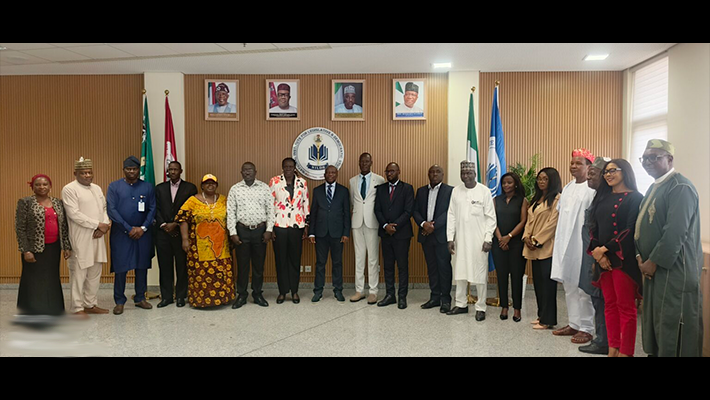
A Ugandan parliamentarian, Avur Pacuto, says Nigeria is increasingly becoming democratic.
Ms Pacuto, team lead for Members and Technical Staff of Uganda’s Parliamentary Committee on National Economy, said this on Monday in Abuja during the committee’s visit to the National Institute for Legislative and Democratic Studies (NILDS).
The delegation was at the institute for a five-day training.
Ms Pacuto said that Nigeria’s democratic development informed the delegation’s decision to visit the country for knowledge-sharing and capacity-building.
“We are here today as leaders from Uganda to learn and share from you, being a sister country in the Commonwealth.
“Because Nigeria is increasingly becoming very democratic, we thought there was no better place than Nigeria to come to,” she said.
Ms Pacuto said African countries needed to learn from one another’s mistakes and successes, rather than depending exclusively on lessons from Europe.
“It is now time for us as Africans to learn from each other’s mistakes and successes. That is why we are here,” she stated.
She explained that the Committee on National Economy was mandated to review, assess and scrutinise government borrowing, grants and guarantees.
The parliamentarian said the delegation was in Nigeria to learn how borrowed resources could be effectively utilised for the common good of citizens.
“We are here to learn more about how borrowed resources should be used for the common good of our citizens, being cognisant of wastages and leakages in public funds,” she stated.
Ms Pacuto said the training would also expose African governments to sustainable borrowing strategies, taking into consideration global economic dynamics and exchange-rate fluctuations.
She added that the delegation hoped to gain further insights into Nigeria’s economic development, cultural diversity and institutional practices.
“We want to learn not only how Nigeria develops and sustains its economy but also the uniqueness of its culture and language,” she said.
Ms Pacuto commended the NILDS director-general and management for accepting the delegation’s request to participate in the training programme.
She used the opportunity to invite Nigerian legislators and NILDS officials to visit the Ugandan parliament for further engagements, experience-sharing and cultural exchanges.
Ms Pacuto thanked the institute for its hospitality, saying that the delegation had already identified valuable opportunities for learning and collaboration.
Declaring the training open, NILDS Director-General Abubakar Sulaiman stressed the importance of parliamentary oversight, public finance scrutiny, and continuous capacity development for effective legislative performance.
Mr Sulaiman said a parliament’s effectiveness depends not only on legislation but also on scrutinising public finances and interrogating complex economic and policy issues.
He said that Uganda’s projected economic growth of 6.5 to seven per cent in 2026 was encouraging, adding, however, that growth alone could not guarantee sustainable development.
He identified sound financial management, fiscal discipline, debt sustainability, efficient expenditure and effective investments as critical factors in improving citizens’ welfare through economic growth.
The director-general said Uganda’s Committee on National Economy had a crucial role in scrutinising national loans, guarantees, public debt and economic development strategies.
He urged committee members to examine borrowing purposes, costs, sustainability, and expected returns, ensuring loan-financed projects delivered approved outcomes and advanced national priorities.
According to him, the changing global economic conditions, geopolitical tensions, technological disruptions and climate vulnerabilities require African legislatures to strengthen capacity and respond effectively to emerging challenges.
He said the training would promote Nigeria-Uganda comparative learning, strengthen evidence-based parliamentary decisions, and enhance participants’ capacity to scrutinise borrowing, monitor projects, and improve recommendations.
(NAN)

We have recently deactivated our website's comment provider in favour of other channels of distribution and commentary. We encourage you to join the conversation on our stories via our Facebook, Twitter and other social media pages.

More from Peoples Gazette

Agriculture
FG tasks ECOWAS on leveraging financing strategies for agroecology
The federal government has urged stakeholders in the agriculture and finance sectors in the West Africa region to leverage financing strategies to enhance agroecology practices

Politics
Katsina youths pledge to deliver over 2 million votes to Atiku
“Katsina State is Atiku’s political base because it is his second home.”

States
Gov. Mutfwang imposes curfew in three Plateau LGAs over insecurity
The commissioner reassured law-abiding citizens that security personnel would operate with professionalism.

States
Akwa Ibom invests N14.6 billion in matching grants to grow basic education
Mr Umoh described the investment as the government’s deliberate effort to advance education.
NationWide
Tinubu mourns former Kogi governor Idris
Mr Idris died in the United Kingdom on Sunday at the age of 77.

NationWide
Court grants ex-minister Uche Nnaji permission to travel abroad for treatment
The court fixed October 26 for continuation of the trial.
Africa
Ebola vaccine trial begins in DR Congo
The trial is aimed at improving understanding of how effective the vaccine is against the Ebola Bundibugyo virus.

World
Air Force officer charged over call for Trump’s impeachment
Mr Watson could face reprimand, reassignment, demotion, forfeiture of pay, extra duties or restrictions, dishonourable discharge, confinement and loss of benefits.


