

How Liberia’s Patrick Sawyer brought Ebola to Nigeria in 2014
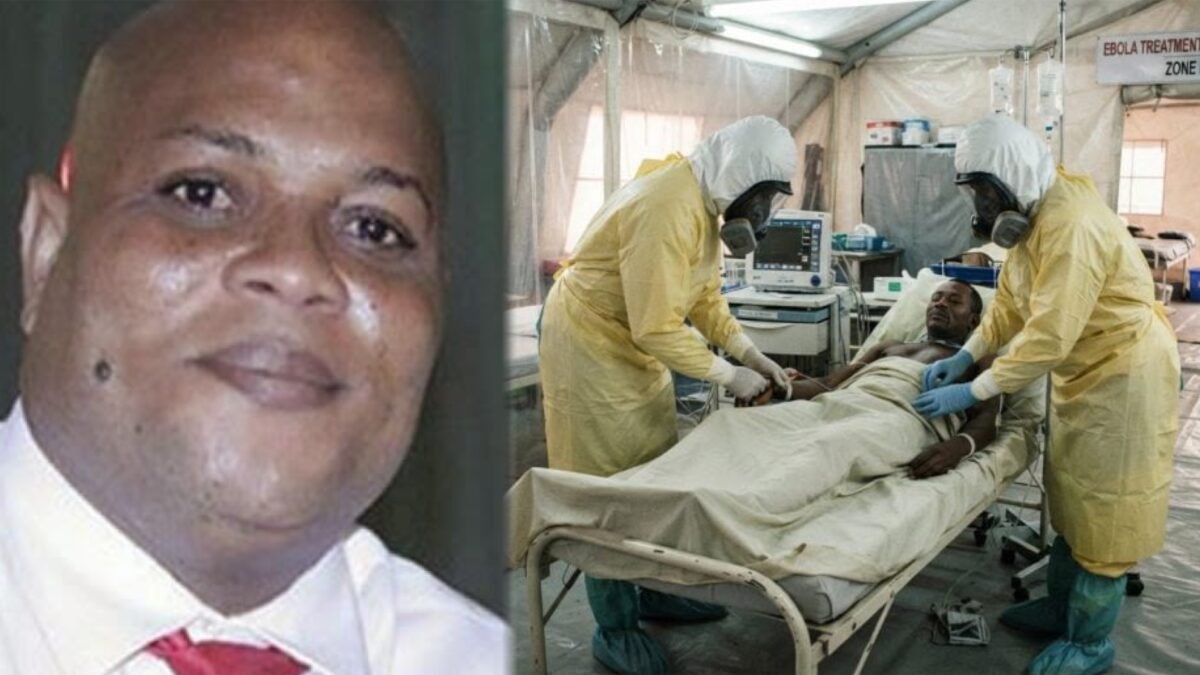
Nigeria, on Tuesday, recorded a case of the deadly Ebola virus disease, the first in more than a decade since Liberian national Patrick Sawyer arrived at the Murtala Muhammed International Airport in Lagos on July 20, 2014, to attend a seminar organised by the Economic Community of West African States (ECOWAS).
The new case has revived memories of the 2014 outbreak, which killed eight people, including a pregnant woman who resumed her new job at First Consultants Hospital a day after Mr Sawyer’s admission.
The hospital’s then Chief Medical Director, Benjamin Ohiaeri, described Mr Sawyer as a bio-terrorist, asserting that the Liberian had planned to infect many Nigerians before dying.
As the nation braces for an incurable Bundibugyo variant of the Ebola virus, Peoples Gazette takes Nigerians down memory lane to the events of July and August 2014, when the actions of a stubborn diplomat nearly put the entire country at risk of exposure.
Mr Sawyer, 40, a dual citizen of the U.S. and Liberia, had departed Monrovia for Lagos, planning a subsequent trip to Calabar, Cross River State, where he had a speaking engagement at an ECOWAS retreat.
He was also an employee of Liberia’s Ministry of Finance and the steel multinational ArcelorMittal.
Upon arrival, Mr Sawyer collapsed at the airport and was taken to First Consultants Hospital, a premium private health facility in Obalende, Lagos, which was on ECOWAS retainership.
He was immediately placed on a gurney and wheeled into the emergency section, complaining of fever and fatigue. The doctor on call initially treated him for malaria and admitted him to the hospital.
Healthcare staff took Mr Sawyer’s blood samples for tests for malaria parasites, liver function, full blood count and other routine checks. His full blood count was normal and showed no signs of infection that night.
However, given Mr Sawyer’s travel history to Liberia, he was asked whether he had had any contact with an Ebola patient or attended the funeral of any Ebola victim before his trip, but he said no.
It would later emerge that Mr Sawyer’s sister had died of Ebola on July 8, 2014, about two weeks before he travelled to Nigeria. He had also been involved in her funeral arrangements.
Mr Sawyer’s Liberian employer, ArcelorMittal, had even given him time off because of his exposure to the virus.
His sister had died at St. Joseph Catholic Hospital in Monrovia, exactly 12 days before Mr Sawyer boarded an ASKY Airlines flight to Lagos on July 20, 2014.
However, the Liberian lied about his travel history to the Nigerian healthcare workers treating him.
On July 21, 2014, Mr Sawyer’s condition deteriorated rapidly as he barely ate and experienced frequent bowel movements. Results of his liver function tests showed elevated liver enzyme levels.
He was subsequently tested for HIV and Hepatitis B, but the results were negative, heightening concerns among staff at the top-tier health facility.
When the doctor on call, Ada Igonoh, checked on him at around 5:00 p.m., she saw that Mr Sawyer had removed the intravenous (IV) fluid bag from its stand and placed it on his bed. Ms Igonoh hung it back on the metal stand.
She would later contract Ebola but survive, becoming one of the few known survivors of the deadly Zaire strain of the Ebola virus in 2014. Her account of the incident contributed to The Gazette’s reporting.
At the time, Mr Sawyer explained that he found it difficult to access the toilet while connected to the IV fluid bag. He complained to Ms Igonoh that he had already had bowel movements about five times that day and might still feel the urge to go again.
Ms Igonoh said she would send a nurse to disconnect the fluid bag to make it easier for him to access the toilet.
On July 22, 2014, ECOWAS officials had become anxious and were seeking updates on Mr Sawyer’s condition, particularly whether he was fit to travel on an 11:00 a.m. flight to Calabar to attend a retreat.
Ms Igonoh said he was too frail to travel.
Stella Adadevoh, the hospital’s consultant, upheld Ms Igonoh’s decision not to discharge the patient.
Ms Adadevoh further asked Ms Igonoh to update Mr Sawyer’s chart to indicate that he was not allowed to leave the facility without the approval of Mr Ohiaeri, the hospital’s Chief Medical Director.
Mr Sawyer’s condition continued to deteriorate, heightening suspicions that he had the deadly Ebola virus disease.
Ms Adadevoh researched laboratories equipped to test for Ebola, finding only two at the time.
When Mr Sawyer was informed that he could be a carrier of the disease, he was neither “surprised” nor “upset”, according to Mr Ohiaeri in an interview with This Day. His reaction suggested that he was already aware of his condition.
“A reasonable man would flinch when he is informed that he is going to be tested for Ebola. A reasonable man would want to know why the suspicion and what his chances of survival are and how he is going to be treated,” Mr Ohiaeri said.
The chief medical director said Mr Sawyer insisted on being discharged and became furious after First Consultants Hospital declined to let him leave.
Mr Sawyer detached his intravenous line and spilled blood on Justina Ejelonu, a 25-year-old nurse who had resumed work at the hospital a day after Mr Sawyer was admitted.
Ms Ejelonu was engaged and two months pregnant. She would later lose the pregnancy and die after contracting Ebola from Mr Sawyer.
Ms Adadevoh sent his blood and urine samples to Professor Sunday Omilabu at the LUTH Virology Reference Laboratory. She immediately activated safety measures and tried to inform the Lagos State Commissioner for Health and the Nigeria Centre for Disease Control and Prevention (NCDC).
Mr Omilabu retired in August 2026 from the Faculty of Medicine at the University of Lagos.
Ms Adadevoh also printed research materials on Ebola and safety measures, which were shared among hospital staff. Protective gear, shoe covers and face masks were provided to healthcare workers.
“A wooden barricade was placed at the entrance of the door to keep visitors and unauthorised personnel away from the patient,” Ms Igonoh wrote in her account of the incident.
By July 23, 2014, results from tests on Mr Sawyer’s samples had returned positive for Ebola. The samples were transferred to Senegal for a second test, which also returned a positive result.
On July 24, 2014, Mr Sawyer asked to be discharged so he could catch a return flight to Liberia the following morning. Ms Adadevoh tried to speak with him to persuade him to cooperate.
However, the Liberian national would not be placated, Mr Ohiaeri said, noting that his behaviour was unbecoming of a diplomat.
“A reasonable man would not say “I must leave the hospital now!” This was very strange to us because being an articulate forty-year diplomat we expected some measure of intelligent conversation on this dreaded disease. So, we could not understand why he was so desperate and determined to leave the hospital when we were clearly trying to investigate his situation and find the way to treat his condition,” Mr Ohiaeri said in his interview with This Day.
Mr Sawyer slumped and died in the bathroom on July 25, 2014, the same day he had planned to catch a flight out of Nigeria.
Ms Adadevoh died in August 2014 after contracting the Zaire strain of the Ebola virus from Mr Sawyer. She was posthumously conferred with a national award.
Threats from Liberia’s ambassador to Nigeria
The hospital faced intimidation from the then Liberian Ambassador to Nigeria, Al Hassan Conteh, who threatened to charge the hospital and its healthcare staff with kidnapping.
He was angry that the hospital had refused to discharge Mr Sawyer to allow him to attend the ECOWAS event in Calabar.
Ms Adadevoh stood her ground, refusing to discharge the patient or succumb to the ambassador’s threats.
“As if Sawyer’s behaviour were not bad enough, we soon began to receive irate calls from the Liberian Ambassador, Al Hassan Conteh, who had apparently been contacted by Sawyer,” Mr Ohiaeri said in a 2014 interview.
“The Ambassador repeatedly badgered Dr Adadevoh, ordering that Sawyer be permitted to leave the hospital and telling her that we had no authority or right to keep him. All of Dr. Adadevoh’s attempts to explain the situation, and my subsequent attempts to intervene, were shrugged off. The only thing the ambassador wanted was for Sawyer to be released, otherwise we would face charges of ‘kidnapping’. The threats were ratcheted up to the extent that he accused us of threatening an international diplomatic row, the consequences of which, he insisted, we would sorely regret,” he said.
Mr Ohiaeri said the Liberian ambassador questioned the veracity of the hospital’s findings and dismissed the report as an attempt to embarrass the Liberian government.
“Did we tell him it was Ebola? Yes we did and what was his response to that? He asked us “how are you sure”. He accused us of just trying to disparage his country and embarrass Liberia. Even when the results were out and it was confirmed positive by W.H.O lab officials, he said he wanted to see the report,” Mr Ohiaeri said.

We have recently deactivated our website's comment provider in favour of other channels of distribution and commentary. We encourage you to join the conversation on our stories via our Facebook, Twitter and other social media pages.

More from Peoples Gazette

States
Independence: NBA urges Nigerians to expect better future
The NBA said that ordinary Nigerians should be deriving benefit from the subsidy removal rather than hardship.

Agriculture
FG tasks ECOWAS on leveraging financing strategies for agroecology
The federal government has urged stakeholders in the agriculture and finance sectors in the West Africa region to leverage financing strategies to enhance agroecology practices

Politics
Katsina youths pledge to deliver over 2 million votes to Atiku
“Katsina State is Atiku’s political base because it is his second home.”

Showbiz
Raye’s ‘This Music May Contain Hope’ album wins 2026 Mercury Prize
The 17-track album is Raye’s second studio album, and it beat other nominees like veteran Paul McCartney, Olivia Dean, JADE, and others to scoop the highly coveted award.
Politics
Bill Clinton quotes Quran, condemns anti-Muslim sentiments in U.S.
Former U.S. President Bill Clinton has condemned anti-Muslim rhetoric and discrimination, noting he is tired of people denigrating Muslims because of their faith.

World
U.S. Attacks: Iran’s IRGC threatens to invade countries, strike American military bases
Iran’s Islamic Revolutionary Guard Corps has threatened to attack neighbouring countries and American bases amid renewed attacks from the United States.
States
Family releases burial timetable for Afenifere leader Fasoranti
The family of the late Afenifere leader and elder statesman, Reuben Fasoranti, has announced burial arrangements for the Yoruba leader.
Anti-Corruption
Lawyer petitions EFCC to probe Makinde’s spending, N30 billion Bodija explosion fund
A legal practitioner, Akinloye Olusegun, has petitioned EFCC to investigate Governor Seyi Makinde’s expenditures from his assumption of office in 2019 to 2026.
Education
Gov Zulum seeks AU support to return 800,000 out-of-school children to classrooms
Mr Zulum pledged to strengthen the state’s partnership with the African Union to expand access to education for about 800,000 out-of-school children.


