


ECOWAS Parliament seeks stronger institutional collaboration to deepen regional integration
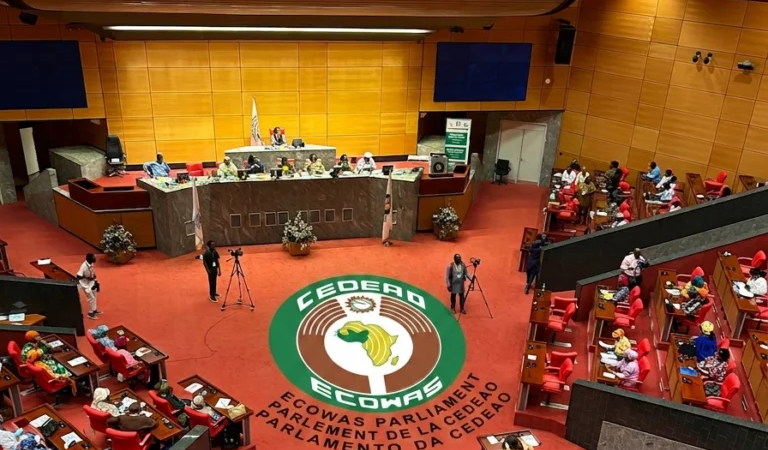
The ECOWAS Parliament has called for the strengthening of intra-institutional collaboration, effective parliamentary oversight and greater accountability to address West Africa’s security, economic and governance challenges and deepen regional integration.
Speaker of the Parliament, Memounatu Ibrahima, made the call at the opening of the Parliament’s 2026 Second Ordinary Session on Friday in Abuja.
Ms Ibrahima said the growing complexity of regional challenges required stronger cooperation among ECOWAS institutions, noting that no single institution could address them independently.
She said the parliament must move beyond observing regional developments to becoming a stronger political voice of citizens through increased legislative and oversight influence.
The speaker highlighted the Lungi Declaration, which reaffirmed ECOWAS leaders’ commitment to strengthening the legislative and oversight responsibilities of the parliament.
She said sustainable regional integration depended on credible institutions, public trust, democracy, justice and respect for the rule of law.
Ms Ibrahima identified consideration of the proposed 2027 Community Budget as a major priority, given increasing financial pressures and development demands across the region.
She urged lawmakers to ensure that budgetary allocations reflected clearly defined priorities, measurable outcomes and tangible benefits for citizens.
The speaker also called on national parliaments to intensify advocacy with their governments to ensure systematic collection and remittance of the ECOWAS Community Levy.
She stressed that resources entrusted to ECOWAS institutions represented both the contributions and expectations of West African citizens.
Ms Ibrahima commended Cape Verde for its peaceful electoral process and congratulated President José Maria Neves on his re-election.
She expressed hope that forthcoming elections in The Gambia and Nigeria would further strengthen democratic governance, peace and regional stability.
President of the ECOWAS Commission, Birame Diop, called for renewed regional solidarity and stronger parliamentary diplomacy to address emerging challenges.
Mr Diop said geopolitical rivalries, economic uncertainties, security threats and competing development priorities had exposed the limitations of individual national responses.
He identified terrorism and insecurity in the Sahel, alongside their growing implications for coastal countries, as major threats requiring coordinated regional action.
The commission president also advocated renewed engagement with international partners, particularly the United States, to strengthen security cooperation and border safety.
He said such partnerships should promote regional stability and facilitate the free movement of people across West Africa.
Mr Diop noted that the region’s population of more than 400 million, abundant natural resources and entrepreneurial potential offered significant opportunities for economic transformation.
He, however, stressed that these opportunities could only be fully realised through interconnected markets and the removal of trade barriers.
He said ECOWAS was prioritising trade liberalisation, elimination of tariff and non-tariff barriers, improved customs procedures, digitalisation and industrialisation.
Other priorities, according to him, include developing regional value chains to strengthen production, competitiveness and economic cooperation among member states.
Mr Diop emphasised that integration must produce practical benefits for traders, farmers, entrepreneurs, young people and ordinary citizens.
He described the ECOWAS Parliament as a critical link between regional institutions and citizens, stressing the importance of strengthening its legislative and oversight functions.
The commission president said the proposed ECOWAS Agenda 2050 required collective commitment and coordinated action by all community institutions.
He urged lawmakers to support regional efforts in peace and security, economic and monetary integration, sustainable development and human capital development.
He also identified gender inclusion and digital transformation as essential components of the region’s long-term development aspirations.
President of the ECOWAS Court of Justice, Justice Charlyne Brumskine, called for stronger collaboration between the judiciary and Parliament to improve compliance with the Court’s judgements.
Ms Brumskine described both institutions as complementary bodies working towards regional integration and the protection of West African citizens.
She explained that while parliament provided citizens with representation and a political voice, the court offered legal protection and remedies for rights violations.
The court president said its credibility depended significantly on the enforcement of its judgements across member states.
She urged lawmakers to encourage governments to comply with the court’s decisions and domesticate community legal instruments to improve access to justice.
Ms Brumskine also highlighted the Court’s Justice 2030 strategic roadmap, designed to bring the institution closer to citizens, particularly women.
She called for adequate and predictable funding, qualified personnel and modern infrastructure to strengthen the Court’s judicial operations.
The court president proposed regular institutional dialogue, periodic briefings on judicial activities and jurisprudence, and stronger parliamentary support for enforcing its judgements.
She reaffirmed the court’s commitment to building a stronger partnership with Parliament and other ECOWAS institutions.
The two-week Second Ordinary Session will feature the presentation of the commission president’s strategic plan and report on the state of the community.
Lawmakers will also consider country reports, parliamentary oversight reports and the proposed 2027 Community Budget.
Other issues scheduled for consideration include regional trade facilitation, the ECOWAS Mission in The Gambia and agricultural development projects.
Efforts to strengthen the regional electricity market will also feature prominently during the session.
(NAN)

We have recently deactivated our website's comment provider in favour of other channels of distribution and commentary. We encourage you to join the conversation on our stories via our Facebook, Twitter and other social media pages.

More from Peoples Gazette

States
Independence: NBA urges Nigerians to expect better future
The NBA said that ordinary Nigerians should be deriving benefit from the subsidy removal rather than hardship.
Agriculture
FG tasks ECOWAS on leveraging financing strategies for agroecology
The federal government has urged stakeholders in the agriculture and finance sectors in the West Africa region to leverage financing strategies to enhance agroecology practices
Politics
Katsina youths pledge to deliver over 2 million votes to Atiku
“Katsina State is Atiku’s political base because it is his second home.”
States
Ondo: INEC distributes sensitive materials for mock election
Mr Ogunseye said the exercise would hold in 406 polling units.

States
Kebbi APC postpones inaugural campaign over INEC mock election
The council apologised for any inconvenience caused by the postponement.
Africa
ECOWAS Parliament seeks stronger institutional collaboration to deepen regional integration
Ms Ibrahima said the growing complexity of regional challenges required stronger cooperation.
States
Police nab two suspects for alleged armed robbery, cultism in Enugu
Police said the suspects would be arraigned in court upon the conclusion of investigations.
Abuja
NAFDAC seals Zuba market, seizes fake, banned products worth over N300 million
The agency urged the public to remain vigilant.
States
Makinde pledges stronger public-private partnership to boost Oyo exports
Mr Makinde identified agriculture, manufacturing and mining as sectors with considerable export potential.


