

Prospects of telemedicine in delivering medical care for ‘hard to reach’ population
![Telemedicine session used to illustrate the story. [PHOTO CREDIT: Neurology adviser]](https://gazettengr.com/wp-content/uploads/Telemedicine-session.jpg)
As a medical laboratory scientist I was asked to deliver some medical diagnostic kits to a village clinic in 2018 and it became my first experience of how healthcare is being delivered in the suburbs. There was no healthcare worker on duty as he has gone to another village because he is covering up to three villages.
This person is the only one on duty in these village health centers. Imagine the number of people who have died or whose health has depreciated because of prompt healthcare delivery. This is just to talk about the human resource for healthcare delivery.
According to Globalcitizen.org, COVID19 has exposed our healthcare challenges which include poor information systems. Inadequate funding, lack of medications and inadequate number of healthcare workers, as well as poor healthcare access, can contribute to high mortality and morbidity.
Achieving complete and accurate medical outcomes requires an efficient and effective healthcare delivery process. Efficiency and effectiveness of healthcare delivery mean doing things economically and the ability of a health intervention to have a meaningful effect on patients in normal clinical conditions, respectively. Technologies that are being used to drive effective and efficient healthcare offer tools to manage and share healthcare data with high-speed computer networks and mobile devices to ensure favorable treatment outcomes and improve healthcare delivery on a case-by-case basis.
These developments are made possible by the contribution of various stakeholders and leadership in healthcare with a major consideration on human resources for health and patients for their process designs. Healthcare access is of ultimate priority and this is possible when there is auto-enrollment and/or reinsurance, to maximise the number of individuals covered by health insurance.
This also means that there is no shortage in the number of healthcare workers. Essential, cost-effective, reliable, and easily accessible can be accessed by telehealth. Telehealth is the distribution of health-related services and information via electronic information and telecommunication technologies and remote patient monitoring. This when well harnessed should help to remove disparities in healthcare access.
Effective digital health will help to achieve better outcomes at a lower cost and increase the scalability of healthcare services and commodities. Access to effective and efficient healthcare constitutes the availability of services and the ability of a government to provide equitable health-care services. Access to services can be evaluated as a standardised relationship between health-care requirements and usage of services, managing personal, financial, organisational, social, and cultural barriers to access to health-care services.
A disparity exists in the availability, accessibility, and affordability of quality healthcare services in the urban and rural areas on the one hand in Nigeria, and between the elites and the poor and most vulnerable citizens, on the other hand in developing countries.
‘Hard-to-reach’ is a term used to describe those sub-groups of the population that are difficult to reach or involve in research or public health programs due to their physical and geographical location (e.g. in mountains, forests or deserts) or their social and economic situation. The ‘hard to reach’ groups include sex workers, drug users, people living with HIV, and people from lesbian, gay, bisexual, transgender, and intersex communities, asylum seekers, refugees, black and minority ethnic communities, children and young people, disabled people, elderly people and traveler families.
The ‘hard to reach’ maybe people who are stigmatised due to the fact they are perceived as being somehow different. If we think in terms of stigma and social exclusion in a healthcare context, the ‘hard to reach’ include people with a variety of conditions or life-limiting illnesses. This may include people with congenital abnormalities or genetic conditions, people with hearing loss and people with mental health problems. Telemedicine has very high scalability and can be used to take care of the ‘hard to reach’ population without them experiencing stigma. Telemedicine refers to the practice of caring for patients remotely when the provider and patient are not physically present with each other.
Modern technology has enabled doctors to consult patients using telemedicine software. Telemedicine also offers a new means to locate health information and communicate with practitioners (eg, via e-mail and interactive chats or videoconferences), thereby increasing convenience for the patient and reducing the amount of potential travel required for both physician and patient.
The application of this tool covers a wide and diverse scope, including online databases and tools to ensure standards of care, critical pathways and patient outcomes, computer-assisted diagnosis, effective drug information and electronic prescription filling, and enhanced availability of research data. Web-based disease management programs encourage clients to assume greater responsibility for their care, help healthcare providers to treat clients earlier (when they are not as ill), provide local and less expensive services, extend scarce healthcare resources, enhance follow-up care, improve client access to services, and increase the accuracy and quality of patients’ medical record.
Clinicians can handle more patients than traditional care models would typically allow, and with increased access and a more connected level of care, physicians and patients can work together to achieve their therapeutic goals, particularly in the home and hospice care environments
Since making its debut in the late 1950s till today more people have been reached with healthcare services and barriers have been broken by cloud storage, management, and scalability. Most people have access to basic telemedicine devices like mobile phones and computers and healthcare is now more accessible, cost-effective, and that has increased patient engagement.
Physicians and patients can share information in real-time from one computer screen to another. In modern healthcare delivery, there is now an increase in interactive medicine, ‘‘Store and Forward’’ approach – which permits providers to share patient information with a practitioner in another location, remote patient monitoring, an increase in revenue generation and ability of clinicians to see more patients. Patients love it because it’s now easier to access healthcare faster.
Affordability, accessibility, availability, and quality of healthcare services have always been preventing the perfect adoption of telemedicine, especially in developing countries. Accessing quality healthcare services via telehealth platforms means that people must be able to afford phones and data to connect their software to their network provider and healthcare service provider.
The adoption must also include that healthcare workers understand how telemedicine work and that means they must be well informed and trained on how to go about consultation sessions and all other aspects of health delivery. This is a huge task to achieve in developing countries because it means not just strengthening Human Resources for healthcare delivery but also providing healthcare workers with tools they need to make healthcare accessible for people online.
The design of telehealth platforms must carry healthcare workers and users along in the design process to know what is possible and appropriate among specific populations. Increasing population in developing countries has created more demand for telemedicine but accessibility is still not optimal as healthcare industries in various countries need to go digital. This must be done in a way that everyone will have equal access without sidelining anyone. The cost of health care in developing countries has always been a crucial issue and therefore it will take so much funding to take Healthcare industries in developing countries digital. To make telemedicine available to citizens who are interested in few available platforms in developing countries a lot of investment must go into advertisement, branding and education.
Out of pocket expenditure on health care has increased many folds over the years and therefore the government must support the citizens in positioning themselves in accessing telemedicine as catastrophic health expenditure is posing a threat to a household’s financial ability to maintain its basic needs. The problem of availability, accessibility and affordability must be solved before telemedicine is phased in to improve healthcare access.
Some of the telehealth platforms in Nigeria include Health Connect 24×7, Mobihealth, Dokita, Helium Health, Doctorcare247 which are enabling thousands of people, especially in urban and rural areas to live a healthier, happier, and longer life by dramatically improving access to quality healthcare. Projecting into the future, telemedicine will enable health-care delivery in distant remote sites and villages, connect primary care physicians, providers, specialists, and patients, offer improved access to quality healthcare delivery, reduce travel times, and ensure fewer or shorter hospital stays. This will lead to cheap healthcare delivery. There is a great need for funding and investment in telemedicine in Nigeria.
There is also a need for the expansion of telemedicine through the adoption of the latest technologies and education. The understanding of telemedicine technology is very important to the expansion of telemedicine. Furthermore, there ought to be access to fast and reliable internet in most rural and remote communities in Nigeria if telemedicine will be fully embraced. Notwithstanding that telemedicine reduces cost, the cost of telemedicine is still not affordable to many especially those in rural and remote communities in Nigeria and even in the Semi-urban areas and urban areas.
Telemedicine has the potential of increasing health-care delivery and making qualified health personnel accessible by patients in remote areas anytime. Other benefits include reducing the costs of health-care delivery and reducing long-queues in hospitals. Healthcare organisations that move aggressively to implement the process improvements, appropriate tools, and technologies, and culture change techniques will achieve cost-effective results and improve interactions with their staff and health outcomes for the care of their patients.
Gabriel Oke is a medical laboratory scientist based in Abuja. He’s on Twitter: @_gabrieloke.

We have recently deactivated our website's comment provider in favour of other channels of distribution and commentary. We encourage you to join the conversation on our stories via our Facebook, Twitter and other social media pages.

More from Peoples Gazette

Agriculture
FG tasks ECOWAS on leveraging financing strategies for agroecology
The federal government has urged stakeholders in the agriculture and finance sectors in the West Africa region to leverage financing strategies to enhance agroecology practices

Politics
Katsina youths pledge to deliver over 2 million votes to Atiku
“Katsina State is Atiku’s political base because it is his second home.”

Politics
I’m contesting senatorial seat to give Benue voice, says Tsegba
Mr Tsegba expressed concern over what he described as the failure of elected representatives to speak out against persistent attacks and killings in their constituencies.

States
30 units of 80-inch LG plasma TVs caught with terrorists’ suppliers: Military
A statement by Mohammed Goni, the acting spokesperson for the operation, said the suspects were arrested on Monday at about 1:30 p.m.
States
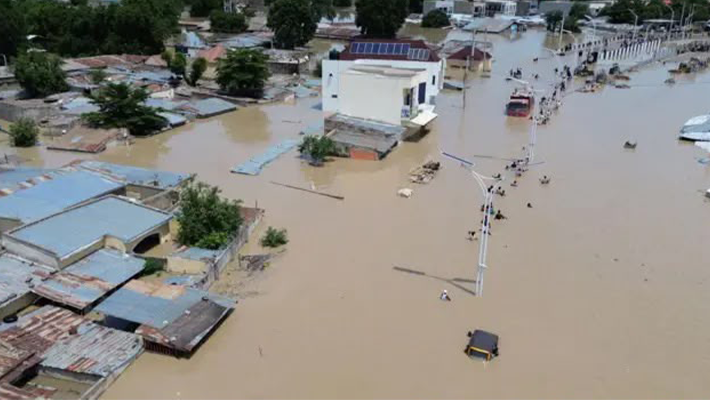
Borno, Adamawa, Yobe map out response strategies, flooding evacuation plans
Borno, Yobe and Adamawa governments have mapped out response strategies and evacuation plans to mitigate the effects of impending floods.

Rights
AUPCTRE faults Tinubu govt over unpaid wage award
The national president of AUPCTRE, Benjamin Anthony, made the call in an interview in Abuja on Wednesday.

Politics
PDP has moved past crisis, uncertainty, says Ohuabunwa
“The party is now rebuilding and will come out stronger and better,” stated Mao Ohuabunwa.

World
U.S. judge orders Trump to release financial records sought by BBC
A court has ordered Mr Trump to produce the financial documents the BBC requested as part of the legal proceedings in his $10 billion defamation suit.


