


Insecurity: Over 700,000 displaced in North-West, says IOM
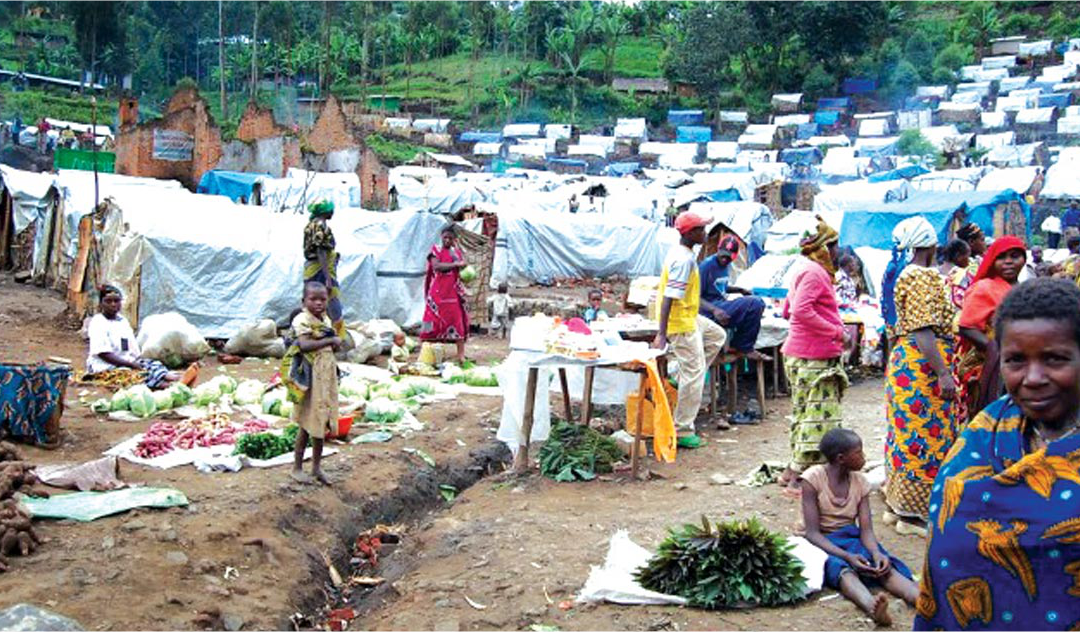
The International Organisation for Migration (IOM) says 737,073 internally displaced persons (IDPs) have been recorded across the North-West.
Sharon Dimanche, chief of mission for IOM Nigeria, disclosed this virtually during a press conference in Katsina on Friday, adding that 147,000 returnees were also documented.
She said the figures were contained in the organisation’s latest displacement tracking matrix (DTM) assessment.
Ms Dimanche said Katsina had almost 181,000 displaced persons, while neighbouring Zamfara recorded more than 261,000.
The IOM chief added that Katsina alone had recorded over 37,000 returnees.
She said about 620,000 people, representing approximately 84 per cent of those displaced across the North-West, were forced from their communities by armed banditry and kidnapping.
According to her, displacement is not only about moving from one location to another, but also about losing homes, livelihoods, safety and social cohesion.
Ms Dimanche said the crisis in the North-West had national implications, affecting food production, livelihoods, education, access to basic services, local economies, social cohesion, stability and development.
She said more than 138,000 people were displaced in Katsina between January 2025 and January 2026.
“Of that number, almost 72,000 were affected by floods, heavy rainfall and windstorms, while nearly 60,000 were displaced by banditry and kidnapping.
“The figures show that insecurity is not the only factor driving displacement, as climate-related shocks are also placing enormous pressure on vulnerable communities,” she said.
She said the consequences of displacement, whether caused by violence or natural disasters, include loss of livelihoods, children being out of school, fear, uncertainty and weakened community resilience.
Ms Dimanche noted encouraging signs, stating that assessed IDPs across the North-West and North-Central regions declined by nearly five per cent between October 2025 and February 2026, while returnees increased by nearly five per cent.
She cautioned, however, that return “is not automatically a durable solution”, stressing that returnees must be able to live safely, earn livelihoods, send their children to school, and address the conditions that initially displaced them.
The IOM chief said peace-building and early warning mechanisms were therefore critical to preventing tensions from escalating into violence and displacement.
She said IOM’s partnership with the European Union (EU), through the Foreign Policy Instrument (FPI), was helping to strengthen peace-building, early warning and community resilience in affected communities.
“IOM is implementing the 18-month community-based protection, conflict resolution and resilience (CPCRR) Programme in Katsina and Zamfara, with support from the EU,” Ms Dimanche said.
Also speaking, Jean Nahesi-Kutumbakana, programme manager/head of sub-office, IOM Katsina, said the programme had established 80 community peace and resilience committees and trained 1,700 community members and stakeholders in conflict prevention, early warning and early response.
He said 160 key informants had been engaged across conflict hotspots and livestock movement corridors, while 41,000 livestock movements involving 2,405 herders and 60,440 livestock had been monitored.
Mr Nahesi-Kutumbakana said 74 per cent of surveyed IDP locations require shelter intervention, while 89 per cent lack adequate sanitation facilities.
He said 552 vulnerable people received integrated mental health, psychosocial, and livelihood support, while 300 at-risk youths and women received peace-building and skills-acquisition training.
The official said 13 quick impact projects had been implemented in Katsina, benefiting 51,493 people through solar-powered boreholes, school blocks and veterinary clinics.
He added that IOM’s peace-media campaign had reached 506,574 people through radio jingles, participatory drama and other awareness activities across Katsina and Zamfara.
He urged stakeholders to sustain collaboration and ensure accurate communication on displacement, humanitarian needs and peace-building initiatives to facilitate effective responses and durable solutions for affected communities.
(NAN)

We have recently deactivated our website's comment provider in favour of other channels of distribution and commentary. We encourage you to join the conversation on our stories via our Facebook, Twitter and other social media pages.

More from Peoples Gazette

Agriculture
FG tasks ECOWAS on leveraging financing strategies for agroecology
The federal government has urged stakeholders in the agriculture and finance sectors in the West Africa region to leverage financing strategies to enhance agroecology practices

Politics
Katsina youths pledge to deliver over 2 million votes to Atiku
“Katsina State is Atiku’s political base because it is his second home.”
Heading 4
Osun 2026: Police deploy air, drone units, assure of adequate security
Mr Iniedu disclosed that a 24-hour call centre had been established.

Heading 2
Boxer Prichard Colón dies at 33 after spending 221 days in coma
The father also thanked fans and supporters for their years of love and prayers.

Heading 5
Police foil bandits’ attack in Katsina, recover exhibits
Mr Aliyu explained that the attackers broke into local shops.

World
Luigi Mangione pleads guilty to killing UnitedHealthcare CEO Brian Thompson
Mr Mangione’s sentencing has been scheduled for December 18.

Lagos
Lagos governor’s wife urges ICT investment
She said targeted ICT empowerment programmes could channel youthful energy into productive ventures.

NationWide
Tackle poverty, unemployment in Nigeria, ASUU tells FG
“Government must redirect its socio-economic policies and projects to prioritise the people on whose behalf they hold public resources in trust,” Mr Piwuna said.


