


2.9 billion people have never used internet: UN

Some 2.9 billion people have never used the internet globally, and 96 per cent live in developing countries, making the world’s poorest left far behind, a new UN report has found.
According to the International Telecommunication Union (ITU), the estimated number of people who have gone online in 2021 actually went up, to 4.9 billion, partially because of a “COVID connectivity boost.”
ITU said people’s ability to connect remained unequal – as many hundreds of millions might only go online infrequently, using shared devices or facing connection speeds that hamper their internet use.
“While almost two-thirds of the world’s population is now online, there is a lot more to do to get everyone connected to the Internet,” Houlin Zhao, ITU secretary-general, said. “ITU will work with all parties to make sure that the building blocks are in place to connect the remaining 2.9 billion. We are determined to ensure no one will be left behind.”
The UN agency’s report found that the unusually sharp rise in the number of people online suggests that measures taken during the pandemic contributed to the “COVID connectivity boost.”
An estimated 782 million additional people went online since 2019, an increase of 17 per cent due to measures such as lockdowns, school closures, and the need to access services like remote banking.
According to the document, users globally grew by more than 10 per cent in the first year of the COVID crisis, which was the largest annual increase in a decade. But it pointed out that growth has been uneven.
Internet access is often unaffordable in poorer nations, and almost three-quarters of people have never been online in the 46 least-developed countries.
Speaking in Geneva on Wednesday, Doreen Bogdan-Martin, director of the ITU, said, “The internet divide runs deep between developed and developing countries. Only a third of the population in Africa is using the internet.”
The report found that younger people, men and urban dwellers are more likely to use the internet than older adults, women, and rural areas, with the gender gap more pronounced in developing nations.
Poverty, illiteracy, limited electricity access and a lack of digital skills continued to hinder “digitally excluded” communities, ITU noted.
(NAN)

We have recently deactivated our website's comment provider in favour of other channels of distribution and commentary. We encourage you to join the conversation on our stories via our Facebook, Twitter and other social media pages.

More from Peoples Gazette

Agriculture
FG tasks ECOWAS on leveraging financing strategies for agroecology
The federal government has urged stakeholders in the agriculture and finance sectors in the West Africa region to leverage financing strategies to enhance agroecology practices

Politics
Katsina youths pledge to deliver over 2 million votes to Atiku
“Katsina State is Atiku’s political base because it is his second home.”
Diaspora
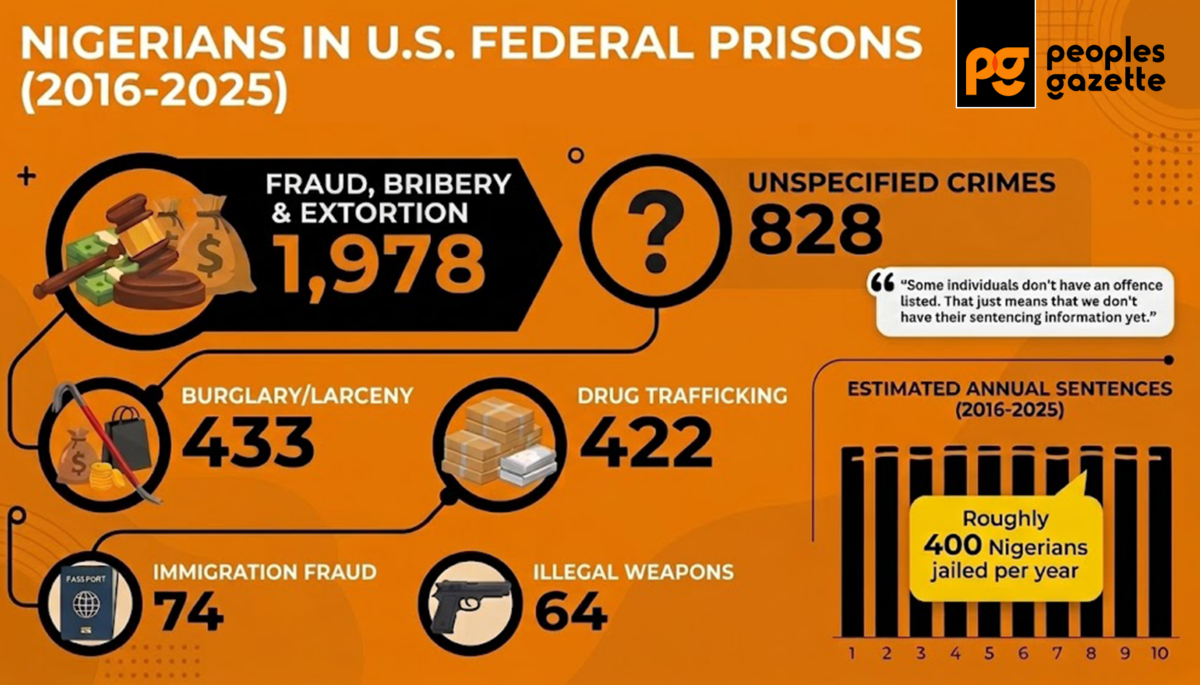
400 Nigerians jailed every year in U.S. federal prisons, document shows
Approximately 400 Nigerians are jailed annually in U.S. federal prisons for various crimes, a document exclusively obtained by Peoples Gazette shows.

Lagos
Lagos flooding started from White men’s colonisation of Nigeria, not caused by coastal highway: Senator Allwell Onyesoh
This flooding of Lagos did not begin today. It dates back to the days of the White men. So, what we are seeing today is not new,” Mr Onyesoh said.

Economy
FG to harmonise digital platforms regulations, governance frameworks
In the meantime, Mr Tijani directed that the regulatory status quo be maintained regarding internet platforms and online intermediaries.

Economy
Shettima urges Nigerian universities to create jobs, be innovative
Vice-President Kashim Shettima says Nigerian universities must become centres of innovation, enterprise and industrialisation to accelerate economic growth.

States
161 people killed in Ogun road crashes, says FRSC
The Federal Road Safety Corps says 161 persons died in 415 road crashes across the state between January and May.

Economy
Six reasons OPay’s new security features give Nigerians greater peace of mind
As digital payments become part of everyday life, keeping money safe has never been more important


