

Lagos paid N4.2 billion WAEC fees in four years: Sanwo-Olu
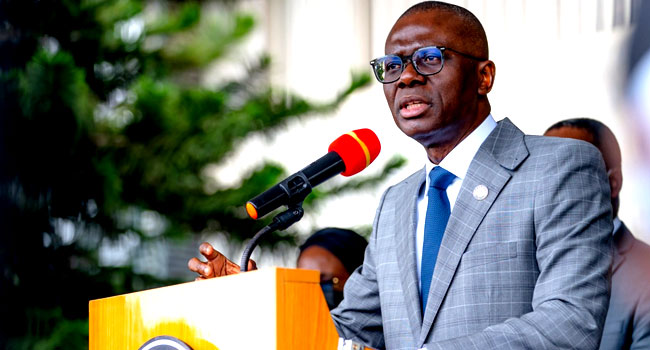
The Lagos State government, on Thursday, said it paid a total sum of N4.2 billion as the West Africa Examination Council (WAEC) fees for students in four years.
Mr Sanwo-Olu said this in Ikeja, at the ministerial session of the 67th National Council on Education (NCE) meeting, with the theme: ”Addressing the Challenges of Policy Implementation: A Panacea for the Achievement of Education 2030 Agenda.”
The governor, who was represented by the commissioner for primary and basic education, Jamiu Alli-Balogun, said the government had not defaulted in the payment of WAEC fees for all public school students in SS3.
He said the payment of the examination fee was a policy which commenced in 2000 when President Bola Tinubu was the Lagos State Governor.
According to him, the intervention started with N200 million in 2000 but metamorphosed into a financial commitment of over N1 billion yearly.
”In the last four years, we have paid over N4.2 billion to keep our promise of full payment of West African Senior School Certificate Examination fees for our public school students, to ensure no student is left behind in the secondary school level of education,” he said.
Mr Sanwo-Olu said easy access to education was another area of focus for the government, irrespective of gender or capability.
He said the government introduced free education at the primary and secondary level with the enactment of the Lagos Compulsory Free Universal Basic Education Law of 2005.
The governor said the law set out a policy to provide free, compulsory, universal basic education for every child of primary and secondary school age and required parents and guardians to ensure that children of school age in their care attended school.
He said this had been yielding the desired result as the sector had continued to see an increase in the number of children in those levels of learning.
Mr Sanwo-Olu said the sector had also continued to see an increase in the number of schools in developing/rural areas of the state.
He said with the government’s approval, a total of six secondary schools were established between January and November in order to encourage easy access to secondary education.
The governor said the adults were not left behind as 21 new adult literacy centres were added to the existing ones.
“We equally established two new universities, the Lagos State University of Education and the Lagos State University of Technology. All these efforts are geared towards expanding the choices of our teeming children and adolescent population.
“These aforementioned policies have attracted many pupils and students from all over the country. All the states in Nigeria are represented in all our public school students’ registers.
“Through our Project Zero Programme, we have reduced the rate of out-of-school children by reabsorbing a total of 11,957 pupils back to school and providing them with uniforms.
“There is no gainsaying that a nation’s socio-economic development rests squarely on the quality of education given to her children.
“This august body must, therefore, ensure appropriate strategies and policies are put forward for effective and efficient policy implementation throughout the federation,” he said.
Mr Sanwo-Olu said as a responsive government, his administration had invested in digital devices in continuation of the agenda to seamlessly fuse education and technology and upgrade the educational system to meet the world standard.
He said as part of efforts to improve teaching and learning in the primary and secondary schools across the state, the government had inaugurated over 1,449 projects, covering 1,036 schools across all 20 LGAs and 37 LCDAs.
The governor said these projects included construction, renovation, and rehabilitation of dilapidated public schools and the supply of composite units of furniture to schools, among other infrastructure projects.
(NAN)

We have recently deactivated our website's comment provider in favour of other channels of distribution and commentary. We encourage you to join the conversation on our stories via our Facebook, Twitter and other social media pages.

More from Peoples Gazette

Agriculture
FG tasks ECOWAS on leveraging financing strategies for agroecology
The federal government has urged stakeholders in the agriculture and finance sectors in the West Africa region to leverage financing strategies to enhance agroecology practices

Politics
Katsina youths pledge to deliver over 2 million votes to Atiku
“Katsina State is Atiku’s political base because it is his second home.”
Economy
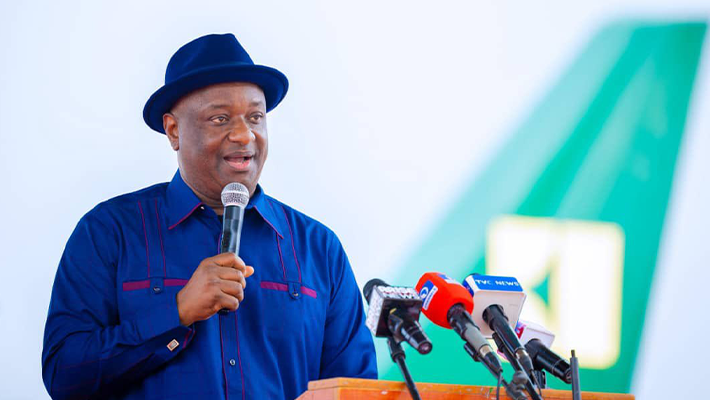
FG pledges policy support for sustainable aviation fuel
He stated that while aviation remains critical to economic growth, the sector must also contribute meaningfully to global efforts to address climate change.

NationWide
Cost-reflective tariffs will improve Nigeria’s power sector: Expert
“Cost-reflective tariffs will not only improve delivery but also encourage new investments in both fossil-fuel and renewable energy generation,” he said.

World
Iran confirms U.S. proposal to resume talks amid latest attacks
Iran says it received proposals from mediators about resuming negotiations with the United States.

World
I’ve made UK better, stronger than my predecessor: Keir Starmer
Mr Starmer hailed himself for taking the Labour Party from “historic defeat” in 2019 to winning the country’s general election in 2024, when it ousted the Conservative Party.
Economy
CSCS declares N1 interim dividend after half-year earnings
The company noted that the interim dividend represented 56 per cent of the total dividend of N1.78 per share paid for the 2025 financial year.

Health
Mental health key to attaining excellence in children, says expert
He said children perform better academically and socially when the learning environment supports their emotional well-being.


