


Bayelsa, Rivers communities drenched in crude from Shell’s leaky pipelines

Communities along the 14-inch crude trunk line operated by Shell Petroleum Development Company (SPDC) in the Niger Delta region suffered spillage in April as 276 barrels of crude oil pervaded their soils and water in three incidents.
The 276 barrels of crude is the cumulative volume of spill from a section of the pipeline that transverses Bayelsa and Rivers communities during the period, NAN learnt on Monday.
Checks at the oil firm’s spill incident portal indicated that two of the spills were caused by sabotage while one was traced to equipment failure.
According to the Joint Investigation Visit (JIV) reports on the incidents obtained by NAN, the leak which occurred at Ikararama in Bayelsa on April 7, was traceable to equipment failure which caused a leakage of 110 barrels.
The Okordia-Rumekpe crude pipeline is part of the Trans Niger Pipeline (TNP) network crisscrossing SPDC’s onshore fields which conveys crude to the SPDC’s crude export terminal at Bonny in Rivers.
JIV is a statutory exercise to ascertain the cause of any recorded spill incident involving oil firms, regulators, host communities and state Ministries of Environment.
The leak incident on April 13 at Ihuowu in Rivers was attributed to sabotage by the JIV report causing a spill of 157 barrels of crude.
The report further showed that also on April 14 at Ukpeliede in Rivers, the same Okordia-Rumekpe trunk line was breached by vandals leaving a leak of nine barrels.
According to the SPDC’s spills records, oil spill response activities were ongoing at the spill sites while recovery of spilled crude would be completed in May.
Also, SPDC reported that it had concluded investigation in seven spill incidents from its operations across the Niger Delta with a total spilled volume of 435.01 barrels of crude.
Of the seven leak incidents, six were caused by sabotage while one was traced to equipment failure.
Mr Bamidele Odugbesan, Media Relations Manager, SPDC, declined comments on the integrity of the frequently breached 14-inch Okordia-Rumekpe pipeline.
(NAN)

We have recently deactivated our website's comment provider in favour of other channels of distribution and commentary. We encourage you to join the conversation on our stories via our Facebook, Twitter and other social media pages.

More from Peoples Gazette

Agriculture
FG tasks ECOWAS on leveraging financing strategies for agroecology
The federal government has urged stakeholders in the agriculture and finance sectors in the West Africa region to leverage financing strategies to enhance agroecology practices

Politics
Katsina youths pledge to deliver over 2 million votes to Atiku
“Katsina State is Atiku’s political base because it is his second home.”

Economy
AUATON condemns Uber’s exit from Nigeria
The Amalgamated Union of App-Based Transporters of Nigeria (AUATON) has condemned Uber’s sudden exit from Nigeria, describing it as unprofessional.

Politics
I’m worried Atiku, Obi will hunt for my head if Tinubu loses 2027 presidential election: Wike
“If anything happens and Mr President fails today, I will be the first politician that Atiku and Obi will hunt for his head,” said Mr Wike.

Showbiz
Venice Film Festival begins with George Clooney honoured with lifetime achievement award
The 83rd Venice International Film Festival has opened in Venice, Italy, with U.S. actor George Clooney receiving the Golden Lion for Lifetime Achievement on Wednesday.

Anti-Corruption
Adeyemi’s PFIPC: House of Representatives’ panel clears Gbajabiamila of collusion
The House of Representatives ad hoc committee investigating the purported Presidential Foreign Intervention Promotion Council has cleared Femi Gbajabiamila of wrongdoing.
Africa
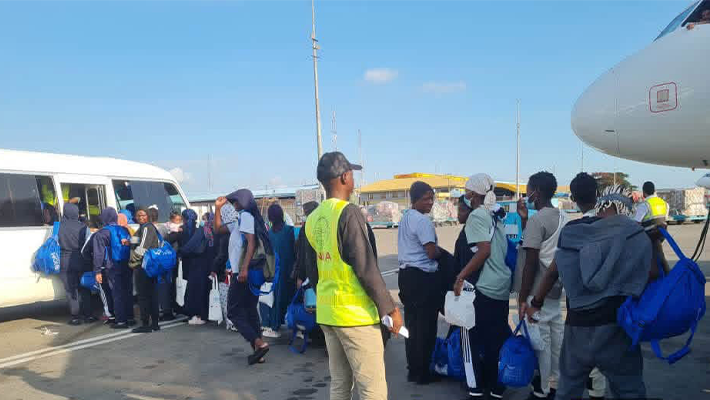
173 Nigerian returnees from Libya arrive in Lagos
NEMA and the National Commission for Refugees, Migrants and Internally Displaced Persons (NCFRMI) received 173 Nigerian returnees from Tripoli, Libya.
Opinion
FIPRE framework offers operational blueprint for AFC’s $750 million climate-resilient fund
The FIPRE framework is designed to shift infrastructure practice “from delivering outputs to delivering sustainable outcomes”. It asks five plain questions of every project.


