

Nigerians languish as food prices soar in Kaduna, Kano, Katsina
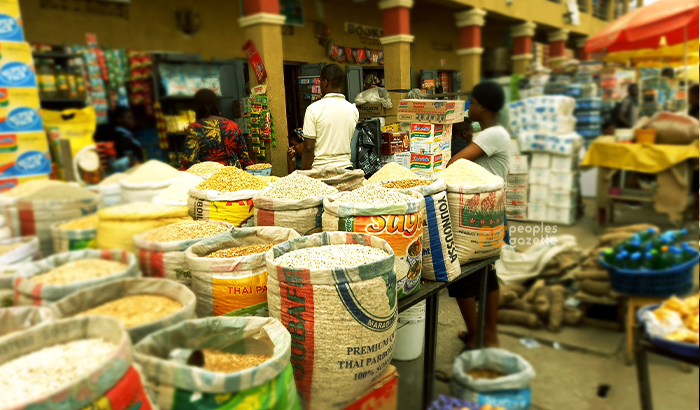
In tune with the extant global trends, Nigeria is experiencing an unprecedented increase in the prices of basic food items.
Checks in Kaduna, Kano, and Katsina showed that Nigeria was not an exception. Rising prices were particularly notable for rice, bread, sugar, garri, beef, and eggs, staples in most homes.
Also, the rising cost has impacted the living standard of the residents as most homes now find it formidably challenging to afford three square meals.
At the Abubakar Gumi Central market and other markets within Kaduna city, the price of Mama Gold rice has risen to about N75,500 per bag, while a 50kg Stallion Optimum brand now sells N77,000 to N80,000.
Also, a loaf of bread was sold between N1,000 and N2,500, depending on the brand and quality.
A measure (mudu) of ‘white garri’ that used to sell for N400 is now sold for between N1200 and N1400. Meanwhile, a measure of ‘yellow garri’ sold for N600 goes between N1300 and N1,500. Similarly, a crate of eggs sold for N3000 now sells between N4,000 and N4,500, depending on the size.
Also, a kilogram of meat (beef) formerly sold for N3,000 before was now sold at N5,000.
Meanwhile, farmers in parts of the state have attributed the high costs of foodstuffs to the removal of fuel subsidy.
In separate interviews in Kafanchan, some farmers blamed the hike in food prices on the high cost of transportation occasioned by the federal government’s removal of the fuel subsidy.
Ishaya Chingali, a large-scale farmer, said inflation had also raised the cost of farm inputs like fertilizers and herbicides.
“If they can take care of the cost of transportation, the high cost of foodstuff will be addressed by 50 per cent,” he stated.
Kure Kade, president of the Organic Ginger Farmers Association, said the only solution was for the government to subsidize farm inputs. He said Nigeria could feed itself without necessarily importing any food.
In a related development, the Kaduna government said it had distributed farm inputs, farm implements, and agro-processing equipment to 40,000 smallholder farmers to boost food production.
The agriculture commissioner, Murtala Dabo, said this in an interview in Kaduna.
The items were distributed under the government’s ‘A Koma Gona’ (Back to Farm) initiative. According to him, the programme targets beneficiaries in the 23 local government areas.
He said the state was the largest producer of ginger, maize, as well as tomatoes in the country, lamenting that the farmers suffered post-harvest losses such as tomatoes and ginger.
Mr Dabo assured that the state government would revisit the now stalled tomato processing plant in Ikara to address the losses suffered by tomato farmers in the area and other surrounding local governments.
He said the state government has commenced the Livestock Development Project (L-PRES) to reduce herder-farmer conflicts in Kaduna.
Meanwhile, a farmer in Kaduna State has appealed to the government at all levels to enhance agricultural mechanisation. He also urged them to replace the animal-drawn plough system for land preparation and other agricultural production processes to boost food security and wealth generation.
Ahmed Abubakar, a member of the Albarka-Shika Farmers Cooperative Society, made the appeal in an interview in Zaria.
He said, “Farming is a business; the government at subnational levels should woo and entice youths by providing simple labour-saving devices to strengthen production. These tools and devices are not affordable to many youths and small-scale farmers. We are in the 21st century, so it is high time to do away with cutlasses and hoes and embrace full-scale mechanised agriculture.
“Bandits and other criminal elements would not allow the small-scale farmers to keep cattle for traditional plough. If the farmers have these machines at their homes, it will not be easily stolen like cattle,’’ he said.
Mr Abubakar said the federal government’s initial intervention for wheat farmers in dry season farming had gladdened the hearts of farmers across the state.
Mr Abubakar said no fewer than 10,000 farmers received improved wheat seed varieties, herbicides, fertilizer, and other inputs for cultivating a one-hectare field at a 50 per cent discount.
(NAN)

We have recently deactivated our website's comment provider in favour of other channels of distribution and commentary. We encourage you to join the conversation on our stories via our Facebook, Twitter and other social media pages.

More from Peoples Gazette

Agriculture
FG tasks ECOWAS on leveraging financing strategies for agroecology
The federal government has urged stakeholders in the agriculture and finance sectors in the West Africa region to leverage financing strategies to enhance agroecology practices

Politics
Katsina youths pledge to deliver over 2 million votes to Atiku
“Katsina State is Atiku’s political base because it is his second home.”

Port Harcourt
Police condemn gruesome killing of four in River community
The command’s spokesperson described the incident as unfortunate and disturbing.
States
Gov Sule sacks six commissioners in cabinet reshuffle
Mr Magaji added that the former commissioners would continue to be part of the government.

Health
MSF raises alarm over rising cholera cases in Borno
Mr Yakubu said MSF currently supports two cholera treatment centres and five cholera treatment units.

NationWide
FAAN launches waste recycling scheme at MMIA
Ms Kuku said the first phase involved introducing indoor colour-coded waste recycling bins across airport terminals.
Agriculture
Farming is reliable income generation in retirement: Poultry Association
Mr Adegbenro said that poultry farming remains a verifiable tool to combat the challenges associated with retirement.

States
Man, 55, remanded in Edo over alleged kidnapping
the Defence Counsel, Emmanuel Afolabi (SAN), did not oppose the prosecution’s application.


