

Sokoto govt enforces two-year rural service for sponsored health workers

The Sokoto State government has introduced a mandatory two-year rural service for all medical and auxiliary healthcare workers trained under its sponsorship scheme.
The Commissioner for Health, Faruku Wurno, said this in an interview with journalists on Tuesday in Sokoto.
He said the initiative aimed to correct long-standing staffing imbalances and ensure equitable healthcare delivery across the state, particularly in underserved rural areas.
According to Mr Wurno, the new policy requires all doctors, nurses, pharmacists, and allied health workers sponsored by the state to serve in rural health facilities for at least two years.
“The decision follows a comprehensive needs assessment that revealed an overconcentration of health workers in urban centres, while many rural communities remain without adequate medical personnel.
“We are not just posting them to rural areas, we are also motivating them with better pay, improved facilities, and enhanced security support,” Mr Wurno stated.
He added that the policy had already inspired interest from the education sector, which was considering a similar model to address teacher shortages in remote areas.
To boost morale and compliance, he said the state government had approved a 10 per cent salary increment for workers deployed to rural communities.
Mr Wurno expressed optimism that many workers would choose to remain in those communities beyond the mandatory period due to the improved working environment and incentives.
“This rural deployment strategy is part of a broader effort by the administration of Gov. Ahmad Aliyu to revamp Sokoto’s healthcare system,” he said.
The commissioner also noted that Sokoto now pays its medical and health workers salaries that match the federal government scale, a development welcomed by organised labour and medical professionals.
He further revealed that the state was already seeing a reversal in the brain drain that previously affected its health sector, as many professionals who had tendered resignation letters had now withdrawn them due to improved welfare packages.
Mr Wurno said professional bodies, including the Nigerian Medical Association (NMA) and the National Association of Nigerian Nurses and Midwives (NANNM), had commended the administration’s commitment to staff welfare and expressed renewed confidence in its leadership.
“These reforms are laying the foundation for a stronger, more responsive healthcare system in Sokoto State,” he affirmed.
(NAN)

We have recently deactivated our website's comment provider in favour of other channels of distribution and commentary. We encourage you to join the conversation on our stories via our Facebook, Twitter and other social media pages.

More from Peoples Gazette

States
Independence: NBA urges Nigerians to expect better future
The NBA said that ordinary Nigerians should be deriving benefit from the subsidy removal rather than hardship.

Agriculture
FG tasks ECOWAS on leveraging financing strategies for agroecology
The federal government has urged stakeholders in the agriculture and finance sectors in the West Africa region to leverage financing strategies to enhance agroecology practices

Politics
Katsina youths pledge to deliver over 2 million votes to Atiku
“Katsina State is Atiku’s political base because it is his second home.”

World
Bank of America fined $1.2 billion over failure to report money laundering transactions
The spokesperson for the bank acknowledged that financial crime compliance was serious.

States
NGO seeks action plan to address VAPP law enforcement gaps in Kaduna
Mr Hasheem described the VAPP Law as a significant legislative framework for addressing different forms of violence.

States
Afreximbank, Cross River, NGF partner for sixth AfSNET investment conference in Calabar
Mr Otu said, “Hosting the sixth AfSNET Investment Conference provides Cross River State with an important opportunity to engage African and international investors.”
Heading 1
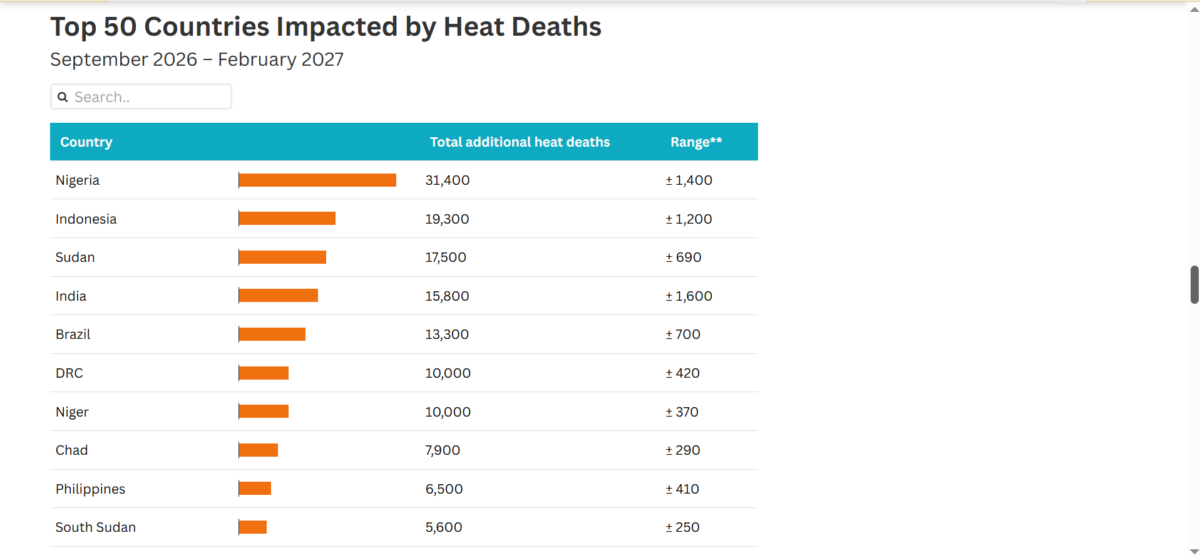
Super El Niño: Nigeria to be hit hardest by heat deaths, over 30,000 people to die, report says
“The anomalously warm temperatures that most of the globe will see during this El Niño event are a ‘postcard from the future’,” the report said.

Africa
Ghana’s crude output records 30% increase
The milestone which is a reversal of the country’s five years of sustained decline.

Politics
Kano’s only female governorship candidate vows to tackle drug abuse
Ms Ahmad, who is contesting on the Because Of Our Tomorrow party platform, said this in an interview on Wednesday in Kano.


