

Mfon Ekpo: Olodo Uprising and the knowledge we fail to see

Over the past month, the phrase Olodo Uprising has moved from social media commentary into wider Nigerian conversations about what our society rewards, who we consider intelligent and whether intellectual rigour is losing cultural ground.
Many Nigerians first encountered the word olodo in childhood, usually as a label for the child who could not answer the teacher’s question or was simply judged not to be very bright. The recent conversation around an Olodo Uprising has given the word new life, this time expressing a general anxiety that intellectual rigour and depth are losing ground while spectacle, virality and ignorance increasingly attract attention and reward.
During the two recent conversations we held at The Discovery Centre on the Olodo Uprising, I found myself interested in an adjacent question: what if our anxiety about ignorance is also exposing how narrowly we have learned to construct and recognise intelligence?
It is easy to recognise knowledge when it arrives in familiar packaging, like a degree or an articulate expert. It becomes harder when the person in front of us does not fit the intellectual mould we respect or expect.
Take Peller and IShowSpeed, two livestreamers who have turned unconventional online personas into massive global audiences. Peller has over 15 million TikTok followers, while IShowSpeed recently completed a 28-day tour across 20 African countries, crossing 50 million YouTube subscribers while in Nigeria. Whatever one thinks about their content, dismissing what they have built as mere foolishness leaves an obvious question unanswered: what do they understand that millions of people who consider themselves more intelligent really do not?
Repeatedly capturing attention globally, or in one of the world’s noisiest information environments, is not entirely accidental. Somewhere beneath the performance is an understanding of audience, timing, humour, cultural cues, collaboration, consistency and the mechanics by which a stranger on a screen becomes interesting enough for people to return tomorrow.
We do not have to admire everything they produce or confuse popularity with wisdom, but neither should we confuse our disapproval of their output with an absence of intelligence in how that output was created.
This habit of overlooking intelligence when it arrives in unfamiliar forms extends beyond social media. We have often done something similar with indigenous African knowledge, downplaying its intelligence and legitimacy and, consequently, its capacity to be at the forefront of innovation and change.
Perhaps this same conditioned instinct makes us ignore or downplay intelligence when it comes from us, but applaud and elevate it when it is presented and repackaged as novel and external to us.
Ọsẹ dúdú, African black soap, is another example. Long before skincare became a sophisticated global industry, generations of producers had developed methods for transforming locally available materials into a product used for cleansing and skincare. Today, black soap is packaged and commercialised far beyond the communities from which that knowledge emerged.
The knowledge did not suddenly become knowledge when academia or commerce became interested in it. It had been knowledge all along.
Traditional medicinal knowledge presents the same challenge. Generations of African communities have accumulated observations about plants, roots, leaves and bark. Not every inherited remedy will withstand scientific scrutiny, but dismissing the entire body of knowledge as archaic would be as careless as accepting all of it unquestioningly.
Perhaps the larger question hidden inside the Olodo Uprising is what happens when labels replace curiosity.
Once we decide that someone is an olodo, a practice is old-school or a form of knowledge is unserious, we no longer have to do the harder work of intellectually engaging with it or admitting to ourselves that someone with less pedigree or education cracked a code we had yet to crack, despite the resources at our disposal.
A continent can possess extraordinary knowledge and still fail to capture its value if that knowledge remains undocumented, untested or dependent on individual custodians.
This is why institutions matter.
Institutions such as the Global Knowledge Centre allow various forms of knowledge to accumulate, encounter disagreement, meet other forms of expertise and survive beyond the people who first carried it. They make it possible for the artisan to encounter the researcher, the practitioner to challenge the academic and indigenous wisdom to meet scientific inquiry.
For centuries, many of the world’s most influential knowledge institutions have existed outside Africa. Africans have travelled outward to study, research and participate in consequential intellectual conversations. But the movement need not remain predominantly unidirectional.
What would it mean to build institutions on the continent that the world also travels towards?
From September 17 to 20, Africa’s first purpose-built Global Knowledge Centre will open its doors in Uyo, Akwa Ibom State, to answer that question. Its proposition is that Africa deserves institutions where knowledge can be created, challenged, preserved, applied and brought into sustained global conversations.
The inauguration of the centre comes ten years after the award-winning conference, The Blueprint of How, began helping Africans translate ideas into action and impact. A decade later, the question has expanded from what individuals can do with what they know to what becomes possible when we build institutions capable of retaining and multiplying knowledge.
The Global Knowledge Festival accompanying the inauguration will bring delegates to Uyo from across Nigeria and several parts of the world. The significance is not simply the number of countries represented, but the direction of travel: people will travel towards Africa to exchange knowledge, and our hope is that long after the festival ends, that direction continues.
We need not endorse everything virality produces to recognise that there is something to be learnt about the ability to command attention. Neither must we romanticise every inherited African practice to recognise that generations before us knew things worth investigating.
Intellectual seriousness requires something harder than either worship or dismissal. It requires curiosity, scrutiny and the humility to admit that valuable knowledge may arrive in “containers” we did not expect.
Perhaps, then, the most important outcome of the Olodo Uprising is not deciding who deserves the label, but asking what the label reveals about us.
Perhaps it exposes not the limits of other people’s intelligence, but the limits of our own imagination and the arrogance of believing that intelligence must look, speak, learn and succeed in ways we already recognise.
Maybe the real lesson of the Olodo Uprising is that ignorance is not always the absence of knowledge. Sometimes, it is the inability to see knowledge when it takes a different form.
And perhaps an olodo was never simply “them”. Perhaps, all along, it was us.
- Mfon Ekpo is Executive Director of The Discovery Centre, Founder of The Global Knowledge Centre, and Convener of The Global Knowledge Festival.

We have recently deactivated our website's comment provider in favour of other channels of distribution and commentary. We encourage you to join the conversation on our stories via our Facebook, Twitter and other social media pages.

More from Peoples Gazette

Agriculture
FG tasks ECOWAS on leveraging financing strategies for agroecology
The federal government has urged stakeholders in the agriculture and finance sectors in the West Africa region to leverage financing strategies to enhance agroecology practices

Politics
Katsina youths pledge to deliver over 2 million votes to Atiku
“Katsina State is Atiku’s political base because it is his second home.”

States
Troops repel ISWAP attack on military base in Pulka, Borno
Troops of Operation HADIN KAI have repelled an attack by suspected ISWAP terrorists on a military base in Pulka, Gwoza council area of Borno.

Showbiz
Shakira, Burna Boy’s ‘Dai Dai’ surpasses one billion YouTube views
Nigerian Afrobeats singer Burna Boy and Colombian singer Shakira have achieved a major milestone with their joint track, ‘Dai Dai’.

Politics
Agege LG boss seeks sustained investment in literacy
Abdul-Ganiyu Obasa, chairman of the Agege council, on Tuesday called for sustained investment in literacy as the world marks the 60th International Literacy Day.

Agriculture
Kaduna ACReSAL, IAR partner to raise farm yields
The Kaduna Agro Climatic Resilience in Semi-Arid Landscapes Project partnered the Institute for Agricultural Research to raise farm yields.
Politics
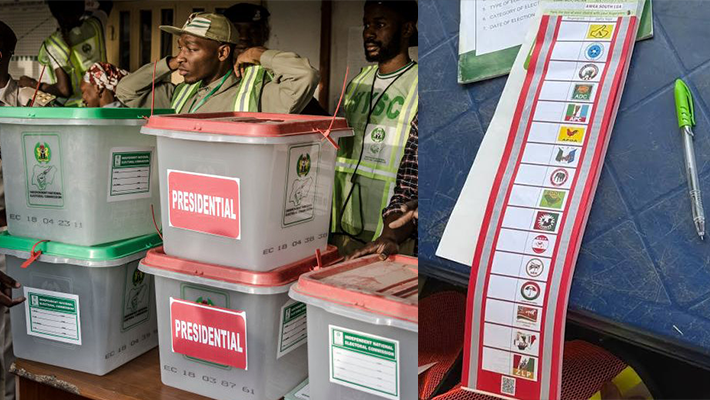
INEC fixes September 19 for by-elections in four states
The Independent National Electoral Commission has fixed September 19 for five by-elections in four states. The states are Gombe, Kano, Bauchi and Delta.

Uncategorized
Nigeria offers two savings bonds for subscription at N1,000 per unit
The Debt Management Office has announced two federal government savings bonds for subscription at N1,000 per unit.


