

SPECIAL: Many Nigerians at risk as NAFDAC stays silent on cyanide testing in garri with 24 million battling vision loss

About 4.5 per cent of Nigerian children and students live with visual impairments, with one in 10 students (around 1.8 million children) needing corrective glasses. Joshua Oladepo, an undergraduate at Ladoke Akintola University of Technology, is one of them. For many students and households, garri is often considered the only meal they can still afford, especially when the chips are down.
According to the World Bank, 141 million Nigerians, or about 63 per cent of the population, are estimated to be living in poverty in 2026. The National Bureau of Statistics (NBS) indicates that 133 million Nigerians experience multi-dimensional poverty (lacking access to health, education, and basic infrastructure).
While it is praised for its hunger-holding and thirst-quenching versatility, many Nigerians blame drinking garri for eye problems.
“Unless I’m at my lowest, I won’t drink garri,” says Mr Oladepo when in “survival mode”.
Beyond the temporary relief of the affordable meal lies an experience he has to contend with. Whenever he drinks garri—dried cassava flakes—his eyes begin to itch. The LAUTECH student’s experience reflects a wider concern among students and poor households who link the staple with eye problems, as several studies point to cyanide in cassava.
The Codex Alimentarius Commission, a joint FAO and WHO food standards body, said in its 2013 food standards programme report that cyanide may be toxic to humans and animals, adding that the severity of toxicity, however, depends on the quantity consumed. To reduce cyanide content, it advocated proper processing and “reasonable” application of technological measures such as Good Manufacturing Practices (GMP). However, it noted that high levels of HCN—the chemical formula for hydrogen cyanide—may remain in garri due to inadequate processing during famine, periods of stress, or when processors rush products to market.
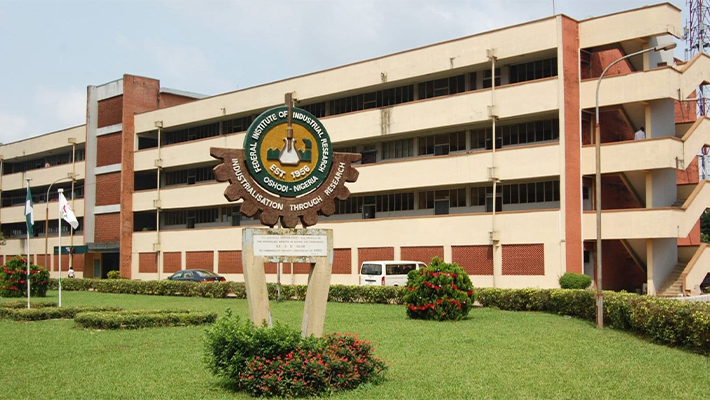
Despite its ubiquity in homes, the National Agency for Food and Drug Administration and Control (NAFDAC)—Nigeria’s agency for food and drugs control—seems silent on cyanide testing in garri. According to Codex, the amount of cyanide-producing compounds in cassava varies with factors such as cassava variety, environmental conditions like drought, and harvest time, with studies showing higher cyanide levels in late-harvested cassava. It was also noted that proper roasting affects residual cyanogenic compounds in garri and can influence its shelf life.
Codex recommends that governments and other entities promote proper processing methods to reduce residual cyanogenic compounds in garri.
Christiana Obiazikwor, the deputy director of public relations at NAFDAC, tells Peoples Gazette that packaged garri falls under the agency’s regulatory mandate and must be registered to ensure it is wholesome for consumption. However, not all garri in the market are certified for human consumption by NAFDAC.
“Those products that are packaged, those are the ones in our mandate,” Mrs Obiazikwor says, explaining that the agency’s mandate is to safeguard the health of Nigerians by ensuring foods are safe and wholesome for consumption.
The NIS 181:2004 Standard for Garri, approved by the Standards Organisation of Nigeria’s governing council, stipulates that total cyanide content in garri must not exceed 20mg per kilogramme, covering both free and bound cyanide. However, the NAFDAC’s spokeswoman could not confirm whether cyanide is among the parameters tested during the registration process.
“We have parameters for what they check in the laboratory,” Mrs Obiazikwor said. “For every product, there are parameters, and there are tests they run, depending on the product. So I don’t know what parameters they test.”
Garri itself is not inherently dangerous, scientists say. According to health experts, proper fermentation, dewatering and roasting can remove most of the cyanogenic compounds naturally present in cassava. But when processing is rushed or poorly done—and when garri is consumed frequently as part of an unbalanced diet—experts warn that residual cyanide may damage the optic nerve and contribute to visual impairment. But as food prices push more students and families towards the low-cost “survival meal”, concerns rise about how safe the garri sold in markets are, who tests it and whether consumers can tell the difference between a properly processed product and one that may pose a health risk.
As cash-strapped students increasingly rely on garri to stave off hunger or assuage thirst, ophthalmologists warn that chronic consumption of poorly processed products, especially alongside poor diets, may expose consumers to residual cyanide and cause optic-nerve damage amid weak consumer safeguards and inconsistent processing standards may expose some consumers to residual cyanide and preventable eye damage.
NAFDAC did not comment on whether cyanide is a mandatory laboratory parameter for packaged garri and how often market surveillance is conducted
Three garri samples pass tests
For this report, The Gazette took three garri samples—two packaged brands, and one purchased at a local market—to the Federal Institute of Industrial Research, Oshodi (FIIRO) in Lagos, for cyanide testing. The institute said it conducted the analyses in accordance with NIS 181:2004, using the Association of Official Analytical Chemists (AOAC) 20th edition (2016), method 999.07.
The first two samples were sent to FIIRO on July 21 this year, and analyses were completed on August 12. FIIRO’s laboratory analysis found 1.44mg/kg total cyanide in Sample B, the garri purchased at a local market, well below the 20mg/kg maximum limit set by Nigeria’s NIS 181:2004 Standard for Garri.
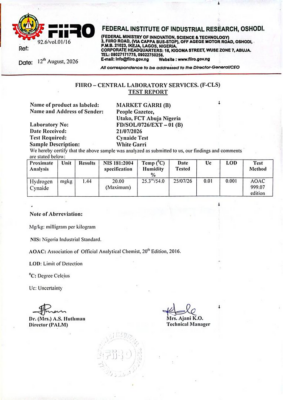
The analysis also found 2.15mg/kg total cyanide in Sample C (the third sample was submitted on July 28, and the result was ready on August 12), a popular packaged brand, while Sample A, another packaged brand, had 1.8mg/kg total cyanide.
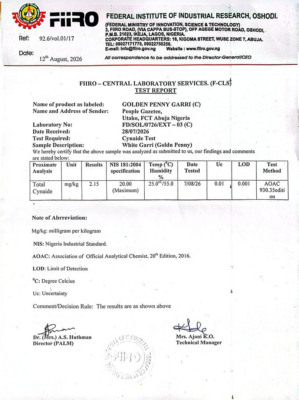
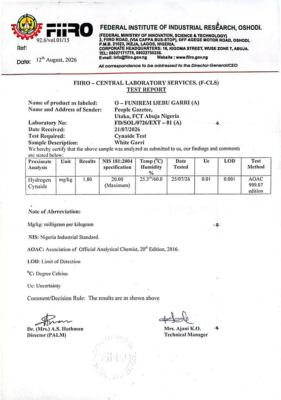
FIIRO concluded that all three results were within the acceptable limit for cyanide content in garri, with a maximum limit of 20mg/kg.
‘Garium sulphate’
‘Garium sulphate’, the affectionate moniker for garri, a staple food widely consumed across West Africa, is made from cassava. Rich in carbohydrates, it is produced by peeling cassava, grating it, fermenting it for several days, dewatering it to remove liquid containing dissolved cyanide, and then roasting it. Due to its affordability, long shelf life, and ease of preparation, garri remains one of the most common meals in the region. People often eat it by soaking it in water with sugar and roasted groundnuts or other proteins, or by kneading it into a dough with hot water and eating it with soup.
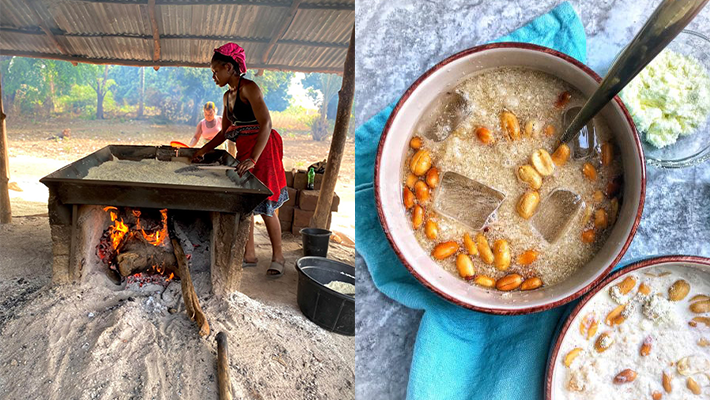
Beyond Nigeria—the world’s largest producer of cassava—garri is also consumed in Sierra Leone, Togo, Ghana, Cameroon, Côte d’Ivoire, Liberia, and the Republic of Benin. Reports indicate that over 70 per cent of cassava produced in Nigeria is processed into garri. However, concerns have persisted over the years about whether excessive consumption may lead to visual impairment.
For Mr Oladepo, whose sibling also experienced itchy eyes, he named ‘garium sulphate’ the culprit. His sibling usually developed itchy eyes typically four to five days after he drank garri.
“Yes, there was improvement (after adding milk), but I’m not interested anymore,” says Mr Oladepo. “Although university life will humble you to drink garri, you just have to be careful.”
Mr Oladepo’s account mirrors claims from other Nigerians who often blame garri for their poor eyesight.
Ahmed Oluwasanjo, a journalist, once did not believe drinking garri could cause poor eyesight. Soaking garri in cold water at least twice daily to keep cool during a three-month hot season, Mr Oluwasanjo says, “The weather was hot then, so drinking sour garri and cold water was how I increased my water intake. I did it for more than three months straight until I started noticing my sight was getting blurry. It was at that point that I decided to stop drinking garri. Since I stopped, I have noticed great improvement in my sight.”
Vivian Uro-Ewa explains that watery eyes and episodes of blurred vision were among the challenges she experienced during her school days.
“Garri almost blind my eyes during school days; If I come out under the sun, everywhere go blur,” Mrs Uro-Ewa says. “Sometimes tears go dey comot by em self. No be say na only garri I dey drink that time, the garri no process well.”
No garri, no problem?
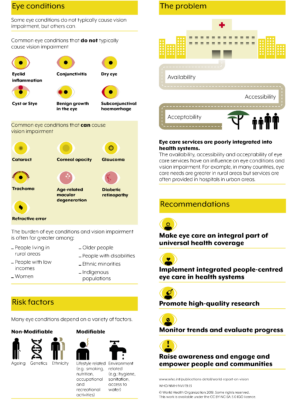
Eye doctors are few and far apart in Africa’s most populous country, and seeing an ophthalmologist or optometrist is considered expensive for many Nigerians. Nigeria faces significant eye-care workforce gaps. The country’s National Eye Health Strategic Development Plan (2024–2028) reported 610 ophthalmologists, 3,000 optometrists, 1,323 ophthalmic nurses and 1,855 mid-level eye-care workers. However, according to the Nigerian Journal of Ophthalmologists, 396 ophthalmologists serve a population of 230 million. The global cost of vision loss, based on minimum wage, was $160 to $216.32 billion in 2020. Using GNI, the global cost of vision loss was $449.36 to $584.66 billion.
This means there was one ophthalmologist for every 578,624 inhabitants. Nigeria had 57 oculoplastic surgeons, or one oculoplastic surgeon per 4,019,917 people. Southern Nigeria had more ophthalmologists (72.2 per cent) than northern Nigeria (27.8 per cent). Similarly, more oculoplastic surgeons were in southern Nigeria (63.2 per cent) than in northern Nigeria (36.8 per cent). More oculoplastic surgeons were in the South-West (21), and only one was in the North-East zone. Lagos had the highest number of oculoplastic surgeons in Nigeria. The Nigerian Optometric Association, the prime umbrella association, says there are over 4,000 doctors of optometry across the 36 states and the Federal Capital Territory.
Experts therefore note that it becomes easy for Nigerians plagued by poor eyesight to blame it on drinking garri, or sometimes on witches and wizards.
Blind spot
Nigeria’s National Blindness and Visual Impairment Survey estimates that more than 24 million Nigerians have varying degrees of vision loss. About 1.3 to 1.5 million people are completely blind. An estimated 4.25 million adults are classified as either blind or visually impaired. The risk of blindness increases significantly with age. For Nigerians aged 40 and older, 4.2 per cent are clinically blind. For individuals over 60, this number spikes to 9.3 per cent. In Nigeria, 84 per cent of blindness is preventable or treatable.
Cataract is the leading cause of blindness (43.0 per cent) and severe visual impairment (45.3 per cent). It affects roughly 400,000 to 600,000 adults in operable stages. Glaucoma is the second most common cause of blindness (16.7 per cent). It affects 5.02 per cent of adults aged 40 or more. It is the number one cause of irreversible vision loss. Only 5.6 per cent of sufferers are aware they have it until significant damage occurs. Nigeria has the second-highest trachoma burden in Africa, placing 3.5 million people (primarily in northern rural zones) at risk.
A report states that over 90 per cent of people living with vision loss globally could be treated with existing, highly cost-effective interventions, suggesting that 1.8 billion people will be living with untreated vision loss by 2050. Furthermore, 90 per cent live in low- and middle-income countries, with the largest share in Asia and sub-Saharan Africa.
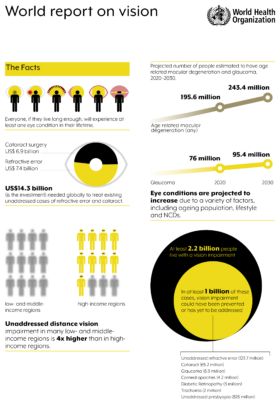
Globally, at least 2.2 billion people have a near or distance vision impairment. For at least one billion of these people, vision impairment could have been prevented or remains unaddressed. Among these one billion people, the main conditions causing distance vision impairment or blindness are cataract (94 million), refractive error (88.4 million), age-related macular degeneration (eight million), glaucoma (7.7 million), and diabetic retinopathy (3.9 million). Presbyopia is the leading cause of near vision impairment (826 million). Refractive errors and cataracts are the leading causes of vision impairment and blindness. An estimated two out of three people in low-income countries who need eyeglasses don’t have access to them. In addition, one in two people globally who need cataract surgery don’t have access to that surgery. Vision impairment poses an enormous global financial burden, with the annual global cost of lost productivity estimated at $411 billion.
The eye problem link
Properly processed garri is considered safe for consumption, as about 96–99 per cent of its cyanide content is removed during cassava fermentation and roasting, and cyanogenic glycosides are largely eliminated in well-processed products. According to research, if cyanide, a naturally toxic compound in cassava, is not adequately removed during processing, it may cause toxicity, with symptoms such as headaches, dizziness, optic nerve damage, and, in severe cases, blindness.
A study by Dateline Health Africa explains that cyanide forms cyanogenic glycosides—such as linamarin and lotaustralin—which enzymes break down to release toxic hydrogen cyanide (HCN), potentially leading to serious health effects. It notes that cyanide can enter the body through inhalation and oral consumption or be absorbed into the bloodstream, affecting the heart, brain, and eyes. The research finds that cyanide disrupts oxygen supply to retinal cells, ultimately leading to blurred vision or even vision loss.
“The moderate consumption of properly processed garri with other dietary additions is not linked with poor vision,” the study states. “However, chronic consumption of poorly processed garri with minimal dietary additions has been associated with vision issues in Africa.”
Cassava exists in two main varieties—sweet and bitter—distinguished by their cyanide content. Sweet cassava contains less than 100mg/kg of cyanide, while bitter cassava contains significantly higher levels. Another study published in the African Journal of Food Science suggests a higher prevalence of poor visual acuity and colour vision defects among long-term consumers of poorly processed garri.
The study, conducted in Kaduna among 180 adults—100 consumers, including students at higher institutions, and 80 non-consumers aged 18 to 56—finds a higher incidence of colour blindness among garri consumers. It reveals that “consumers of garri have poorer visual acuity and colour vision when compared with the non-consumers of garri”.
It points out that this may be due to exposure to an unsafe amount of cyanide in garri, that is, greater than 10ppm, which was consumed over a long period of time, adding, “Consumption of processed cassava (garri) increases the high incidence of refractive errors among the consumers, which may consequently contribute to high prevalence of blindness and severe visual impairment in the study area.”
Cassava exists in two main varieties—sweet and bitter—distinguished by their cyanide content. While sweet cassava contains less than 100mg/kg of cyanide, bitter cassava contains significantly higher levels, with research published in the African Journal of Food Science suggesting a higher prevalence of poor visual acuity and colour vision defects among long-term consumers of poorly processed garri.
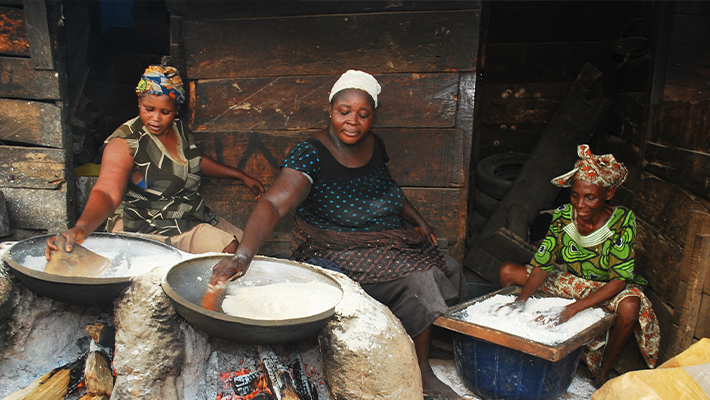
A 2023 experimental study by Azubuike Onua of the Department of Ophthalmology, University of Port Harcourt, and Stephen Musa of the Department of Anatomical Pathology, University of Port Harcourt Teaching Hospital, concluded that longer processing of garri meant for consumption reduces its cyanide content and minimises the adverse impact on the optic nerve.
Researchers examined 24 Wistar albino rats fed high-cyanide cassava processed for making garri—some fed cassava fermented for 24 hours twice daily for 60 days and others for 48 hours. Varying degrees of optic neuropathy were found, with the condition worse among those fed cassava fermented for 24 hours twice daily for 60 days.
In a September 2002 study, ‘Exposure to cyanide following a meal of cassava food’, 12 individuals were given 150g of garri to consume to measure cyanide in their blood. While cyanide exposure followed their consumption of garri, researchers concluded that the quantity absorbed from a single meal was small and unlikely to cause acute intoxication. They suggested that frequent consumption could cause cyanide to accumulate in the blood, while exposure to cyanide from garri has been implicated in ataxic polyneuropathy and amblyopia. Ataxic polyneuropathy is a neurological condition that damages peripheral nerves, while amblyopia is reduced vision.
Tropical amblyopia was linked to cyanide poisoning and visual impairment, including blindness, optic atrophy and scotoma, in a 1971 study published in the American Journal of Ophthalmology, which examined tropical amblyopia in Nigerians. The study examined 360 Nigerian patients with tropical nutritional neuropathy, more commonly called tropical ataxic neuropathy, for ophthalmic findings.
Drinking garri without tears
Experts note that cassava itself is not inherently toxic, but it can form harmful cyanogenic compounds during garri processing. They also agree that poorly processed garri may risk eye health because of its cyanide content, and they identified blurred vision, difficulty reading, and reduced colour vision as early warning signs.
Peter Abikoye, a consultant ophthalmologist at the Federal Medical Centre, Abeokuta, Ogun State, tells The Gazette that even though there is a link between garri consumption and visual impairment, which may have been diagnosed during investigations into patients’ lifestyles and nutrition, “it is not as it is being assumed in the public circle”.
Mr Abikoye says that when cyanide remains at high levels during the production stage, it affects the eyes. He added that while no specific group is more vulnerable, individuals who consume poorly processed garri over a long period may be at risk.
“Chronic cyanide intake can affect different parts of the eye, particularly the retina and optic nerve, which are closely linked to significant visual impairment and possible blindness,” the eye doctor explains. “When these compounds remain at high levels due to poor processing, they are converted into hydrogen cyanide in the body. This interferes with the ability of retinal cells to utilise oxygen, leading to a condition known as hypoxia.”
He, however, notes that early detection can make such vision impairment reversible and advised garri drinkers to prioritise well-processed garri.
Kolade Ajagbe, an ophthalmologist at the Federal Medical Centre, Bida, Niger State, states that eye problems can arise from multiple causes, including nutritional deficiencies. He explains that cyanide toxicity may affect the eyes by disrupting blood supply to the optic nerve or directly damaging it, with early symptoms including blurred vision and reduced visual acuity.
“If visual problems related to cyanide toxicity occur, recovery depends on factors such as exposure level, duration, and how quickly treatment begins,” he says, adding that more research is needed to establish a definitive link.
“The issue is not that ‘eating garri causes blindness’. Rather, chronic consumption of poorly processed cassava products under certain conditions may increase the risk of toxic optic nerve damage,” Ugwu Chinedu tells The Gazette.
A consultant ophthalmologist at the Eye Foundation Hospital, Ijebu-Mushin, Ogun State, Mr Chinedu admits drinking garri can cause visual impairment. Still, the concerns stem from poorly processed cassava, which retains high levels of cyanogenic compounds.
Noting that it is usually difficult to attribute a patient’s vision problem to a particular food, the ophthalmologist says, however, that in populations highly dependent on cassava-based foods and poor diets, there is a risk of toxic and nutritional optic neuropathies, which may cause gradual vision loss and colour vision changes.
“This is different from conditions like cataract, where the problem is clouding of the lens, or glaucoma, where there is progressive damage often associated with raised eye pressure,” the doctor explains. “In settings where people have a very high dependence on cassava products, poor dietary diversity, and possible nutritional deficiencies, one should be aware of what is known as toxic and nutritional optic neuropathies. These conditions can present with gradual reduction in vision and changes in colour vision.”
Mr Chinedu explains that recovery depends on the severity of exposure. He warns that “prolonged toxic damage to the optic nerve can become permanent because nerve cells do not regenerate easily”.
Christian Ifijen tells The Gazette that garri, on its own, does not cause poor vision. On conditions associated with chronic cyanide intake, which he says depletes vitamin A stores, Mr Ifijen identified pallidal optic atrophy, easily classified as nutritional optic atrophy, as well as colour vision defects and notes that the severity of the conditions depends on how often people consume under-processed garri, adding that the damage occurs during the conversion of auto-toxins and leads to vitamin deficiency.
“Chronic cyanide consumption from garri has been shown to deplete vitamin A stock, and there are well-documented relationships between vitamin A deficiency and iron-related pathologies,” says the ophthalmologist who works at the Irrua Specialist Teaching Hospital (ISTH), Edo State.
Mr Ifijen advised garri consumers to watch for blurred or reduced vision and an inability to differentiate colours, especially red and green. He, however, said the effects could be reversed if detected early and suggested high protein intake and vitamin A supplements.
An ophthalmologist at Brighthouse Eye Clinic, Ijeoma Ilora, highlighted the role of poor processing, particularly inadequate fermentation, in potential visual disturbances. She, with over a decade of experience, recounted a case in which a patient’s eye health improved after reducing garri intake, suggesting a possible link in some cases. The ophthalmologist maintains that drinking garri that is not adequatwell-processed could expose consumers to residual toxins more directly than when kneaded into dough with hot water and eaten with soup.
Mrs Ilora underscores the need for proper fermentation which is essential for reducing cyanide levels, while rapid processing within 24 hours may not allow full detoxification, and that safety depends primarily on proper fermentation, not on whether it is white or yellow garri. However, she notes that yellow garri may be slightly safer because it contains palm oil added during processing.
“But the main concern is garri with high cyanide content. It’s not really about yellow or white, although the yellow one may be slightly better because of the oil,” she says.
Sifting eye problems from garri
While ophthalmologists underlined that the risks of eye defects are largely associated with poorly processed garri, the National Cassava Processors and Marketers Association (NCPMA) says advances in cassava processing technology have significantly reduced cyanide levels in the staple over the years.
Bola Asiru, the administrative secretary of the NCPMA, explains proper processing removes much of the cyanide but noted that some rural areas still use traditional processing methods because of limited access to improved processing technology.
“Fortunately, technology has gone beyond that, but you will be surprised that the various things that you are running away from can be traced to some rural areas, inner villages, where they don’t even know that technology exists.
“The level of cyanide that usually causes health hazards has come down, and during the processing, a lot of it can be removed, but I can tell you that people eat cassava now, whether it is sweet or not, because even cyanide is low. But we continue to hold this like in those days, during the early 1960s, 1970s, 1980s, and 1990s, cassava was very bitter, and the cyanide was very high,” he tells The Gazette.
Mr Asiru did not say how consumers can identify well-processed garri or how the association ensures its members adhere to recommended processing methods.
While adding milk to garri makes it more refreshing, many consumers believe it helps reduce the risk of eye-related problems associated with it. Experts, however, offer differing views on how much that protection matters.
Mr Abikoye says adding milk to well-processed garri makes no difference.
“For poorly processed garri, adding milk helps to reduce the risk significantly,” the expert says.
Mr Chinedu believes that even though milk and onions are nutritious, “there is no strong scientific evidence that simply adding milk or onions specifically prevents cyanide toxicity from garri”.
Instead, he recommends a balanced diet with adequate protein, vitamins, and minerals supports overall eye health.
“Garri remains an important and culturally significant food in Africa,” says the ophthalmologist. “The goal is not to discourage its consumption but to ensure it is produced safely and consumed as part of a healthy diet.”
Mr Ifijen discloses that increased protein intake, such as milk, would likely reduce cyanide toxicity but there is “no documented evidence to show that taking garri with onion or milk or taking it with other agents can reverse or reduce the damage”.

We have recently deactivated our website's comment provider in favour of other channels of distribution and commentary. We encourage you to join the conversation on our stories via our Facebook, Twitter and other social media pages.

More from Peoples Gazette

Agriculture
FG tasks ECOWAS on leveraging financing strategies for agroecology
The federal government has urged stakeholders in the agriculture and finance sectors in the West Africa region to leverage financing strategies to enhance agroecology practices

Politics
Katsina youths pledge to deliver over 2 million votes to Atiku
“Katsina State is Atiku’s political base because it is his second home.”

World
World in most dangerous nuclear moment since end of Cold War, UN chief warns
A statement by the UN highlighted Mr Guterres’ concern as the General Assembly held a high-level meeting to mark the International Day for the Total Elimination of Nuclear Weapons.
Economy
OPay names top 10 teams in N18 million national innovation challenge
As the top 10 teams advance to the Boot Camp, they move one step closer to transforming their ideas into solutions that can address real-world challenges.

Anti-Corruption
USAF cybercriminals Chijioke Odimegwu, Harafat Mogaji jailed 189 months for multimillion-dollar phishing heist
Chijioke Odimegwu and Harafat Mogaji, former members of the United States Air Force at the time, attacked businesses with email “spamming” and phishing campaigns.

Abuja
TCN announces maintenance, disruption in parts of Abuja
The Transmission Company of Nigeria says there will be a three-hour annual preventive maintenance exercise at the Kubwa 132/33kV transmission substation in Abuja.
NationWide
SPECIAL: Many Nigerians at risk as NAFDAC stays silent on cyanide testing in garri with 24 million battling vision loss
A NAFDAC spokeswoman told Peoples Gazette it did not know if cyanide is on the agency’s testing checklist and did not state how often market surveillance is conducted.

Economy
Benin secures €500 million in international financing with ADF support
Benin secured €500 million in international bank financing, supported by the African Development Fund, to facilitate priority investments in several sectors including education.


