

The hunger votes are coming
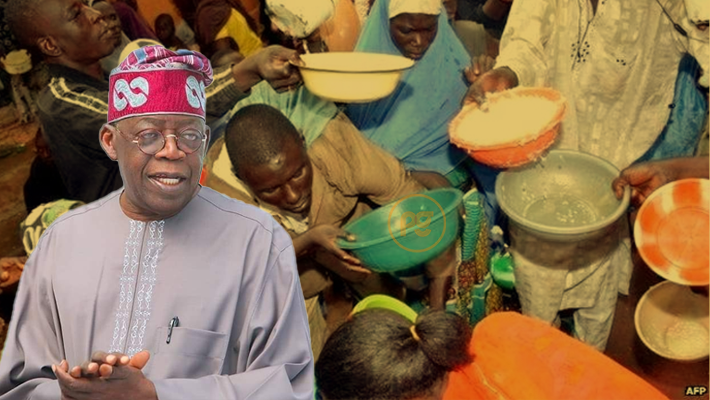
The gloves are off. Hunger is now a prized pugilist in Nigeria’s political ring. Nigerians who can no longer find refuge in the neutral corner are being pummelled by hunger, with each passing day bringing another blow to households already struggling to remain on their feet.
The fight has become brutally unequal. On one side stands Tinubu’s government, armed with the machinery of state power and an abundance of political explanations for the country’s economic woes. On the other are millions of Nigerians whose only defence against the relentless assault of hunger is the desperate effort to keep their families alive.
There will be no respite until Nigerians decide that enough is enough on polling day, 16 January 2027, and use their votes to send Bola Tinubu packing from the Presidential Villa in Abuja.
The political consequences of hunger are often underestimated by those who experience economic hardship through government statistics rather than through the daily struggle to put food on the table.
For a family living on a modest income, the cost-of-living crisis doesn’t become an abstract economic jargon when mothers stand before their cooking pots, wondering how to stretch the little rice remaining in the kitchen to feed their families; fathers return to their homes after a day’s work with money that can no longer purchase what they bought a few months earlier; or schoolchildren leave their homes without breakfast, hoping that something will be available at school to silence the discomfort of their empty stomachs.
In some homes, dinner has become a privilege reserved for those days when money is available, while in others, parents have quietly reduced their own food portions so that their children can have something to eat. These are the private tragedies unfolding behind the public language of Tinubu’s economic reforms.
Tinubu’s government may find comfort in the argument that its economic reforms were necessary to correct structural distortions inherited from previous governments. The removal of the oil subsidy and the liberalisation of the foreign exchange market have been defended as difficult decisions required to restore economic stability.
But governments cannot indefinitely demand that citizens bear the consequences of policy choices without demonstrating that those choices are improving their lives. Economic reform must ultimately be judged by what happens to the ordinary Nigerian, not by the applause it receives in international financial circles or the satisfaction it generates among investors.
A government that celebrates improving macroeconomic indicators while millions of its citizens struggle to afford basic food necessities must understand that the distance between its economic narrative and the lived experiences of Nigerians is becoming politically dangerous.
The most disturbing consequence of prolonged hunger is the way it gradually dismantles the dignity of ordinary people. A father who cannot provide for his household begins to experience poverty as a personal failure, even when the circumstances responsible for his predicament are beyond his control. A mother who must repeatedly explain to her children why their favourite meals have disappeared from the family menu carries a burden that no government statistic can adequately capture.
Young graduates who have spent years acquiring university degrees find themselves unable to secure employment that can sustain independent living, while those fortunate enough to have jobs discover that their salaries disappear long before the end of the month. The Nigerian household has become an arena in which the consequences of government policy are experienced with an intimacy that no presidential campaign speech can conceal.
There is a political danger in assuming that Nigerians will indefinitely tolerate these conditions because they have endured hardship under previous governments. The memory of suffering does not necessarily produce political submission. Sometimes, it produces the determination to punish those considered responsible for prolonging it.
Hunger has a peculiar political character because it follows the voter home. It does not disappear when the campaign convoy leaves town, nor does it become less painful because a presidential spokesman offers another explanation for the state of the economy. The voter who listens to promises at a political rally must still confront the price of food the following morning. The difference between campaign rhetoric and household reality is where the political fortunes of an incumbent government can begin to unravel.
Tinubu should pay particular attention to the political consequences of this widening gulf. His government cannot assume that the political structures assembled around his presidency will automatically translate into electoral loyalty. Governors, political appointees, party financiers and an elaborate campaign machinery may provide the appearance of political strength, but none of these can guarantee the gratitude of a hungry electorate.
The ballot belongs to the citizen, and the citizen’s assessment of government performance is not necessarily determined by the political calculations of party leaders. The family that has spent three years adjusting its expectations downwards may eventually decide that another four years of the same experience is a price it cannot afford.
The 2027 presidential election will therefore be about more than the competing ambitions of political parties and their candidates. It will be a referendum on the economic circumstances in which Nigerians have been forced to live since Tinubu assumed office.
The opposition must understand this and resist the temptation to reduce the coming election to a contest of personalities. Its most persuasive argument must be grounded in the experiences of households that have watched their purchasing power collapse and their living standards deteriorate. Nigerians need to know what an alternative government proposes to do differently, how quickly it intends to address the cost-of-living crisis and what safeguards will prevent another round of economic experimentation from being imposed on citizens without adequate protection.
Hunger does not automatically translate into electoral defeat for an incumbent. Political loyalty, regional calculations, ethnic considerations, religious affiliations and the weakness of opposition parties can complicate the relationship between economic hardship and voting behaviour.
But no incumbent should mistake the patience of suffering citizens for an unlimited political mandate. The longer hunger remains a permanent feature of Nigerian life, the more difficult it becomes for the government to persuade voters that another term is desirable.
On 16 January 2027, millions of Nigerians will have an opportunity to express their verdict. Some will walk to their polling units carrying the memory of meals their children could no longer afford, school fees they struggled to pay and months in which their salaries failed to sustain their families. Others will remember the indignity of having to borrow money to meet basic household needs. Their votes may not all go in the same direction, but the cumulative weight of their economic experiences will shape the election.
The hunger votes are coming. Tinubu may command the instruments of political power today, but he cannot command the stomachs of hungry Nigerians. The ballot box offers citizens an opportunity to make their anger count, and a government that has failed to make life more bearable must be prepared to face the consequences of that failure.
The final bell is approaching. On polling day, the Nigerian electorate will decide who leaves the ring: hunger or Tinubu. And if the umpire chooses to play footsie, the ringside audience may well respond with stones, stones that will ring like a bell, to borrow from the late Chilean poet, Pablo Neruda.
Abdul Mahmud, a human rights attorney in Abuja, writes weekly for The Gazette

We have recently deactivated our website's comment provider in favour of other channels of distribution and commentary. We encourage you to join the conversation on our stories via our Facebook, Twitter and other social media pages.

More from Peoples Gazette

States
Independence: NBA urges Nigerians to expect better future
The NBA said that ordinary Nigerians should be deriving benefit from the subsidy removal rather than hardship.

Agriculture
FG tasks ECOWAS on leveraging financing strategies for agroecology
The federal government has urged stakeholders in the agriculture and finance sectors in the West Africa region to leverage financing strategies to enhance agroecology practices

Politics
Katsina youths pledge to deliver over 2 million votes to Atiku
“Katsina State is Atiku’s political base because it is his second home.”

Economy
Nigeria Customs collects N1.42 trillion, processes nearly 100,000 goods declarations
Customs collected N697.84 billion in September and N722.91 billion in October, bringing the total revenue for the two months to N1.42 trillion.
Opinion
The hunger votes are coming
The final bell is approaching. On polling day, the Nigerian electorate will decide who leaves the ring: hunger or Tinubu.
World
‘It slows me down,’ Biden gives update on cancer battle
Mr Biden, America’s 46th president, announced shortly after he left the White House that he had been diagnosed with prostate cancer.
Economy
26 governors increased spending faster than revenue despite higher state allocations: World Bank
According to the World Bank, expenditure grew faster than revenue in 26 of the 34 states with comparable data.

NationWide
SON joins NESS technical committee to boost export quality assurance
“The move will facilitate the integration of SON’s Export Certificate Programme (SONEXCAP) into the National Single Window,” the organisation said.

Sport
NPFL Derby: Nasarawa United fight back to beat Plateau United 3-1
Nenrot Silas put Plateau United ahead in the 11th minute, giving the visitors an early advantage.


