

Rudolf Okonkwo: Diary of an African travelling across Europe
Day One: From Lisbon, Portugal, to Rome, Italy
I left New York on Monday, November 9, and it is now Tuesday, November 10, 2026, day one of the diary of an African travelling across Europe for the first time since I started teaching post-colonial African history at the School of Visual Arts in New York City.
It wasn’t the same as my last time in Europe in 2017. Now, I see the ghosts of dead people, the sweat of stolen people and the blood of tortured people. I see monuments to stolen African resources.
I also see some funny stuff.
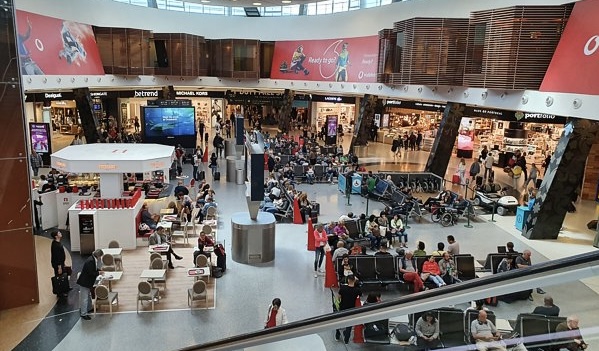
Like at Lisbon Airport, where I first landed. The first thought that came to me was: Is this the airport from which the Portuguese used to control Mozambique, Angola, Brazil, São Tomé and all their other colonies?
Of course, the Portuguese empire existed long before this airport was built. But standing there, I could not help thinking about the empire that Lisbon once commanded.
I look at the men and women of Portuguese heritage and wonder what happened to them. They do not look like the people who once had an empire. They look like shells of their former selves.
I started this journey from New York City, flying TAP Air Portugal.
At JFK, these Portuguese were moving around like chickens beaten by the rain. But the moment they entered their country’s national carrier, they started running their mouths, speaking loudly in Portuguese. It made me wonder what it would be like if Nigeria had a national carrier that Nigerians could use to go home from other parts of the world.
Oh, at Lisbon Airport, on the bathroom wall, they had images showing which toilets were for men and which were for women. I forgot to take a picture. Maybe on my return trip.
But the image I saw of a woman had a waist that was not typically European. I checked around and did not see women moving about with such bottoms. I suspected that might be one of the things they borrowed from Africa.
Yes, despite what you have heard, I mean, nyash na nyash, it is not true. Some nyash pass others.
Unless you can find such women in the villages of Portugal.
Anyway, I digress.
Meanwhile, Lisbon Airport is fairly large. We were transported to and from the aircraft by bus. I really thought Portugal was all done. But there is still life left in it, going by the activities at the airport. Busy!
The Portuguese, among the Europeans who pioneered the colonial adventure into Africa, are still enjoying the dividends of centuries of empire, beginning long before Vasco da Gama and continuing until the end of Portuguese colonial rule in Angola and Mozambique in 1975.
What am I talking about?
They have not even left.
I see the signs.
The Black people I saw speaking Portuguese were probably from Angola, Mozambique and the like. Some were cleaners at the airport and support staff.
Most of the African men I saw were loading luggage, food and other supplies into the aircraft. Some were refuelling the aircraft.
The passport clearance officers I encountered were, of course, young white Portuguese men.
Was I seeing the remnants of the old colonial arrangement, or was my new understanding of African history making me see colonialism everywhere?
After a quick two-hour stopover, I joined another flight to Rome.
In Rome, I hope to visit the site where Julius Caesar was cremated. Yes, I know he was cremated, but I need to see the place where a temple was built in his honour.
On arrival in Rome, I waited at the airport for my host to come and pick me up. While waiting, I looked around at the people. I was seeing Europeans from different countries speaking different languages. They have come to accept each other and figured out how to live together and share a relatively small continent. It works for them.
I was surprised that when I arrived in Lisbon and went through immigration, it was not just an immigration check into Portugal; it was also one into much of Europe, the countries in the Schengen club. By the time I arrived in Italy, it was like a local flight. You come out of the plane and go your way.
Quite impressive.
It was the easy movement of people needed to enhance trade and services. Imagine arriving anywhere in Africa and being able to move easily to other parts of the continent. And not just the movement of goods and services, but also the movement of people.
I could not stop thinking about Africa. The Europeans who once crossed oceans to divide Africa among themselves have now found ways to bring much of their own continent together. Meanwhile, we Africans, whose ancestors moved across territories long before Europeans drew lines on our maps, still struggle to move from one African country to another.
I wondered what our continent would look like if an African could land in Lagos, travel to Accra, continue to Abidjan and end up in Dakar without worrying about border harassment, unofficial payments and all the other obstacles that make travelling across Africa unnecessarily difficult.
We have ECOWAS and its free-movement arrangements, but anyone familiar with the realities of crossing some African borders knows that what is written on paper is not always what happens on the ground.
After her class for the day, my host, Hauwa Ibrahim, came to pick me up.
For those who do not know who she is, her story in law and human rights advocacy includes her famous defence of Amina Lawal, Safiya Hussaini and Hafsatu Abubakar in cases involving Sharia court convictions. For her work, she was awarded the European Parliament’s Sakharov Prize in 2005.
In the course of this trip, I will have an extensive dialogue with her, which I hope to turn into a book later. We will discuss conversations going on about Africa and the world. We will interrogate history and its consequences, including decisions made generations ago that continue to shape our lives today.
I am primarily in Rome to speak to her students in the Global Governance class at the University of Rome.
Before I retired for the day, Hauwa took me to the Vatican for a late-night look. It was nothing like anything I had imagined.
We drove around the fortified walls of the Vatican, stopping at intervals to look at the headquarters of the Catholic Church.
At night, it was intimidating.
At certain corners, I saw Italian military men guarding the territory. Along the avenues were souvenir shops still open at 10:00 p.m. Near an entrance to the Vatican Museums, I saw tourists streaming out.
I will tell you later about the things going on in my mind, the characters jumping in and out, wanting to speak.
I imagined past popes who did great things within the walls of this tiny country. I also imagined those whose decisions brought suffering to millions of people.
I thought about Pope Urban II and his call for the First Crusade in 1095. I wondered about the decisions made by popes over the centuries that changed the world, for good and for bad.
As lights from the dome of St Peter’s Basilica shone in the night, I marvelled at the secrets hidden in the Vatican’s archives. I wondered how many stories about Africa and the rest of the world were buried in those records.
In the days to come, I plan to go in and meet the Pope.
He and I have some things to discuss.
I know he is currently travelling in Latin America.
He better come back to the Vatican before I leave.
Keep following me as I update you on this trip across Europe.
- Rudolf Ogoo Okonkwo teaches Post-colonial African History, Diasporic African Literature, and African Folktales at the School of Visual Arts in New York City. He is the author of “This American Life Sef.” His latest book is “A Kiss That Never Was.”

We have recently deactivated our website's comment provider in favour of other channels of distribution and commentary. We encourage you to join the conversation on our stories via our Facebook, Twitter and other social media pages.

More from Peoples Gazette

States
Independence: NBA urges Nigerians to expect better future
The NBA said that ordinary Nigerians should be deriving benefit from the subsidy removal rather than hardship.

Agriculture
FG tasks ECOWAS on leveraging financing strategies for agroecology
The federal government has urged stakeholders in the agriculture and finance sectors in the West Africa region to leverage financing strategies to enhance agroecology practices

Politics
Katsina youths pledge to deliver over 2 million votes to Atiku
“Katsina State is Atiku’s political base because it is his second home.”

Economy
UN chief seeks increased investment in clean electricity
Mr Guterres made the call during a high-level dialogue on clean energy transition and electrification, titled ‘35 by 35: Powering the Future’, in Antalya, Türkiye.
Opinion
Rudolf Okonkwo: Diary of an African travelling across Europe
The Europeans who once crossed oceans to divide Africa among themselves have now found ways to bring much of their own continent together.
Showbiz
Meta deactivates Russell Brand’s Instagram, Facebook accounts after rape sentencing
Meta has deactivated British former comedian and actor Russell Brand’s Instagram and Facebook accounts following his conviction and sentencing for four sexual offences.
Abuja
NSITF: EFCC continues N2 billion fraud trial against ex-labour minister Chris Ngige
The Economic and Financial Crimes Commission, EFCC, says it has continued prosecuting former labour minister Chris Ngige over alleged abuse of office.

Economy
Stock market loses N293 billion as profit-taking persists
The Nigerian stock market closed on a negative note on Wednesday as investors’ wealth declined by N293 billion.

Health
Domestic TB funding rose 14% to $5.6 billion, says WHO
WHO says domestic funding for TB rose 14 per cent to $5.6 billion between 2024 and 2025, helping sustain essential services despite declining international financing.


