

Abdul Mahmud: Oshiomhole’s rebuke and Tinubu’s roads to development
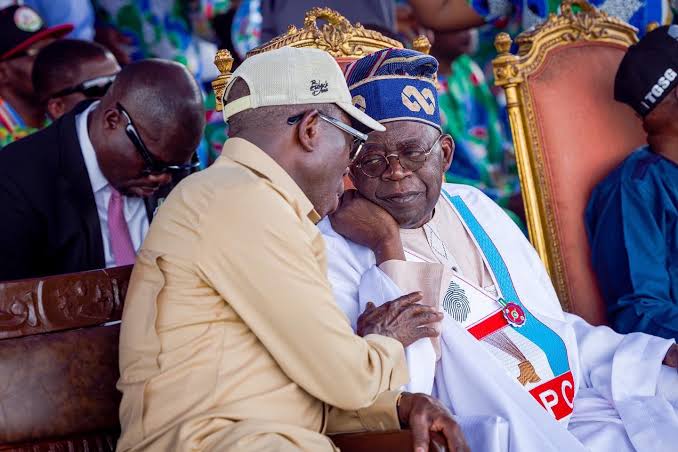
Senator Adams Oshiomhole has spent the better part of the last decade disappointing many of those who once admired his willingness to confront power without regard for political convenience.
The former labour leader who built his reputation challenging governments, confronting economic injustice and defending ordinary Nigerians appeared, after entering the highest circles of partisan politics, to have surrendered much of that instinct to the demands of political loyalty.
Critics who once applauded his fearless interventions increasingly saw a politician more inclined to defend the government than to question it, even when the facts demanded uncomfortable conversations.
This perception explains why his recent criticism of the Minister of Works, David Umahi, attracted attention far beyond the immediate controversy over the deplorable condition of federal roads across the South-South.
Nigerians were not simply listening to another senator speaking about infrastructure; they were witnessing, for the first time in many years, Adams Oshiomhole sounding less like the partisan politician he had become and more like the labour leader Nigerians once knew. If there has been a Damascus Road moment in his recent political journey, it lies in his willingness to confront his own government over the deplorable condition of the nation’s roads.
His remarks resonated because they echoed the frustration of millions of citizens who have watched the federal highway network deteriorate to a point where travelling between neighbouring states has become a dangerous undertaking.
The roads connecting the South-South to other parts of the federation have become symbols of official neglect, imposing enormous economic costs on commuters. Every failed section of highway increases transport costs and delays the commerce of traders whose only offence is that they depend on roads this government has failed to maintain.
Oshiomhole spoke with unusual force because the condition of those roads has become impossible to defend, regardless of political affiliation. David Umahi has repeatedly argued that the Federal Government inherited decades of neglect and that reconstruction cannot be completed overnight.
Typically, he has blamed the rising costs of cement as the reason for the neglect. Few would dispute that inherited problems require time and considerable financial resources to resolve. Public office, however, also demands candour; and not the careless claim about rising cement prices when these roads were actually constructed with asphalt.
Regardless, citizens trapped for hours on impassable roads expect less explanation and more visible progress. Their patience diminishes each time they encounter another failed section of road that has become an obstacle course of craters and kidnappers.
Roads occupy a place in national development that no government should underestimate. They are not strips of asphalt connecting one town to another. They remain the principal arteries through which the Nigerian economy continues to function.
Commerce does not wait for political speeches. Every damaged highway extracts its own invisible tax upon the economy through higher transport costs, lost productivity and avoidable accidents.
This sad reality has become even more pronounced because Nigeria lacks a national rail network capable of carrying freight and passenger traffic. Successive governments announced ambitious railway programmes, but Nigeria remains overwhelmingly dependent upon highways for the movement of people and goods. That dependence transforms every failed federal road into a national economic problem rather than a regional inconvenience.
President Bola Tinubu appeared to recognise this broader reality when he recently addressed Catholic Bishops. His observation that flyovers should not be regarded as indices of development deserves careful reflection because it touches on one of the most persistent misconceptions in contemporary governance.
Physical monuments have increasingly replaced practical infrastructure as the preferred measure of governmental performance. Governors compete to commission increasingly elaborate flyovers while road networks linking rural communities remain neglected.
Photographs celebrate concrete structures rising above city skylines while the roads beneath are incapable of supporting efficient transportation. The fascination with flyovers has become one of the defining characteristics of state governors across Nigeria. Capital cities have become exhibition grounds where each governor seeks to leave behind towering concrete monuments that dominate official documentaries.
Those structures certainly have their place within modern urban planning, particularly where traffic congestion requires grade-separated intersections; the problem arises when they become substitutes for comprehensive transport policy.
A flyover cannot compensate for neglected intercity highways. Neither can it revive agricultural production where farmers cannot transport produce to market because feeder roads have collapsed.
The flyovers being built by governors create two spectacles at once. From their concrete heights, they showcase the ambition and modernity of public infrastructure, yet they also compel travellers to look down upon sprawling slums whose neglect, absence of urban planning, and lack of renewal stand in sharp contrast to the engineering triumph above them.
The elevated roadway thus becomes not only a symbol of development but also an unintended viewing platform from which the failures of urban governance are laid bare. Benin City, Ibadan, Damaturu, Keffi and Mararaba illustrate this contradiction with painful clarity. The question, however, is: do these Governors, so preoccupied with the pursuit of legacy, recognise the contradiction?
The contrast between concrete flyovers and the condition of the neighbourhoods below invites an uncomfortable inquiry into the purpose of public infrastructure. Development cannot consist of isolated monuments surrounded by dying neighbourhoods.
Lasting progress requires investments that improve citizens’ daily lives rather than projects designed primarily for ceremonial commissioning, given that these governors prefer projects that provide immediate visual evidence of performance.
While a completed flyover offers opportunities for ribbon-cutting ceremonies, routine road and drainage maintenance rarely attracts similar public attention, despite producing far greater economic value.
The connection between Oshiomhole’s intervention and President Tinubu’s observation therefore extends beyond coincidence. Both point towards a larger conversation about the meaning of development and the obligations of public office.
Oshiomhole’s rebuke is a reminder to the government that neglected federal roads isolate citizens and weaken economic activity across an important region of the federation, while Tinubu’s address to Catholic Bishops reminds governors that impressive urban monuments cannot become substitutes for infrastructure that sustains national productivity. Both interventions expose the growing distance between political symbolism and practical governance.
Nigeria’s economic future will not be secured by counting the number of flyovers standing above state capitals while roads connecting the country’s productive regions continue to decay.
Prosperity depends upon transport networks that reduce costs and permit the efficient movement of people and goods across Nigeria. Governments that understand this reality will invest less energy in spectacular monuments and greater attention in restoring the roads upon which citizens depend every single day.
Senator Oshiomhole’s criticism should therefore be received not as an isolated political outburst, but as a reminder that public accountability begins where the daily experiences of citizens expose the distance between official assurances and the condition of the roads that still carry Nigeria’s economy.
Abdul Mahmud, a human rights attorney in Abuja, writes weekly for The Gazette

We have recently deactivated our website's comment provider in favour of other channels of distribution and commentary. We encourage you to join the conversation on our stories via our Facebook, Twitter and other social media pages.

More from Peoples Gazette

States
Independence: NBA urges Nigerians to expect better future
The NBA said that ordinary Nigerians should be deriving benefit from the subsidy removal rather than hardship.

Agriculture
FG tasks ECOWAS on leveraging financing strategies for agroecology
The federal government has urged stakeholders in the agriculture and finance sectors in the West Africa region to leverage financing strategies to enhance agroecology practices

Politics
Katsina youths pledge to deliver over 2 million votes to Atiku
“Katsina State is Atiku’s political base because it is his second home.”
Economy
Nigeria’s inflation dropped to 14.63% in September: NBS
NBS said September headline inflation fell by 0.65 per cent to 14.63 per cent, down from 15.39 per cent in August.

States
Remi Tinubu inaugurates 50 CNG buses, launches ₦1 billion empowerment programme in Edo
Mrs Tinubu said the initiatives would improve transportation and create economic opportunities for residents.

Uncategorized
Alleged Fraud: Witness tells court he facilitated N1.4 billion forex transactions for Yahaya Bello’s associate
Justice Maryanne Anineh adjourned the case until October 27 and November 24, 2026, to continue the trial.
Politics
2027: Only eight women on INEC’s list of Katsina’s 420 legislative candidates
The final list released by INEC showed that only eight women will be contesting in the general elections in Katsina.

World
Finland’s Appeal Court reduces terrorism sentence of IPOB agitator Simon Ekpa
A Finnish district court had last year sentenced Mr Ekpa to six years’ imprisonment for terrorism and tax fraud.
NationWide
2027: ‘No vacancy’ for Akpabio’s seat, senators declare
The lawmaker said Mr Akpabio had already secured the Senate presidency in the 11th assembly.


