

Abuja-Lagos highway to last 100 years, travel time will be four hours: Minister
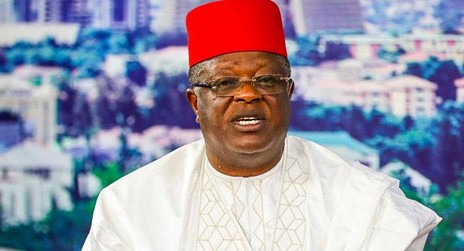
The federal government has promised that the proposed construction of the Abuja-Lagos Greenfield super highway which will be completed by 2027, is projected to last 100 years.
Disclosing this at a press briefing on Saturday, the minister of works, David Umahi, stated that the travel time to and from both locations on the 470 kilometres highway, will take just four and half hours if driving at 100 kilometres per hour speed, The Nation reports.
“When I first introduced this to the public, many doubting Thomases were saying ‘it is impossible, Lagos-Abuja that is done in 14 hours cannot be done in four and half hours’, that is the renewed hope of Mr President,” he said.
According to the former Ebonyi State governor, the road will be constructed entirely with concrete, rather than asphalt, which costs more.
He explained that the construction of the road will be executed by a private sector consortium at no cost to the government, adding that the consortium will operate the facility for a yet-to-be-determined period on a build, operate and transfer deal.
Mr Umahi noted that the road will be tolled at different points for the investors to recoup their investment.
Stating that the contractor should be on site in three months, the minister further stated that President Bola Ahmed Tinubu has “approved that I fast-track this project. This project is going to be two lanes but each lane is going to be a two-carriage way and it is going to be 14 metres.
“The only carriageway that is equivalent to this is the Third Mainland Bridge where each carriageway is 14 metres. It is going to be built on 275-millimetre thick concrete.
“The live-shelf design of this project is going to be 100 years. It is going to be completed within four years and this is doable. There are a number of bridges that will be built. There are a number of tolling points that are going to be there.
“We are not putting any kobo but we will assist them in every direction,” he explained further.
Recall that Mr Umahi had on Sunday, after a meeting with Mr Tinubu in Abuja, revealed that the FG was planning two super highways across the country through a Public Private Partnership scheme.

We have recently deactivated our website's comment provider in favour of other channels of distribution and commentary. We encourage you to join the conversation on our stories via our Facebook, Twitter and other social media pages.

More from Peoples Gazette

Agriculture
FG tasks ECOWAS on leveraging financing strategies for agroecology
The federal government has urged stakeholders in the agriculture and finance sectors in the West Africa region to leverage financing strategies to enhance agroecology practices

Politics
Katsina youths pledge to deliver over 2 million votes to Atiku
“Katsina State is Atiku’s political base because it is his second home.”

Heading 2
Ooni of Ife pays tribute to late elder brother, says his death created irreplaceable vacuum
The monarch prayed for the departed soul to rest in peace and for comfort for his immediate family, friends, business associates and everyone whose lives he impacted.
Africa
Information minister congratulates Ibietan on re-election as APRA scribe
Mr Idris described Mr Ibietan’s re-election as a well-deserved recognition of his professionalism.
States
Niger governor donates N100 million to IBBU’s College of Medicine, 41 pioneer medical students
Mr Bagana stated that the 41 pioneer medical students of the institution comprised 21 males and 20 females.

Politics
2027: Minister vows to mobilise one million votes for Tinubu, Radda in Katsina
Mr Rabe-Darma vowed to mobilise over one million votes for President Bola Tinubu and Governor Dikko Radda ahead of the 2027 elections.

Heading 5
Mamdani considers arresting Israeli PM Netanyahu if he visits New York
Mr Mamdani said his administration’s legal department is weighing the option of arresting the Israeli leader as determined by the law.

Lagos
LAWMA unveils reforms to end waste backlog in Lagos
He said conventional dumpsites were no longer sustainable because of Lagos’ coastal terrain, limited land availability and growing urban population.


