

Academics in UNILAG say insecurity could be surmounted through research
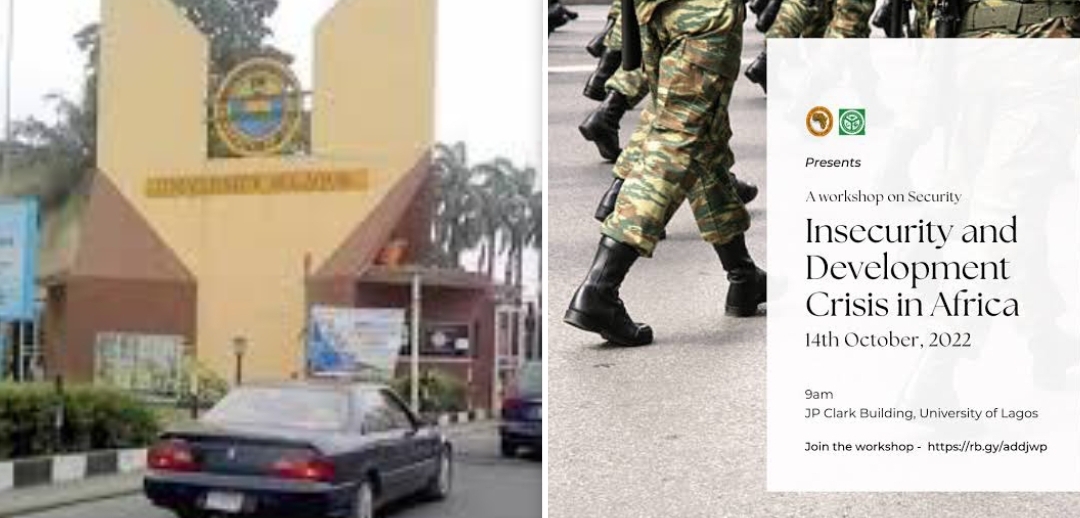
Members of the academia at a gathering on Friday at the University of Lagos challenged one another to pursue groundbreaking research to solve Nigeria’s security challenges.
The agreed that academics possess the capacity to find solutions if they properly channel their research skills.
Speakers and participants at the workshop themed: “Insecurity and Development Crisis in Africa” believed that more would be achieved in surmounting the challenges if their colleagues dug deeper through discussions and continuous research, rather than just write papers.
The event was organised by the Institute of African and Diaspora Studies, University of Lagos in collaboration with the Nigerian Institute of International Affairs.
In his keynote address, Isaac Olawale Albert, a professor of Peace, Security and Humanities at the University of Ibadan, said that there was a need for those in academia to begin to re-examine their activities.
“The issue of security is mind boggling currently and should give every serious-minded person or group of persons cause for concern,” Mr Albert said. “Our academic activities must become more development relevant.”
“Most of the time, we are more interested in doing things academically. We become professors, want people to be afraid of us and we end up like paper tigers,” he stated.
The don noted that the workshop was basically aimed at solving the challenges of insecurity in the Sahel and the Lake Chad regions, which were the two problematic regions that had faced deep seated security problems over time.
“So, what we are doing here is to take a physical look at the problems, reflect on how they can be managed, identify the gaps that we have to fill and probably at the end of the meeting, advise the government on the gaps that we have to fill.
“So, it is a development relevant academic engagement and why I am particularly interested in this meeting is that, most of us who teach in the universities, or most of us in the academia, most of the time, we engage in what we call monologue of the deaf.
“That is why I am very happy with this institute, for engaging in this type of discussion that could help the government, which is struggling to attend to several other contending issues.”
Mr Albert advised that the incoming administration must first arrest the general issue of insecurity in the country.
“We have issues of banditry, insurgency, herders crisis, kidnapping, ritual killings and many more, which have put fear in the residents. Government must deal with that.
“Another security problem we must deal with is this nagging problem of oil theft. It is a huge security problem.
“They have stolen so much that now, we are facing what we technically refer to as tragedy of the commons.
“Those who are stealing oil have stolen so much that they don’t even have enough oil to steal. They have taken so much that the capacity to even produce what they will steal is no longer there. This is a major security problem.
“The third is confidence building in this country. You know we no longer trust ourselves as a people and it has never been like this before.
“You know, this idea that we come to meetings and once a person is speaking in a language that does not go down well with us, we begin to suspect the person, is also disturbing,” he said.
The professor said that the incoming government had a lot of work to do and would need not less than three years to first bring about a state of stability, before the nation could start to achieve anything.
Professor Muyiwa Falaiye, Director, Institute of African and Diaspora Studies (IADS), University of Lagos, in his opening remark, noted that the workshop was to investigate the historical perspective of insecurity in Africa at large.
According to the professor of African Socio-Political Philosophy and expert in African and Diaspora Studies, it was also to explore the nexus between insecurity and development crisis and provide a platform for reappraisal of the elongated security challenges.
He said that the workshop would also seek to interrogate the diverse actions, reactions, and blueprints of community/state and concerned bodies toward achieving a secure region.
The don noted that it would also examine the mechanisms deployed in addressing insecurity and development crises and go ahead to recommend alternative security arrangements and blueprints for the development of the continent.
“It goes without saying that there are lots of crises in Africa as a whole and therefore, it is important for scholars and the academia to come together to find ways of ameliorating these issues, through general discuss such as this.
“So at the end of the workshop, we owe it a duty to the government to suggest solutions, find ways and means in resolving the crisis.
Mr Falaiye asserted that “we all know that military solution alone cannot help us and that is why we should come together and seek other means.”
Presenting his lead paper, Professor Joshua Bolarinwa of the Research and Studies Department, Nigerian Institute of International Affairs (NIIA), advised that an analysis of what makes a conflict intractable should be conducted at both the local and macro levels.
The lead paper, with the theme “Intractability of Insecurity in Africa; Issues and Lessons” suggested the need to consider the socio-political and economic contexts in such an issue.
According to him, Africa needs to proactively develop homegrown/indigenous solutions to its problems and champion an Africa-led response to complex regional security challenges with determination and political will.
(NAN)

We have recently deactivated our website's comment provider in favour of other channels of distribution and commentary. We encourage you to join the conversation on our stories via our Facebook, Twitter and other social media pages.

More from Peoples Gazette

Agriculture
FG tasks ECOWAS on leveraging financing strategies for agroecology
The federal government has urged stakeholders in the agriculture and finance sectors in the West Africa region to leverage financing strategies to enhance agroecology practices

Politics
Katsina youths pledge to deliver over 2 million votes to Atiku
“Katsina State is Atiku’s political base because it is his second home.”

Heading 5
ACF hails 19 northern governors for creating regional security trust fund
The chairman urged northern governors to sustain the political will behind the initiative

Heading 1
Canadian authorities charged two men for defrauding international students $126,000; hunt fleeing suspect
CBSA officers executed search warrants at the suspects’ homes and businesses, where electronic devices containing the evidence of their fraudulent activities were recovered.

Hot news Home top
Spain beat Belgium 2-1, face France in World Cup semi-finals Tuesday
The European champions move on to the semi-finals against back-to-back finalists France on Tuesday at Dallas Stadium.

NationWide
Focus on criminals, stop targeting journalists, CPJ tells Nigerian security agencies
She also pointed out harsh bail requirements imposed on journalists, describing Mr Ugagbe’s bail conditions as “utterly punitive.”

Education
Tinubu upgrades Nasarawa poly to university
Mr Onanuga said the approval followed a proposal by Senator Ahmed Aliyu, who represents the Nasarawa West Senatorial District.

Lagos
Lagos govt signs agreement to automate vehicle registration
Mr Osiyemi said the initiative would simplify and speed up vehicle registration by eliminating cumbersome processes.


