

ANEEJ demands transparency, recovery of N14 billion paid for Benin-Asaba road rehabilitation
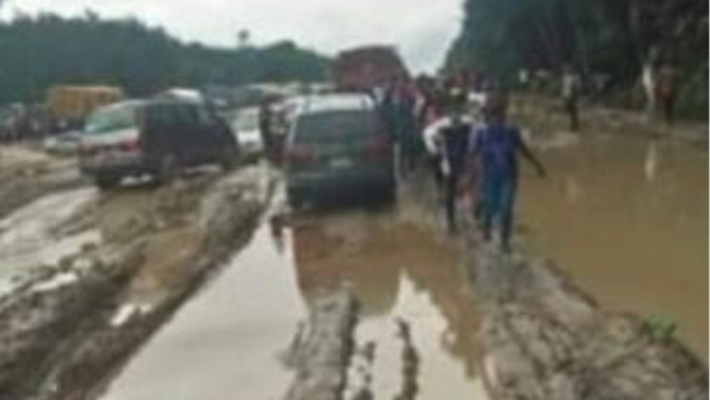
The Africa Network for Environment and Economic Justice (ANEEJ) has demanded a refund of over N14 billion allegedly paid to Hartland Nigeria Limited for work on the Benin-Asaba road corridor.
David Ugolor, executive director of ANEEJ and publisher of The Common Good Letter, made the demands at a news conference in Abuja on Monday and said the money should be refunded to the federal government.
Mr Ugolor said the demands aimed to ensure transparency, accountability, and the recovery of public funds allegedly committed to the project.
“We are particularly concerned by a recent statement by the Minister of Works, Senator Dave Umahi, that the federal government had paid about N14 billion to Hartland, a local firm, for the project.
“The minister also said that only about 40 per cent of the agreed work had been completed,” he said.
Mr Ugolor said the statements raised fundamental questions about the contract, payments, certification, and the level of work executed.
He stressed that the concerns were not allegations by ANEEJ but issues arising from facts the minister publicly stated.
“Our concern is that Nigerians are entitled to know exactly how N14 billion was committed, certified, paid and accounted for.
“We must distinguish between the contract value, the amount paid, the amount certified and the actual value of work delivered,” he said.
He said the organisation’s first demand was the publication of the contract documents, including the original Hartland contract, variations, supplementary agreements and the full scope of work.
Mr Ugolor said making the documents public would enable Nigerians to determine the scope, cost, completion period and performance obligations attached to the project.
“The original contract should not be a secret. If citizens do not know the scope of work, how do we measure performance or completion? We also demand the publication of the payment trail, including all payment certificates and details of payments made in relation to the project.
“The Federal Ministry of Works should disclose how much was paid, the dates of payments, the certificates against which the payments were made, who certified the work and who approved the payments.
“We also sought disclosure of the amount paid as mobilisation, subsequent payments and any balance that remained recoverable. The third demand was for an independent technical verification of the reported 40 per cent completion,” he said.
According to him, an independent assessment is necessary to establish whether the 40 per cent represented physical completion, financial completion, certified quantities, road length completed or a combination of the factors.
“We therefore call for qualified engineers to independently establish what was contracted, what was paid, what was certified, what was delivered and what remains outstanding.
“The fourth demand is for the publication of the status of the advance payment guarantee (APG) and recovery of public funds,’’ he added.
Mr Ugolor recalled that Mr Umahi had directed officials to call up the APG and write to the relevant banks to refund the money.
He said Nigerians needed to know the bank or institution that issued the guarantee, the amount covered, its expiration date, whether it had been formally called up and how much had been recovered.
“Our main interest is that the job is not done and we want the money to be returned to the treasury.
“The fifth demand is for an investigation into the complete chain of responsibility surrounding the contract,” he said.
Mr Ugolor called on the Economic and Financial Crimes Commission (EFCC) and the Independent Corrupt Practices and Other Related Offences Commission (ICPC) to examine the procurement, contract management, certification, payments, supervision and performance of the project.
“The Bureau of Public Procurement (BPP), the Code of Conduct Bureau and other competent authorities should join the probe.
“The investigation should establish who recommended the payments, who certified the work, who supervised the project, who approved variations and who authorised subsequent payments,” he said.
Mr Ugolor welcomed the minister’s directive to audit Hartland’s payment records and certificates across its projects but said the exercise should be conducted independently.
“You cannot be a judge in your own case; the review should not remain an internal administrative exercise, given the magnitude of the public interest involved.”
He said ANEEJ was not opposed to enforcement of the law but warned that arrest alone could not answer questions surrounding the N14 billion.
Mr Ugolor also called for the review of Hartland’s previous performance on federal government projects to determine whether its performance history was considered during subsequent procurement processes.
He said ANEEJ was not alleging that procurement laws were violated but wanted the BPP and Federal Ministry of Works to demonstrate that relevant provisions of the Public Procurement Act were followed.
He said poor infrastructure delivery imposed economic and social costs on Nigerians through increased transportation expenses, vehicle damage, delayed movement of goods and disruption of emergency services.
Mr Ugolor said ANEEJ had already submitted petitions to the EFCC, ICPC, BPP, Code of Conduct Bureau, the Office of the Attorney-General of the Federation, and the Minister of Justice.
“The Benin-Asaba road corridor is too important to become another unresolved infrastructure story,” he said.
(NAN)

We have recently deactivated our website's comment provider in favour of other channels of distribution and commentary. We encourage you to join the conversation on our stories via our Facebook, Twitter and other social media pages.

More from Peoples Gazette

States
Independence: NBA urges Nigerians to expect better future
The NBA said that ordinary Nigerians should be deriving benefit from the subsidy removal rather than hardship.

Agriculture
FG tasks ECOWAS on leveraging financing strategies for agroecology
The federal government has urged stakeholders in the agriculture and finance sectors in the West Africa region to leverage financing strategies to enhance agroecology practices

Politics
Katsina youths pledge to deliver over 2 million votes to Atiku
“Katsina State is Atiku’s political base because it is his second home.”

States
Gov Soludo intervenes in Anambra communal crisis
Mr Soludo summoned an emergency peace and security meeting with key stakeholders from the affected communities for Wednesday.

States
Gov Mutfwang condemns attacks on traders in Plateau
Mr Mutfwang condoled with the families and victims of the incident.

States
Ex-RTEAN chair, son remanded over murder in Ekiti
Mr Oriiyomi said the deceased was abducted by the defendants over a land dispute.
Education
Teachers’ Day: Provost, NAPTAN seek elevated status for teaching
Mr Azeez noted that the country remains among nations with low budget allocations to education.
States
Miners’ Deaths: FG donates N250 million to families of 37 victims
Mr Shettima conveyed the condolences of President Bola Ahmed Tinubu to the government and people of the state over the tragedy.
States
Troops rescue captives after bandits attack in Zamfara
The army said security forces have intensified operations to deny criminal elements freedom of movement.


