

China’s imports from Nigeria rose by $2.3 billion in six months: Envoy
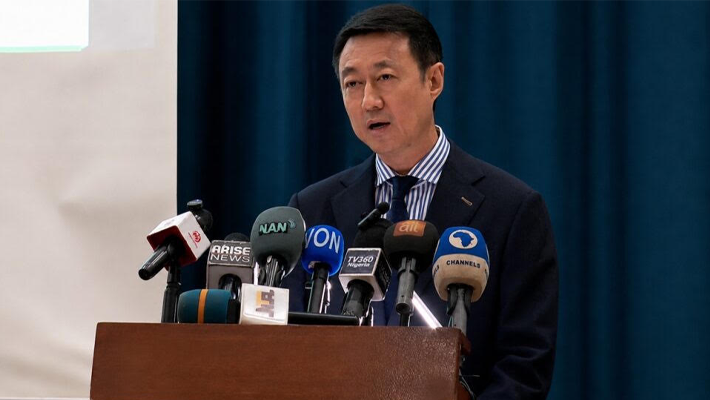
Chinese Ambassador to Nigeria, Yu Dunhai, says China’s imports from Nigeria rose by about 2.3 billion dollars in the first half of 2026, an increase of 80 per cent.
Mr Yu disclosed this during an international seminar on “China’s Zero-Tariff Measures and Africa’s Economic Structural Transformation”, organised by the Centre for China Studies (CCS) on Friday in Abuja.
According to him, the surge followed the implementation of China’s zero-tariff policy for African countries.
The ambassador said Nigeria-China bilateral trade also reached 18 billion dollars within the same period, representing a 35 per cent year-on-year increase.
He said the figures demonstrated the immediate impact of China’s zero-tariff policy, which took effect on May 1 and covers all 53 African countries with diplomatic relations with China.
“Chinese imports from Nigeria surged 80 per cent to 2.3 billion dollars, with monthly growth exceeding 40 per cent in both May and June,” Yu said.
According to him, the policy has already contributed to an estimated six per cent increase in overall African exports to China.
He said China-Africa trade reached a historic 207 billion dollars in the first half of 2026.
According to him, Chinese imports from Africa rose to 29 billion dollars in May and June alone, representing a 24 per cent year-on-year increase.
Mr Yu said the policy had reduced trading costs for Nigerian exporters, citing savings recorded on commodities such as sesame, cattle bone granules and liquefied propane.
“Every 100 tons of sesame exported saves 11,000 dollars in costs, while Nigeria’s annual export of 7,000 tons of cattle bone granules saves nearly 450,000 dollars,” he said.
He added that a single shipment of 23,000 tons of Nigerian liquefied propane attracted about 300,000 dollars in tax savings under the policy.
The envoy, however, noted that the removal of tariffs alone would not guarantee Nigeria’s economic transformation.
According to him, there is a need for improved product quality, reliable supply chains and local processing.
He urged Nigerian businesses to increase investment in value addition and meet Chinese market standards to sustain access to the country’s 1.4 billion consumers.
Mr Yu also called for stronger trade and investment cooperation, including industrial parks, technology transfer and training, saying China was ready to support Nigeria’s efforts to process raw materials locally.
“China aims to accelerate negotiations on trade facilitation, investment protection and quarantine standards to offer a stable institutional environment for investors,” he said.
He urged Nigerian exporters and small businesses to take advantage of platforms such as the China International Import Expo, Canton Fair and China-Africa Economic and Trade Expo to connect directly with Chinese buyers.
The Minister of Foreign Affairs, Bianca Ojukwu, said the zero-tariff policy was an opportunity to transform Nigeria from an exporter of raw materials into a producer of value-added goods.
“The objective should be to ensure that a greater proportion of the value generated from Africa’s resources remain within Africa,” the minister, represented by the ministry’s permanent secretary, Dunoma Ahmed, said.
Also speaking, the Minister of State for Agriculture and Food Security, Aliyu Abdullahi, said Nigeria must focus on exporting rather than merely exporting.
“The question before us is not, can Nigeria export more? The question should be, can Nigeria export better?” Mr Abdullahi said.
He identified processed cassava, premium rice, spices, hibiscus, cashew products, soybean products, fruits and vegetables as areas with significant export potential.
Abdullahi also said that Nigeria must complement tariff-free access with modern processing industries, efficient logistics, quality assurance, traceability, storage infrastructure and export certification.
The director of the centre, Charles Onunaiju, said the seminar was designed to move discussions on China’s zero-tariff policy from policy announcements to practical implementation.
He said the policy represented an opportunity for Africa to address structural economic challenges, but warned that African countries must develop strategies to fully exploit market access.
Mr Onunaiju said the African Continental Free Trade Area (AfCFTA) could play a critical role by harmonising standards, strengthening regional value chains and creating economies of scale for African exporters.
He said the seminar’s objective was to bring together critical stakeholders to identify practical solutions to challenges that could prevent African businesses from benefiting fully from the Chinese market.
Mr Onunaiju urged African countries to treat the zero-tariff policy as “a starting point” for deeper industrialisation rather than an end in itself.
The seminar brought together government officials, farmers, manufacturers, exporters, traders and other stakeholders to examine how African economies could maximise the new market access.
(NAN)

We have recently deactivated our website's comment provider in favour of other channels of distribution and commentary. We encourage you to join the conversation on our stories via our Facebook, Twitter and other social media pages.

More from Peoples Gazette

States
Independence: NBA urges Nigerians to expect better future
The NBA said that ordinary Nigerians should be deriving benefit from the subsidy removal rather than hardship.

Agriculture
FG tasks ECOWAS on leveraging financing strategies for agroecology
The federal government has urged stakeholders in the agriculture and finance sectors in the West Africa region to leverage financing strategies to enhance agroecology practices

Politics
Katsina youths pledge to deliver over 2 million votes to Atiku
“Katsina State is Atiku’s political base because it is his second home.”

States
Three siblings drag relative to court over alleged defamation
The defendant, through his counsel, M.K. Mustapha, denied the allegations.

NationWide
Regulations not to gag FinTech, digital assets operators: SEC
Mr Ajomale said the commission’s mandate was to manage risks and ensure financial system stability.

NationWide
ICRC supports NMCN to tackle violence in healthcare settings
Mr Alhassan expressed appreciation to the ICRC for its continued partnership and support.

NationWide
NIA condoles families of crashed NAF aircraft victims
Mrs Nwachukwu said, “Words are insufficient to convey the profound grief felt across our industry following this tragedy.”

NationWide
Psychiatrist urges FG to pay adequate attention to mental healthcare
The 2026 World Mental Health Day is with the theme, “Lived Experiences Heard: Real Voices, Real Change.”

States
Kano anti-graft commission gives retired civil servants 48 hours to vacate offices
Ms Ada’u-Kutama said the directive was to enforce the earlier circular issued by the Office of the Head of Civil Service in the state.


