

Court strikes out suit seeking to compel INEC to allow voting without PVCs
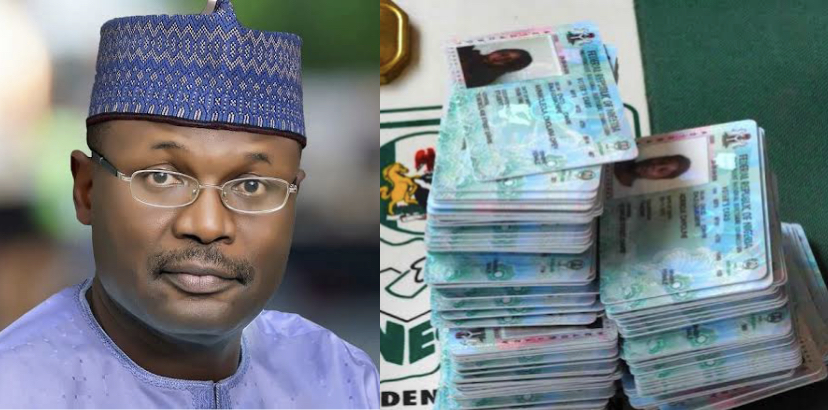
The Abuja Division of the Federal High Court on Tuesday struck out a suit seeking to compel INEC to allow the use of temporary voter cards or Voter Identification Numbers (VIN) in the 2023 general elections.
The Incorporated Trustees of the International Society for Civil Liberties and Rule of Law had dragged INEC to court seeking an order to compel it to allow voting without the Permanent Voter Cards (PVCs).
Emmanuel Chukwuka and Bruno Okeahialam led it.
The plaintiffs filed the suit in December 2022, alleging that if the court did not intervene, about 29 million registered voters would be disenfranchised in the 2023 general elections.
The plaintiffs asked the court to determine whether INEC could, as a consequence of its contraption, disenfranchise or deprive Nigerians of the right or opportunity to vote in the forthcoming general elections.
This, they said, was having regard to the true intention of Section 47(1) of the Electoral Act 2022.
In the suit marked FHC/ABJ/CS/2022, the plaintiffs asked the court to declare that having been duly registered, owners of the uncollected PVCs should be able to vote.
The plaintiff’s counsel, Max Uzoaka, prayed the court to declare that those registered with INEC as voters whose names were contained in the voters register should not be deprived of the right to vote.
The lawyer said INEC’s concept of “no PVC, no vote’’ would deprive eligible voters whose PVCs were burnt during attacks on INEC’s offices of the opportunity to vote during the elections.
He submitted that the Bimodal Voter Accreditation System, BVAS, was designed to read details of registered voters without PVCs since the Voter Identification Number (VIN) was captured on INEC’s database.
In his counter-argument, Abdulaziz Sani (SAN), counsel to INEC, prayed the court to decline jurisdiction on the matter because INEC had extended the deadline for collecting PVCs.
He also told the court that the plaintiff’s claim that BVAS could capture the last six digits of the VIN was a mysterious submission saying he was hearing it for the first time.
Delivering judgement, Justice Binta Nyako held that the suit was inchoate.
The judge reasoned that it was a “Catch-22’’ situation as, on the one hand, INEC was begging registered voters to take delivery of their PVCs.
On the other hand, affected potential voters claimed that their PVCs were not available for collection.
A Catch-22 is a seemingly absurd situation from which an individual cannot escape because of contradictory rules or limitations.
“Unless you give me a list of uncollected PVCs and a list of those who have registered but have not gotten their PVCs, then I can make a decision; if not, it remains a dicey situation,’’ the judge ruled.
She maintained that the suit amounted to an academic exercise since INEC had extended the date for registered voters to collect their PVCs, and the exercise was still ongoing.
Justice Nyako also held that the Electoral Act allowed INEC to deploy any technological device for the election and that INEC still had time to deploy the device to ensure that all eligible voters could vote.
She, however, said she would not dismiss the suit but only strike it out to allow the plaintiffs to re-file it if they had fresh and sufficient evidence.
“If INEC concludes the distribution of the PVCs it has, and you still have these 29 million voters you are representing who haven’t collected theirs, then bring back the suit,’’ the judge ruled.
(NAN)

We have recently deactivated our website's comment provider in favour of other channels of distribution and commentary. We encourage you to join the conversation on our stories via our Facebook, Twitter and other social media pages.

More from Peoples Gazette

States
Independence: NBA urges Nigerians to expect better future
The NBA said that ordinary Nigerians should be deriving benefit from the subsidy removal rather than hardship.

Agriculture
FG tasks ECOWAS on leveraging financing strategies for agroecology
The federal government has urged stakeholders in the agriculture and finance sectors in the West Africa region to leverage financing strategies to enhance agroecology practices

Politics
Katsina youths pledge to deliver over 2 million votes to Atiku
“Katsina State is Atiku’s political base because it is his second home.”

States
Police warn youths against blocking Kebbi-Sokoto highway
Mr Usman said the latest blockade disrupted vehicular movement for about three hours.

Africa
U.S. warns citizens travelling to South Africa over crime, terrorism, unrest
The acting national police commissioner said at least 10 vehicles were burnt in Johannesburg and 14 in Durban.

Economy
Nigeria’s $1 trillion economy depends on homegrown innovation, market access: NBTI DG
The DG said sustainable national prosperity cannot be achieved through government expenditure or natural resources alone.

NationWide
NBET begins N729 billion legacy debt payments to GenCos
Mr Odeyemi described the development as a significant milestone in implementing the debt reduction programme.
Africa
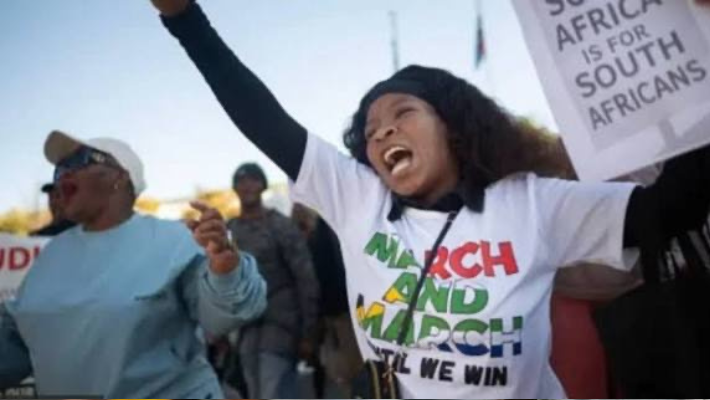
Anti-foreigner protests force South Africa to withdraw asylum seekers applications
The protests erupted over a Constitutional Court ruling easing access to asylum.

Heading 2
2028 Olympics: Super Falcons defeat Comoros 2-0 in first leg
The Nigerian team finally opened the scoring in the 48th minute with a tap-in by Michelle Alozie.


