


First batch of Gaza hostages expected to be released Friday

Delays are already affecting the start of a four-day ceasefire deal between Israel and Hamas to allow aid into Gaza and to free dozens of hostages, which was set to go into effect after nearly seven weeks of war.
The truce was due to begin on Thursday at 10am (0800 GMT) but the exact timing remained unclear as Israel had yet to say when it would pause its air and ground offensive in the coastal area.
An Israeli army spokesman said the process of returning hostages from the Gaza Strip to Israel is complex and not yet concrete.
The military is preparing the implementation of this first phase of the hostage exchange agreement, said Daniel Hagari late on Wednesday.
However, the repatriation of the people abducted to the sealed-off coastal strip could take time and take place in several stages, he said.
“The release (of hostages) will begin according to the original agreement between the parties, and not before Friday,” Israel’s security adviser Tzachi Hanegbi was quoted by newspapers Haaretz and the Times of Israel and the N12 channel as saying.
“The talks on the release of our hostages are progressing and will continue on an ongoing basis,” Mr Hanegbi said.
The first exchange of hostages kidnapped in Israel for Palestinian prisoners was initially expected to take place on Thursday.
The Times of Israel cited an Israeli official as explaining the delay by saying that both Israel and Hamas would have to sign a document ratifying the agreement for it to come into force.
Haaretz reported that Israeli officials had said there would be no halt to the fighting as long as there is no finalised timeline for the agreement with Hamas.
The agreement foresees 100 hostages being released from Gaza in exchange for 300 Palestinian prisoners held in Israel.
The Israeli Cabinet signed off on the deal early Wednesday after weeks of fraught negotiations mediated by Qatar and the United States.
The deal’s first step involves the release in stages of 50 Israeli women and children that have been held by militants in Gaza since the Oct
In a second step, up to 50 further Israeli hostages are also to be exchanged in small groups for up to 150 further Palestinian prisoners.
The ceasefire is to be accompanied by larger aid deliveries for the suffering civilian population in the Gaza Strip, where food, water, electricity, and medical supplies are running scarce.
Israel said the ceasefire will last at least four days but could be extended by one day for every additional 10 hostages released. A maximum of 10 days is planned for the entire exchange.
After that, the Israeli army’s fight against Hamas and other Islamist extremists in the Gaza Strip is to continue.
Terrorists from Hamas and other Palestinian militant groups carried out unprecedented massacres in southern Israel on October 7, killing around 1,200 people and taking around 240 people hostage.
Of the 240 people who were kidnapped and taken to Gaza, four women have so far been released by Hamas. One young soldier was rescued by the Israeli military.
The army also found the bodies of two people. It is unclear how many hostages are still alive. Local media reported Israel will pass on a first list of names of hostages to be released.
Kidnapped mothers and children were not to be separated. The Israeli government on Wednesday announced the names and details of the 300 imprisoned Palestinians who are eligible for release from prison.
On the list are 123 people under the age of 18, with the youngest being 14. According to the list, 33 prisoners are girls and women. They are accused of throwing firebombs, arson, and knife attacks, among other offences.
No prisoners serving time for murder are set for release. Once free, they are to return to the places where they lived before their imprisonment, such as the West Bank or East Jerusalem.
Shortly after the October 7 attack, Israel’s military launched airstrikes on the Gaza Strip and deployed ground troops with the aim of destroying Hamas. According to the Hamas-controlled Ministry of Health, more than 16,000 people have been killed so far.
The Israeli army said on Wednesday that soldiers have destroyed around 400 tunnel shafts since the start of the war.
Many of the tunnels used by Hamas were found under civilian hospitals, schools, and houses. The Palestinian Red Crescent said more patients are to be evacuated from the ruined al-Shifa Hospital in Gaza City.
Fourteen ambulances, accompanied by staff from the UN and Doctors Without Borders, arrived at the Gaza Strip’s biggest hospital on Wednesday.
Patients were to be taken to hospitals in the south, where conditions are relatively safer than in the north.
(dpa/NAN)

We have recently deactivated our website's comment provider in favour of other channels of distribution and commentary. We encourage you to join the conversation on our stories via our Facebook, Twitter and other social media pages.

More from Peoples Gazette

Agriculture
FG tasks ECOWAS on leveraging financing strategies for agroecology
The federal government has urged stakeholders in the agriculture and finance sectors in the West Africa region to leverage financing strategies to enhance agroecology practices

Politics
Katsina youths pledge to deliver over 2 million votes to Atiku
“Katsina State is Atiku’s political base because it is his second home.”

Opinion
Bola Tinubu’s presidency enters Kafka’s world
Appearance acquires greater authority than fact itself.

Politics
Abia, Anambra seek peaceful principles in boundary conflict resolutions
The governments of Anambra and Abia have vowed to apply principles of peaceful resolution to address the lingering interstate boundary disputes between them.

Abuja
Tinubu seeks stronger partnership with Rotary
Mr Tinubu has called for stronger collaboration between the Nigerian government and Rotary International in healthcare, education, youth empowerment and community development.
Port Harcourt
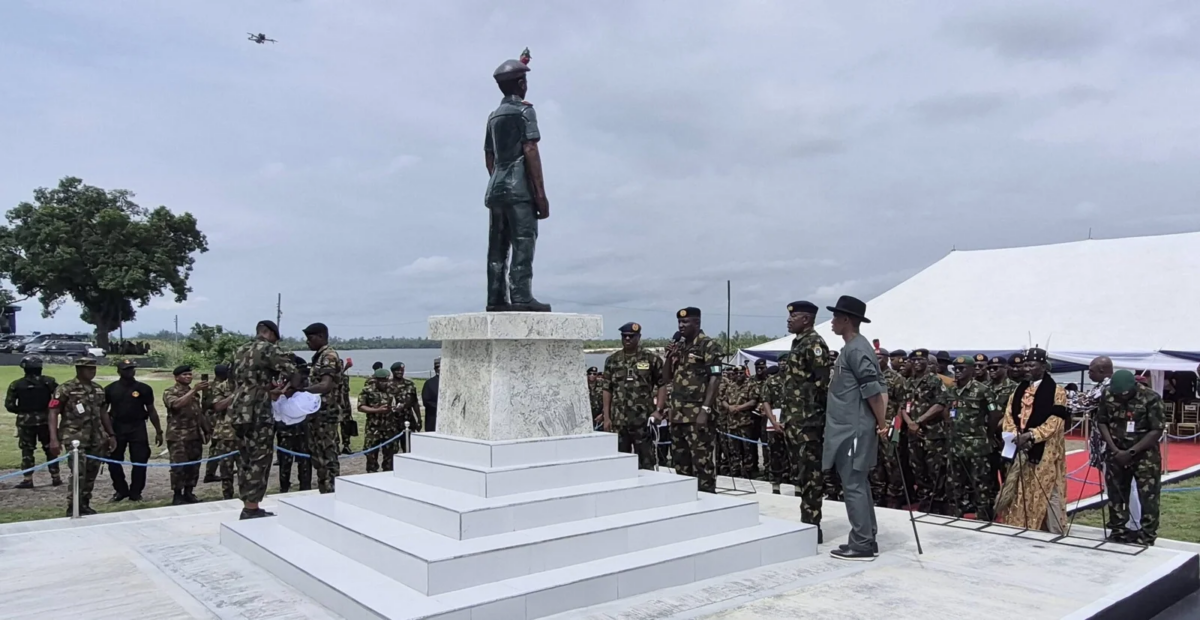
Army honours 11 cadets killed in training accident
Army chief Waidi Shaibu, on Sunday, unveiled a cenotaph in honour of 11 Nigerian Defence Academy naval cadets who died in a boat accident during training in 1990.

Economy
Coastal state governors urged to adopt AU fisheries framework
Coastal state governors have been urged to domesticate the African Union Policy Framework and Reform Strategy for Fisheries and Aquaculture.

States
Kano: Gov Yusuf spends N928 billion on community development projects
The Kano government says it has spent over N928 billion on the execution of 1,508 community development projects in the last three years of Governor Abba Yusuf’s administration.


