

Gender inequalities in agriculture cost world $1 trillion: FAO
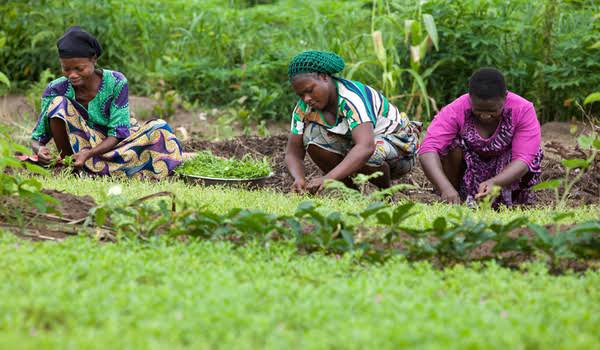
The UN’s Food and Agriculture (FAO), says gender inequalities in food and agriculture are costing the world over $1trillion, noting that levelling the playing field for women working in the sectors can bring growth and help feed millions.
Over one third of the world’s working women are employed in agrifood systems, which include the production of food and non-food agricultural products, as well as related activities from food storage, transportation and processing to distribution.
But in a new report published on Thursday, FAO says that gender inequalities such as less access for women to knowledge and resources, and a higher unpaid care burden, account for a 24 per cent gap in productivity between women and men farmers on farms of equal size.
Women employees in the agricultural sector are also paid nearly 20 per cent less than their male counterparts.
“If we tackle the gender inequalities endemic in agrifood systems and empower women, the world will take a leap forward in addressing the goals of ending poverty and creating a world free from hunger,” FAO Director-General Qu Dongyu, said in his foreword to the report.
According to FAO, closing the gender gap in farm productivity and the wage gap in agricultural employment would “increase global gross domestic product by nearly $1 trillion and reduce the number of food-insecure people by 45 million”, at a time of growing global hunger.
The report shows that women’s access to land, services, credit and digital technology lags behind men’s, while a higher burden of unpaid care limits their opportunities for education, training and employment.
FAO points out that discriminatory social norms reinforce gender barriers to knowledge, resources and social networks – holding women back from making an equal contribution in the agrifood sector.
“In many countries there still is much to do to ensure that women own land in equal proportion to men and that legal frameworks protect their rights,” the report says.
Its authors described as “alarming”, the slow pace of change in terms of women farmers’ access to ownership of livestock and essentials such as irrigation and fertilisers.
The report also notes that in agrifood systems, “women’s roles tend to be marginalised and their working conditions are likely to be worse than men’s – irregular, informal, part-time, low-skilled, or labour-intensive”.
According to the report, creating a level-playing field in terms of farm productivity and agricultural wages would add one per cent to global gross domestic product, or almost $1 trillion, and bring down food insecurity by two percentage points, benefitting 45 million people.
This is a striking projection at a moment when global hunger is on the rise. WFP estimates that more than 345 million people worldwide face crisis levels of food insecurity this year, an increase of almost 200 million since early 2020. Of these, 43 million are one step away from famine.
The report’s authors also show that agricultural projects which specifically empower women have broad economic and social benefits.
According to FAO, “If half of small-scale producers benefited from development interventions that focused on empowering women, it would significantly raise the incomes of an additional 58 million people and increase the resilience of an additional 235 million”.
The scale of women’s employment in agrifood systems in some developing countries points to the potential impact that equality-boosting interventions could have.
For instance, in southern Asia, 71 per cent of all working women are employed in the sector (versus 47 per cent of men).
FAO points out that monitoring and accelerating progress on gender equality in agrifood systems hinges on “the collection and use of high-quality data, disaggregated by sex, age and other forms of social and economic differentiation”, which is currently lacking, as well as rigorous gender research.
On a policy level, the report’s authors recommend urgent action to close gaps related to access to assets, technology and resources.
They say that improving women’s productivity in the agrifood sector requires interventions which “address care and unpaid domestic work burdens, provide education and training, and strengthen land-tenure security.
FAO also advocates for social protection programmes which have shown to increase women’s employment and resilience.
Indeed, the UN agency’s study underscores that when economies shrink, women’s jobs go first, as has been the case during the COVID-19 pandemic.
(NAN)

We have recently deactivated our website's comment provider in favour of other channels of distribution and commentary. We encourage you to join the conversation on our stories via our Facebook, Twitter and other social media pages.

More from Peoples Gazette

States
Independence: NBA urges Nigerians to expect better future
The NBA said that ordinary Nigerians should be deriving benefit from the subsidy removal rather than hardship.

Agriculture
FG tasks ECOWAS on leveraging financing strategies for agroecology
The federal government has urged stakeholders in the agriculture and finance sectors in the West Africa region to leverage financing strategies to enhance agroecology practices

Politics
Katsina youths pledge to deliver over 2 million votes to Atiku
“Katsina State is Atiku’s political base because it is his second home.”
Health
HERFON to unveil two-volume book on non-communicable diseases
HERFON says it will unveil a two-volume book on non-communicable diseases on October 15 in Abuja, alongside free health screening for participants.

World
Beijing’s 12345 hotline sets pace in citizen-centred urban governance
Beijing 12345 Hotline Citizen Service Centre is emerging as a model of technology-driven urban governance, placing residents’ needs at the centre of public service delivery.

Anti-Corruption
Uche Nnaji drops forged NYSC certificate, submits only WAEC result to INEC for governorship election
Mr Nnaji’s corruption trial will resume on October 26 as the ICPC seeks his conviction for forging his NYSC and UNN degree certificates.

Opinion
Abdul Mahmud: When the ruling party needs guns to win election
No president should need an AK-47 to win an election, and no ruling party should need the threat of one to persuade Nigerians to vote for its candidate.

World
Heavy social media use linked to lower life ratings among youths in 16 countries: Gallup
“What stands out is that moderate social media use for adults is associated with better outcomes on many wellbeing measures,” said Gallup chief.

States
Sokoto govt donates N38 million, grains to families of fallen heroes
The Sokoto government donated N38.25 million and bags of grains to the families of 24 fallen soldiers and 57 injured personnel in recognition of their sacrifices in service.


