

Institute urges oil firms to strengthen financial discipline

The Chartered Institute of Treasury Management has urged oil and gas companies in Nigeria to enhance their financial management systems and adopt prudent treasury practices to prevent insolvency.
The call follows the receivership of Nestoil Limited, whose Lagos headquarters was sealed after a Federal High Court order permitted creditors to take possession of its assets.
The enforcement, backed by a Mareva injunction, also affected Neconde Energy Limited and its stake in Oil Mining Lease 42, with outstanding liabilities reportedly exceeding $1.01 billion and N430 billion.
Daniel Akeju, a researcher and advocate for treasury policy guidelines at the institute, said in a statement on Thursday that the development had sent shockwaves through the oil and gas sector.
According to him, it exposed systemic weaknesses in treasury governance, liquidity planning, and financial risk management.
“This development serves as a critical warning to operators in a capital-intensive and volatile sector such as oil and gas,” he said.
He explained that, despite the industry’s exposure to global price shocks, disciplined and professionally structured treasury systems remained the foundation of financial stability.
He noted that successful oil companies often maintained rolling liquidity forecasts, conducted scenario-based stress tests, and sustained reserve buffers.
“Ignoring these fundamentals leaves firms vulnerable to price fluctuations, production delays, and cash flow disruptions. Liquidity planning must align with market volatility, or the organisation risks collapse. Sustainable treasury management requires constant debt sustainability analysis, covenant monitoring, and proactive refinancing. When borrowing outpaces cash inflow, insolvency becomes only a matter of time,” he said.
He emphasised the need for treasury functions to report directly to boards and risk committees to ensure proper oversight of funding strategies and exposure management.
“A governance gap allows financial stress to grow unnoticed until it becomes a crisis; that is precisely what happened in this case,” he said.
He explained that receivership was often a last resort, triggered by eroded trust between borrowers and lenders.
“When communication weakens and debt restructuring is delayed, confidence deteriorates. Treasury officers must maintain transparency with banks and investors to preserve trust,” he said.
Mr Akeju also identified a lack of embedded risk controls in the sector, including commodity price hedging, foreign exchange management, and production-linked financial simulations.
“Without these buffers, firms are left at the mercy of unpredictable global forces beyond managerial control,” he added.
He urged oil firms to reposition treasury management as a strategic survival function rather than a mere administrative unit. According to him, key focus areas should include liquidity resilience, debt governance, transparency, governance oversight, and market risk mitigation.
“Investments should be driven by measurable returns, not prestige-driven expansion. Treasury governance must promote operational realism,” he said.
Mr Akeju stressed that the Nestoil case should serve as a warning to all upstream, midstream, and downstream operators, particularly indigenous firms dependent on leveraged financing.
“Financial sustainability in today’s oil and gas sector is no longer defined by asset size or project volume. It is defined by treasury discipline, governance integrity, and strategic liquidity management,” he said.
He said the Nestoil receivership underscored the urgent need for structured treasury systems, sustainable financing frameworks, and transparent lender engagement.
“In an industry where fortunes can change overnight, treasury leadership is not optional. It is indispensable,” Mr Akeju stated.
(NAN)

We have recently deactivated our website's comment provider in favour of other channels of distribution and commentary. We encourage you to join the conversation on our stories via our Facebook, Twitter and other social media pages.

More from Peoples Gazette

States
Independence: NBA urges Nigerians to expect better future
The NBA said that ordinary Nigerians should be deriving benefit from the subsidy removal rather than hardship.

Agriculture
FG tasks ECOWAS on leveraging financing strategies for agroecology
The federal government has urged stakeholders in the agriculture and finance sectors in the West Africa region to leverage financing strategies to enhance agroecology practices

Politics
Katsina youths pledge to deliver over 2 million votes to Atiku
“Katsina State is Atiku’s political base because it is his second home.”

World
Ebola: UK alerts citizens over travel to Nigeria
Nigeria recorded its first Ebola virus case on October 20, 2026.

States
Delta funding 2026 projects without new borrowing, says commissioner
The commissioner attributed the approach to fiscal discipline and improved revenue generation.
States
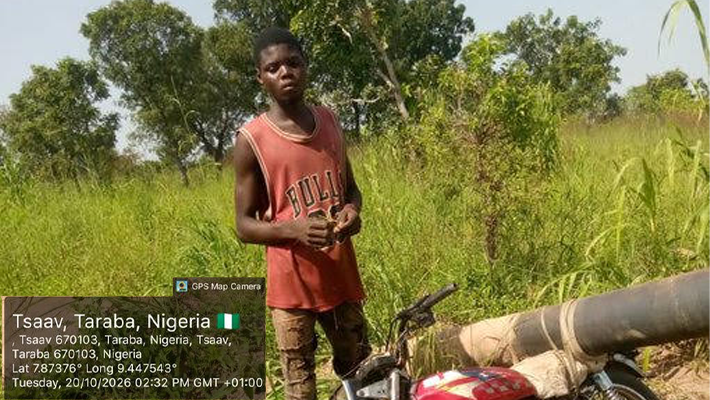
Troops foil pipeline vandalism, nab suspect in Benue
Mr Zubairu stated that the suspect attempted to transport a section of the pipeline.
Politics
2027: Igbo group endorses Obi’s candidature
The group said it had painstakingly appraised all the frontline presidential candidates.

Education
UNICEF, Airtel join forces to bolster digital inclusion
Ms Prah expressed satisfaction with the participation of girls in digital learning.

World
Ilhan Omar may be jailed if found guilty of immigration fraud: Trump
The Somali born-American politician, Ms Omar accused Mr Trump of weaponsising law enforcement agents.


