

Iran to announce restricted zone outside Strait of Hormuz

Iran on Monday said it would announce a restricted zone outside the Strait of Hormuz in the coming days.
Mohsen Rezaei, Secretary of Iran’s Supreme National Security Council, said any ship attempting to pass through the zone would be placed on Tehran’s sanctions list.
Speaking in a recent interview with state-run IRIB TV, he said the zone would stretch from “the line where the U.S. naval blockade begins to the Strait of Hormuz region and inside the Persian Gulf on the other side (of the strait).”
He said vessels entering the zone without prior coordination with Iran would face sanctions affecting their insurance coverage and future passage through the waterway.
According to Mr Rezaei, the measure formed part of a broader strategic shift in Iran’s approach to war and diplomacy aimed at increasing pressure on Washington.
He insisted that the Strait of Hormuz remained completely closed, dismissing U.S. claims that ships and oil tankers were crossing the waterway as a “lie”.
Mr Rezaei said some vessels had attempted to cross the strait through a route near Oman, with some switching off their navigation systems to avoid detection.
He said most of the vessels receive blows, adding that Iran had no intention of sinking them for now due to environmental concerns.
The Iranian official also disclosed that Iran had, for the first time, test fired a domestically developed anti-destroyer missile over a U.S. aircraft carrier 48 hours earlier.
He described the test as a warning that the U.S. naval blockade was vulnerable.
“The special missile created hell for the Americans, and they fled,” Mr Rezaei said.
Mr Rezaei said the Strait of Hormuz would remain closed until the United States took practical steps to fulfil its obligations under a peace memorandum of understanding signed by Tehran and Washington in June.
He added that Iran and Oman would announce a new international corridor for passage through the strait in the coming days.
The corridor, he said, would be managed by Iran.
Following U.S.-Israeli strikes on Iran on February 28, Tehran restricted passage through the Strait of Hormuz, while U.S. forces imposed a naval blockade targeting vessels travelling to or from Iranian ports and coastal areas.
(Xinhua/NAN)

We have recently deactivated our website's comment provider in favour of other channels of distribution and commentary. We encourage you to join the conversation on our stories via our Facebook, Twitter and other social media pages.

More from Peoples Gazette

States
Independence: NBA urges Nigerians to expect better future
The NBA said that ordinary Nigerians should be deriving benefit from the subsidy removal rather than hardship.

Agriculture
FG tasks ECOWAS on leveraging financing strategies for agroecology
The federal government has urged stakeholders in the agriculture and finance sectors in the West Africa region to leverage financing strategies to enhance agroecology practices

Politics
Katsina youths pledge to deliver over 2 million votes to Atiku
“Katsina State is Atiku’s political base because it is his second home.”
States
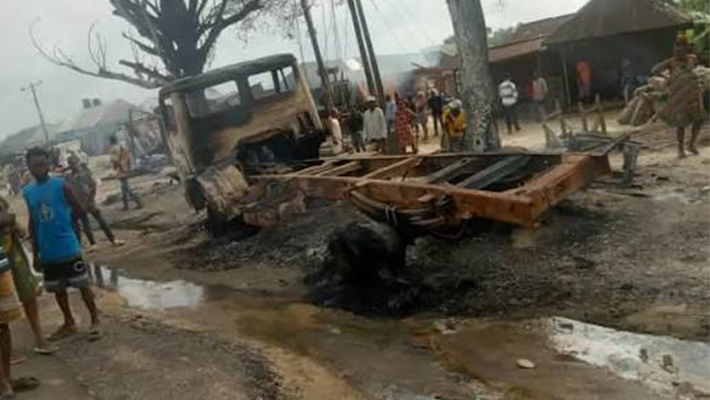
Tanker Fire: Police confirm one death in Cross River
Police said the tanker was involved in a road traffic accident before it overturned and caught fire.

States
Bauchi police arrest two for allegedly assaulting officers on duty
The incident occurred around 9:00 a.m. on Saturday.

World
Gaza: American actress Angelina Jolie shares satellite images of destruction, demands urgent aid
The war in Gaza has resulted in catastrophic losses and widespread displacement.

NationWide
Anyim seeks inclusive technology to curb inequality
Mr Anyim challenged institutions and professionals to develop strategies to harness technological advancement.

Heading 2
UNIZIK introduces digital clearance, certificate systems to reduce graduation delays
The vice-chancellor said the university had also digitised its transcript processing system.
Health
Study links 2.3 million global cancer cases to infections in 2024
The researchers said the findings underscored the importance of infection control in cancer prevention.


