

Lack of data, shelter for survivors responsible for rising gender-based violence in Anambra: Group
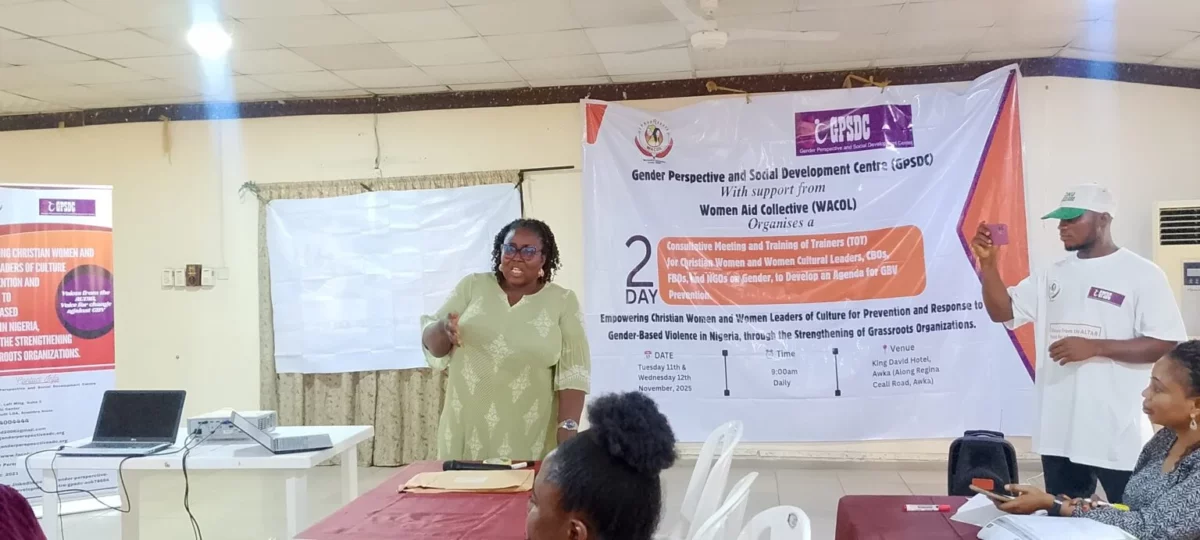
The Gender Perspective and Social Development Centre (GPSDC) has identified the lack of data and shelter for survivors as key factors fuelling rising cases of gender-based violence in Anambra State.
The Executive Director of GPSDC, Eucharia Anekwe, stated this in Awka on Wednesday during the opening of a two-day training aimed at building community capacity in tackling GBV.
The training is themed, “Empowering Christian Women and Women Leaders of Culture for Prevention and Response to Gender-Based Violence in Nigeria, through the Strengthening of Grassroots Organisations.”
Ms Anekwe said the absence of reliable data and shelters weakens prevention, protection, and prosecution mechanisms, allowing GBV to persist and escalate.
She stated, “Without GBV data, policymakers cannot gauge the scale of abuse, allocate resources effectively, or design interventions. These have allowed many cases to go unreported and perpetrators to act with impunity. Without safe shelters, survivors are often forced to return to their abusers, leaving them trapped and vulnerable to repeated or more severe violence.’’
Ms Anekwe laments that Anambra State has only one sexual assault referral centre, which she describes as inadequate.
“By the time a survivor reaches the referral centre, evidence may have been tampered with due to the long distance,” she said.
She commended the ministry for women and social welfare for its efforts in the fight against GBV in the state.
Meanwhile, the training is supported by the Women Aid Collective (WACOL).
The Founder, Shoulder for Gender Support and Development, Chioma Okeke, blamed the high rate of rape and sexual assaults on poor parenting.
“As parents, we have focused so much on raising the girl child to build her confidence, competence, and self-worth, making her less vulnerable to abuse. We have neglected instilling proper morals and responsibility in our sons, and now we see the consequences. Many lack self-control. To address this societal problem, the change must begin from the home,” she said.
However, the Programme Manager of GPSDC, Oge Ozoemena, said certain cultural practices and religious interpretations contribute to gender inequality.
“The project seeks to harness cultural and religious platforms to drive positive social change by engaging Christian communities and women leaders,” she said.
(NAN)

We have recently deactivated our website's comment provider in favour of other channels of distribution and commentary. We encourage you to join the conversation on our stories via our Facebook, Twitter and other social media pages.

More from Peoples Gazette

Agriculture
FG tasks ECOWAS on leveraging financing strategies for agroecology
The federal government has urged stakeholders in the agriculture and finance sectors in the West Africa region to leverage financing strategies to enhance agroecology practices

Politics
Katsina youths pledge to deliver over 2 million votes to Atiku
“Katsina State is Atiku’s political base because it is his second home.”

Lagos
Lagos residents decry soaring corn prices
A corn trader, Justina Odion, blamed the high retail price on increased wholesale costs.
NationWide
Afam Okeke wins NBA general secretary election with 8,478 votes
The live results portal showed that a total of 82,167 voters were accredited for the general election held on Saturday.

States
Tinubu is pillar of my infrastructural development: Gov Sani
The governor said that the N1 trillion Light Rail Project will commence in the next two months.

States
Troops foil abduction of Borno female students
He said that the terrorists reportedly gained access to the facility with the assistance of suspected collaborators

Rights
Civil society organisations key to strengthening Nigeria’s democracy: CDHR
He said civil society organisations serve as a bridge between the government and the people.

NationWide
2027: Nigeria won’t drift into one-party state, says LP presidential candidate
Mr Okereke described the one-party state narrative as a mere political construct.


