

Lagos Flooding and the Coastal Highway: Separating facts from fiction
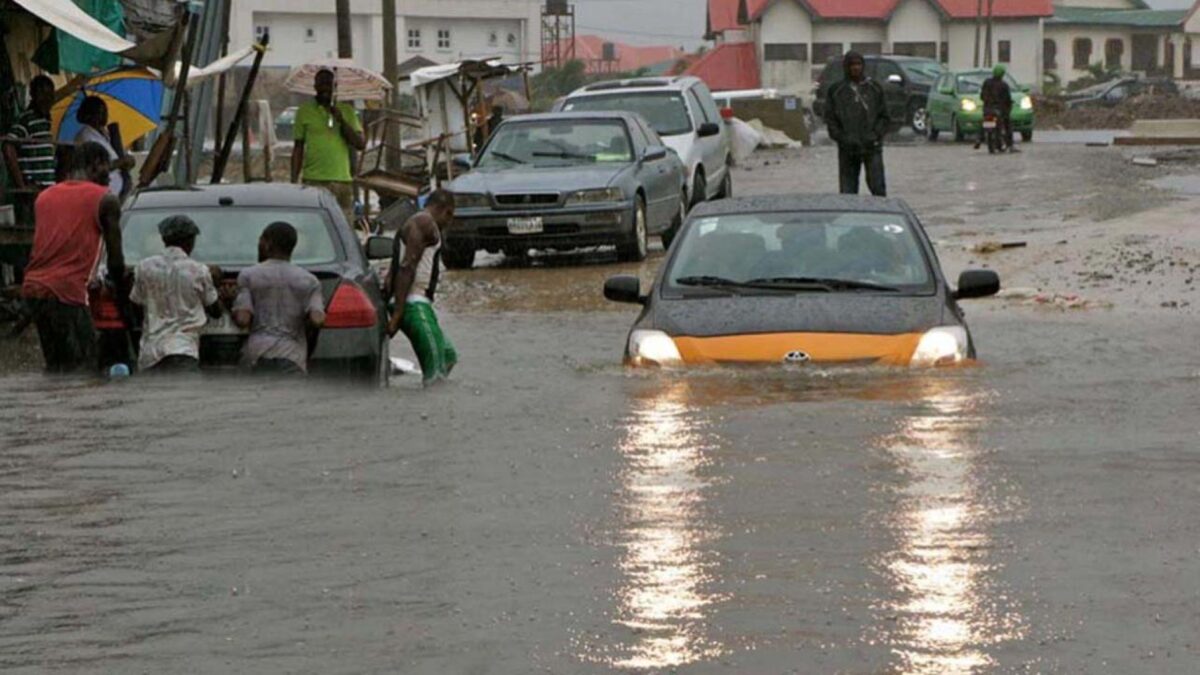
Every rainy season, Lagos floods. And every rainy season, the same debate returns.
The Lagos–Calabar Coastal Highway is blamed for virtually every flood event—from Victoria Island to Lekki, Ajah, and even communities far beyond the project corridor. Social media amplifies dramatic images, commentators draw sweeping conclusions, and before long, opinion begins to replace evidence.
The challenge is not that people ask difficult questions. They should. Major infrastructure projects deserve scrutiny. The real challenge is that public debate increasingly relies on assumptions rather than science.
If Nigeria is to make better infrastructure decisions, we must distinguish between correlation and causation.
Lagos was flooding long before the coastal highway
One of the most persistent myths is that flooding in Lagos is a new phenomenon created by the Coastal Highway. History tells a very different story.
Flooding has affected Lagos for decades. Historical records, engineering studies, government reports and environmental assessments consistently document recurrent flooding across Lagos Island, Victoria Island, Ikoyi, Lekki, Ajegunle, Surulere, Agege, Mushin, Oshodi, Ikorodu and many other communities long before construction of the highway commenced.
The reasons are well understood. Lagos occupies one of the world’s largest coastal wetland systems. Much of the city sits only a few metres above sea level. Large portions are naturally floodplains, lagoons, marshes and reclaimed land.
In simple terms, Lagos was built on land that naturally stores water. No highway created that reality.
Climate change is making an existing problem worse
Climate change has undoubtedly increased flood risk. Rainfall events are becoming more intense.Sea levels continue to rise. Storm surges are becoming more frequent.
High tides increasingly coincide with heavy rainfall, reducing drainage systems’ ability to discharge stormwater into the Lagos Lagoon.
This phenomenon, often called tidal locking, is now recognised globally in low-lying coastal cities.
When the receiving water body is already at an elevated level, even well-designed drainage systems can temporarily lose efficiency. This is a climate problem, not simply an infrastructure problem.
The real drainage challenge
Another misconception is that flooding automatically means drainage has failed. Not necessarily. Drainage systems are designed for specific storm events.
When rainfall exceeds design capacity, temporary flooding is expected even in highly developed countries. More importantly, drainage systems function as networks.
If downstream channels are blocked by waste, illegal developments, sediment accumulation or encroachment, upstream sections cannot perform effectively.
This explains why some Lagos communities experience repeated flooding despite having drainage infrastructure. Engineering alone cannot solve what is fundamentally a governance, maintenance and land-use challenge.
What an ESIA actually does
Environmental and Social Impact Assessments (ESIAs) are often misunderstood. Many assume that an approved ESIA guarantees that no environmental impacts will occur. That is not its purpose.
An ESIA identifies potential impacts, evaluates their significance, proposes mitigation measures, establishes monitoring requirements and recommends adaptive management throughout construction and operation. It is a risk management instrument—not a promise of zero impact.
This distinction matters because complex infrastructure projects inevitably create temporary environmental disturbances. The relevant question is not whether impacts exist. It is whether they have been identified, assessed and are being managed appropriately.
Can the highway influence local flooding?
Yes. Construction activities can temporarily alter local drainage patterns if not properly managed.
Temporary diversions, excavation works, stockpiles, construction traffic or blocked drainage channels may create localised flooding during construction. These are recognised engineering risks.
Responsible contractors are expected to monitor, mitigate and rectify such issues promptly. However, these localised construction impacts should not be confused with the broader hydrological dynamics that drive flooding across metropolitan Lagos.
A flooded street several kilometres from the project corridor cannot automatically be attributed to the highway without hydrological evidence. Science demands more than coincidence.
The need for evidence-based debate
Infrastructure projects of this scale deserve independent monitoring. Government agencies should continue publishing environmental monitoring results. Contractors should maintain transparency. Communities should report genuine concerns.
Researchers should independently assess environmental performance. Constructive criticism improves projects. But criticism should be based on data rather than speculation. Public confidence grows when evidence—not emotion—guides discussion.
The bigger picture
The coastal highway is ultimately one project within a much larger urban system. Whether it succeeds environmentally will depend not only on its engineering design but also on broader investments in integrated flood management, drainage rehabilitation, wetland conservation, solid waste management, urban planning and climate adaptation.
No single road can solve Lagos flooding. Equally, no single road can reasonably be blamed for every flood experienced across a rapidly growing coastal megacity of more than twenty million people. That is simply not how hydrology works.
Moving beyond myths
Nigeria needs better conversations about infrastructure. They should ask difficult questions, demand transparency, and insist on rigorous environmental standards while holding developers accountable.
But Nigerians should also recognise that good public policy depends on facts.
Flooding in Lagos is a complex interaction of geography, geology, climate change, urbanisation, land-use decisions, drainage management and coastal processes.
Reducing that complexity to a single explanation may make for compelling headlines, but it does little to solve the problem. Evidence—not assumptions—must remain the foundation of both public debate and public policy.

Dr Eugene Itua is an environmental and infrastructure governance specialist whose work focuses on climate resilience, environmental assessment, sustainable infrastructure, and evidence-based public policy.

We have recently deactivated our website's comment provider in favour of other channels of distribution and commentary. We encourage you to join the conversation on our stories via our Facebook, Twitter and other social media pages.

More from Peoples Gazette

States
Independence: NBA urges Nigerians to expect better future
The NBA said that ordinary Nigerians should be deriving benefit from the subsidy removal rather than hardship.

Agriculture
FG tasks ECOWAS on leveraging financing strategies for agroecology
The federal government has urged stakeholders in the agriculture and finance sectors in the West Africa region to leverage financing strategies to enhance agroecology practices

Politics
Katsina youths pledge to deliver over 2 million votes to Atiku
“Katsina State is Atiku’s political base because it is his second home.”

Economy
Lagos butchers seek land for Eko Ranches, plan pilot scheme
The Lagos State Butchers Association says it is seeking approval to begin a pilot ranching scheme at Oko-Oba Abattoir while awaiting land for Eko Ranches.

World
Five Nigerians appointed to UN information system consultation group
Five Nigerians have been appointed to the 92-member Multistakeholder Consultation Group of the United Nations Group on the Information Society.
States
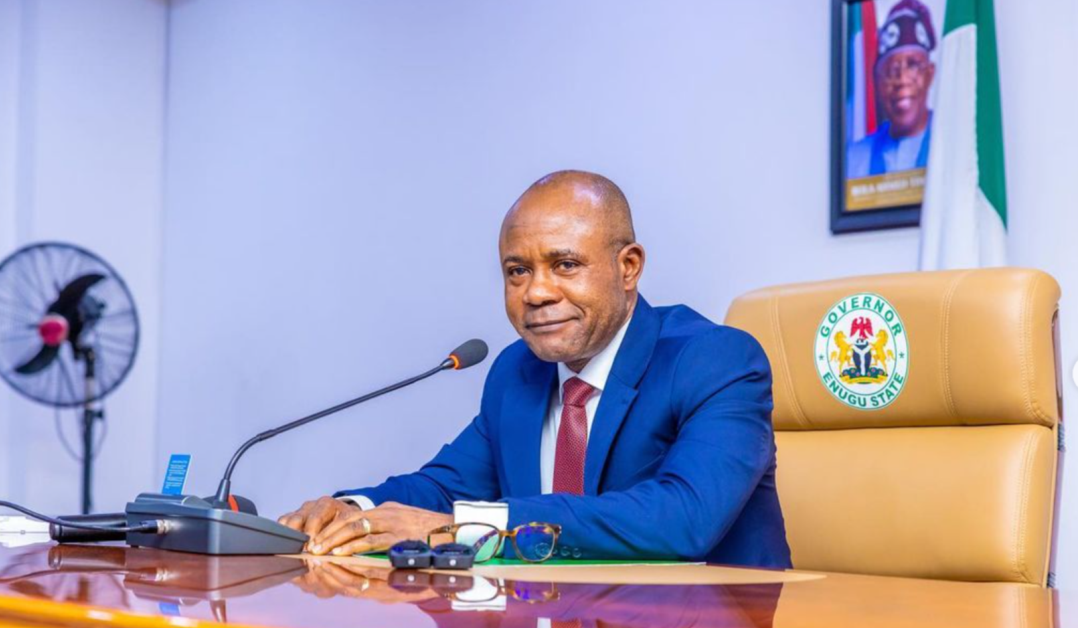
Mbah inaugurates multibillion-naira pharmaceutical company in Enugu
Governor Peter Mbah has inaugurated Anchorage Pharmaceutical Industries Limited, a multibillion-naira pharmaceutical company in Trans-Ekulu, Enugu.

Maiduguri
Shettima arrives in Maiduguri to inaugurate projects
Vice-President Kashim Shettima has arrived in Maiduguri, Borno, to inaugurate Kashim Ibrahim University Teaching Hospital, a hostel, and 104 staff housing units.
Abuja
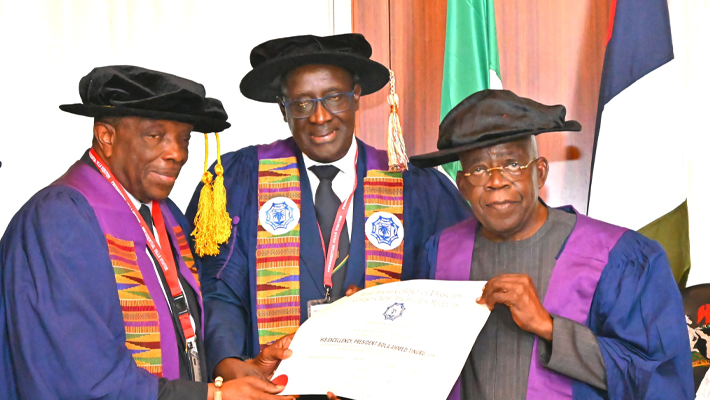
Tinubu receives medical fellowship from WACP
Mr Tinubu said his government was committed to championing comprehensive health sector reforms to make healthcare delivery more accessible and affordable.
Economy
Women-led businesses targeted as DBN, AfDB sign $61 million financing agreement
The Development Bank of Nigeria has signed a $61 million gender-focused financing agreement with the African Development Bank to support women-led businesses.


