

NAFDAC seizes 10,000 cartons of fake goods
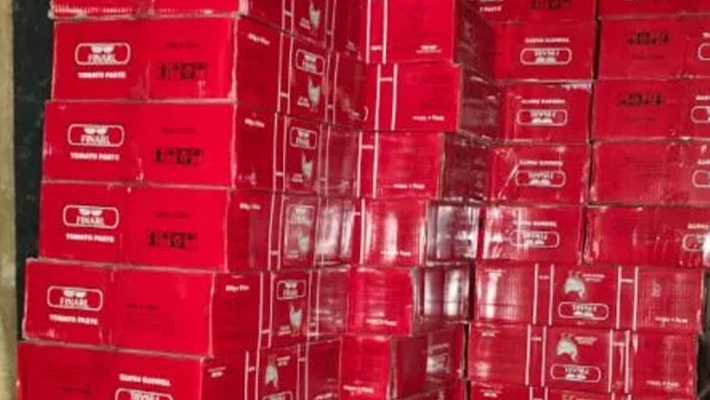
The National Agency for Food and Drug Administration and Control says over 10,000 cartons of unregistered tomato paste and cosmetic products were seized at the Lagos Trade Fair Market.
The five-day operation was conducted by NAFDAC’s Investigation and Enforcement team at the cosmetics section of the market.
Martins Iluyomade, NAFDAC’s director of Investigation and Enforcement, told journalists on Tuesday that the raid was part of ongoing efforts to remove unregistered and harmful products from the Nigerian market.
He said, “We seized over 10,000 cartons of unregistered tomato paste, as well as cosmetics such as creams, soaps, body sprays, washes, air fresheners, and toothpaste. We cannot guarantee the safety of these seized products because they have not undergone any regulatory scrutiny.
“One way to safeguard public health is to remove harmful products from markets before they can kill unsuspecting Nigerians. I can say authoritatively that deaths from substandard medicines, cosmetics, and unsafe foods exceed the number of people killed by Boko Haram.
“This is why the agency remains committed to ensuring Nigerians use only products that have passed regulatory processes, assuring safety and effectiveness.”
The director stated that a newly inaugurated multi-agency task force would enhance NAFDAC’s surveillance against substandard medicines and unsafe processed foods nationwide.
He added that the agency’s partnership with the Nigeria Customs Service to strengthen border control was yielding results.
“We are working hard to prevent falsified and unregistered items from entering the country, hence our memorandum of understanding with the Nigeria Customs Service. The Nigeria Customs Service has handed over many seized fake products to us, and we have also transferred some to them,” he added.
Mr Iluyomade urged Nigerians to use NAFDAC’s decentralised registration process to verify and register their products. He reaffirmed NAFDAC’s commitment to eliminating the country’s unregistered, substandard, and expired products.
(NAN)

We have recently deactivated our website's comment provider in favour of other channels of distribution and commentary. We encourage you to join the conversation on our stories via our Facebook, Twitter and other social media pages.

More from Peoples Gazette

States
Independence: NBA urges Nigerians to expect better future
The NBA said that ordinary Nigerians should be deriving benefit from the subsidy removal rather than hardship.

Agriculture
FG tasks ECOWAS on leveraging financing strategies for agroecology
The federal government has urged stakeholders in the agriculture and finance sectors in the West Africa region to leverage financing strategies to enhance agroecology practices

Politics
Katsina youths pledge to deliver over 2 million votes to Atiku
“Katsina State is Atiku’s political base because it is his second home.”

Sport
2027 AFCON Qualifier: Guinea-Bissau beat Madagascar, extend lead over Nigeria in Group L
Guinea-Bissau now have 10 points, Nigeria seven points, while Madagascar and Tanzania have two points each.

Africa
WHO raises concern over rising Bundibugyo Ebola deaths, insecurity in DR Congo
Mr Ghebreyesus said the outbreak, declared six months ago, had spread across 67 health zones in eight provinces in the DR Congo.

Africa
Afreximbank urges industries to boost intra-African trade as alternative to China in global markets
“As global markets look to diversify production beyond China, Africa must position itself as a natural partner of choice,” Mr Maayergi said.

World
Russell Brand faces probe over prison message to supporters
Mr Brand was convicted at Southwark Crown Court of one count of rape and three counts of sexual assault.

Politics
Tinubu admits cost-of-living crisis after APC dismissed widespread hunger claims
According to Mr Tinubu, the 2027 election is about the country’s future and direction.

World
WHO pushes for stronger vaccination, screening, treatment to eliminate cervical cancer
WHO said that expanding HPV vaccination, improving screening access, and ensuring timely treatment are critical to protecting women.


