

PDP’s umbrella tears apart, no longer offers cover
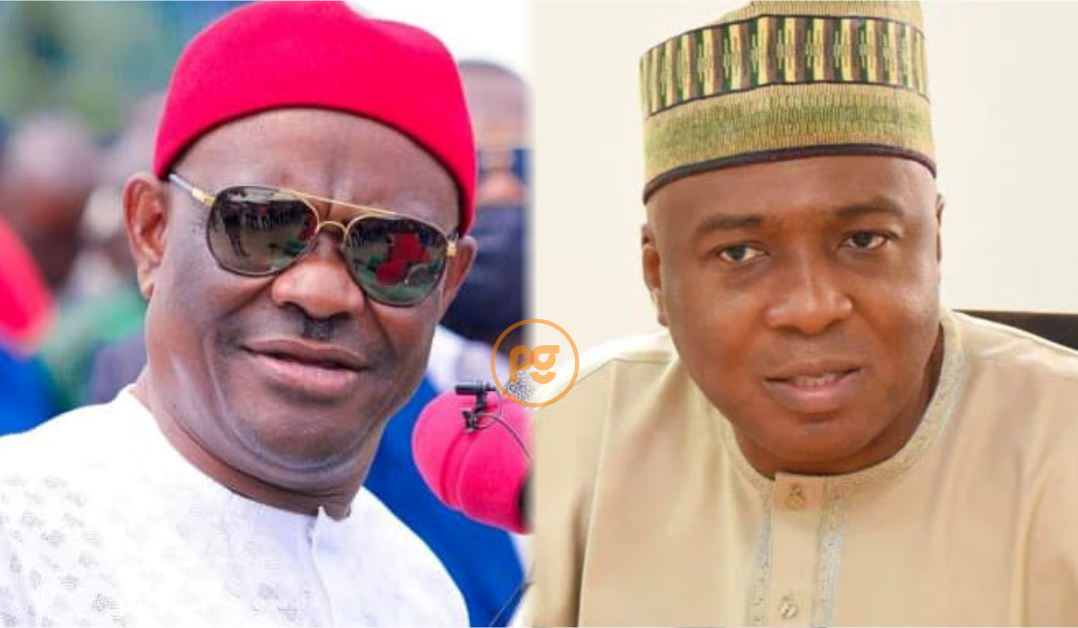
Over the weekend, the police unsealed the Peoples Democratic Party (PDP) national secretariat at Wadata Plaza in Abuja, granting access to a faction of the party backed by Nyesom Wike, President Bola Tinubu’s minister in charge of Abuja.
In a statement issued by party spokesman Jungudo Mohammed, the factional national chairman, Abdulrahman Mohammed, said the police action was in compliance with a court order. However, Ini Ememobong, spokesperson for the Tanimu Turaki-led faction, argued that the judgment cited by the police had already been appealed, with all parties duly informed, and accused the police of taking sides with the faction backed by Wike.
Ahead of next year’s general election, the PDP, rather than focus on countering the ruling All Progressives Congress (APC) as expected of any viable opposition, appears to be deliberately set on a course of internal infighting. The consequence is predictable: a fragmented opposition that risks clearing the path for the smooth re-election of President Tinubu.
Once a towering entity in Africa’s political landscape, the PDP has battled one self-inflicted crisis after another since losing the presidency to the APC in the 2015 general election. That electoral defeat did more than transfer power. It exposed a structural weakness that had always existed within the former ruling party but was masked by incumbency.
From its inception in 1998, the PDP was never established as an ideological party. It was a carefully constructed coalition of convenience designed to manage Nigeria’s transition from military to civilian rule, and brought together political elites from the north, South-West technocrats, South-South oil interests, and the South-East political class under one umbrella.
What held that coalition together was not shared philosophy, but shared access to power. Once that access disappeared, so did the glue. Since 2015, party members yet to decamp have struggled to answer a fundamental question: what is the PDP without power? It’s been over ten years, and the once dominant political force in Nigeria, and one can add Africa, still has no answer to this critical question.
Stuck to an old order that has outlived its political usefulness, the PDP has refused to evolve. The party’s failure to produce a credible new generation of leadership has led it to recycle familiar but tired names each election season. In functional political systems, electoral defeat triggers introspection and reinvention. In the PDP, it triggered stagnation and has since set the party on the path of irrelevance.
What has emerged since its defeat is a hollow structure animated by personal ambition rather than collective purpose. The long history of defections in pursuit of political ambitions, led by key figures such as Atiku Abubakar, has brought the PDP to its present state. For years, Atiku moved in and out of the PDP in pursuit of his presidential ambition, often working against the very party that made him vice president, and one that he sought to lead.
The PDP’s instability did not begin with recent crises; it was normalised over the years by figures like Atiku, whose repeated defections blurred the line between opposition and sabotage. For years, Atiku did not just defect from the PDP; his actions helped define its culture of political opportunism. Each time he left the party and returned, he helped to reinforce the dangerous precedent that the PDP was a platform of convenience, not conviction.
Yes, things may have taken a far worse trajectory since the emergence of the G5 group led by Wike. However, political pundits would argue that every damage Wike is inflicting on whatever is left of the remaining shred of credibility the PDP once had, he learnt from Atiku.
The G5 governors’ rebellion, which began as a dispute over zoning and evolved into a public demonstration that party loyalty within the PDP is conditional, negotiable, and ultimately expendable, was taken from Atiku’s playbook, one that was reinforced by the former vice president’s defections and political repositioning over the years. No thanks to Atiku and Wike, in today’s PDP, defection is now seen as a strategy, with internal discipline lacking.
Since 2023, Nigerians have watched a steady erosion of what remained of the PDP’s organisational coherence. Key figures have either drifted toward the ruling party or retreated into political irrelevance. The party’s national voice has grown faint, inconsistent, and at times, incoherent.
Against the administration of President Tinubu, the PDP has failed to articulate a compelling alternative for Nigerians increasingly disillusioned with the APC. It has not done the work of an opposition by offering a clearer and better direction for Nigeria. Instead, it remains trapped in nostalgia for its years in power and has failed to present itself as a credible government-in-waiting.
If the PDP continues on its current trajectory, Nigeria risks drifting into a de facto one-party system, with the APC as the unchallenged centre of political gravity.
There is a broader implication here that should concern even those with no love or sympathy for PDP. A weakened opposition is not just a party problem; it is a national problem. Nigeria’s political stability depends on the presence of a credible counterweight to the ruling party. Without it, the system tilts toward dominance, accountability weakens, and electoral competition becomes less meaningful.
The tragedy is that the PDP was once uniquely positioned to prevent this. It had national spread, institutional memory, and deep political networks. But these assets were squandered through years of internal dysfunction and complacency.
Today, what remains is a party that behaves less like an opposition preparing for power and more like a crumbling coalition negotiating its survival. A sad turn of events that should concern every Nigerian.
Maduekwe is a communications professional. Write him: mrmaduekwe@gmail.com

We have recently deactivated our website's comment provider in favour of other channels of distribution and commentary. We encourage you to join the conversation on our stories via our Facebook, Twitter and other social media pages.

More from Peoples Gazette

States
Independence: NBA urges Nigerians to expect better future
The NBA said that ordinary Nigerians should be deriving benefit from the subsidy removal rather than hardship.

Agriculture
FG tasks ECOWAS on leveraging financing strategies for agroecology
The federal government has urged stakeholders in the agriculture and finance sectors in the West Africa region to leverage financing strategies to enhance agroecology practices

Politics
Katsina youths pledge to deliver over 2 million votes to Atiku
“Katsina State is Atiku’s political base because it is his second home.”

Heading 1
EFCC chair warns Nigerian girls against dating Yahoo boys, sextortionists
Mr Olukoyede decried the rising incidents of sextortion in the country.

Politics
2027: Fubara playing active role in Rivers political team, says Wike
Mr Wike said Mr Fubara remains an integral and active part of the ruling political team.

Africa
2027 AFCON: Tanzania, Kenya, Uganda plan joint visa for football fans
Kadaga said the proposed arrangement would enable fans to attend matches in different countries and visit tourist attractions.

Hot news Home top
NCC to block cloned, counterfeit phones from Nigerian mobile networks, registers 231 million devices
Mr Ogoh said the checks also apply to other SIM-enabled equipment, including tablets, modems and PoS terminals.

Education
FG assures NASU of continued dialogue on workers’ welfare
The minister urged NASU to sustain dialogue, collective bargaining and tripartite engagement as effective mechanisms for resolving industrial disputes.

States
Yobe govt. donates 160 motorcycles, operational equipment to forest guards
The SSG said the equipment also includes 900 raincoats, 900 rain boots, 900 blankets, 900 torchlights, and 900 mosquito nets.


