

Rethinking Nigeria’s GDP: The trillion-naira pivot to unlock state-level biodiversity finance

Nigeria’s GDP—projected at about ₦277 trillion in 2024—offers a misleading portrait of national prosperity. It captures the short-term gains from extractive industries but ignores the long-term economic losses from ecosystem degradation. Each year, Nigeria loses approximately 350,000 hectares of forest—equivalent to 490,000 football fields—resulting in soil erosion, biodiversity collapse, and increased climate vulnerability.
Natural capital, including the mangroves of the Niger Delta, provides essential services such as flood protection, support for fisheries, and carbon storage. Yet these assets are treated as free inputs. Their degradation could cost Nigeria up to $1 billion annually in lost ecosystem services—far exceeding the cost of preserving them.
To achieve economic sovereignty, Nigeria must rethink its financial metrics and embrace biodiversity finance. This means treating nature as a strategic, financeable asset. State governments are uniquely positioned to lead this pivot by implementing Natural Capital Accounting (NCA), which quantifies ecosystem value and enables data-driven investment decisions.
Existing collaborations between the National Bureau of Statistics and the World Bank have laid the groundwork. Now, state leaders must build on this foundation—drawing inspiration from global models such as Costa Rica, where NCA has transformed natural assets into economic engines.
The federal mandate and the state dividend
Federal initiatives are in motion, but state-level policymakers must assume leadership in driving transformative change. By adopting NCA, state governments can unlock the ‘State Dividend,’ making their natural assets attractive to private and blended funding sources through verified data. Transparent benefit-sharing schemes should be enforced to sustain community engagement. When states deliver concrete benefits from the ‘State Dividend’, such as revenue sharing or new jobs for local conservation, they lay the groundwork for lasting stewardship and robust biodiversity finance.
Nigerian states with abundant biodiversity hold significant untapped financial potential, offering distinct investment opportunities. For example, a state may offer substantial returns from ecotourism, minimal environmental risk, and additional benefits such as job creation and community development. These well-defined investment prospects make biodiversity hotspots attractive to investors and facilitate the mobilisation of financial support.
Financing instruments for biodiversity conservation
Private investment in nature conservation in Nigeria accounts for less than 15% of total environmental funding. Attaining the country’s biodiversity and conservation objectives necessitates an estimated annual investment of 500 billion naira. This significant funding shortfall underscores the imperative for state governments to adopt targeted, innovative financial instruments designed to mobilise the resources needed for environmental protection.
Nigeria’s newly launched Carbon Market Activation Policy—projected to unlock $2.5 billion by 2030—reinforces the urgency of state-level biodiversity finance, offering a national framework that complements subnational efforts to monetise ecosystem services and scale nature-based investments.
Government incentives
| Environmental User Fees/Charges | Redirect Park entrance fees to Wildlife Trust Funds |
| Ecological Fiscal Transfers (EFT) | Link FAAC allocations to state-level environmental performance |
| Biodiversity-Relevant Taxes | Impose Green Levies on dredging, plastic, and water abstraction. |
| Green Tax Incentives | Offer tax holidays for verified biodiversity restoration investments. |
Market-based instruments
Global evidence, including Costa Rica’s thriving biodiversity credit market, demonstrates that well-designed, market-based mechanisms can attract investment while safeguarding ecosystems—outcomes relevant for Nigerian policymakers. Successful replication requires strategic adaptation and procedural discipline. State governments should adopt the following five-point, time-bound action plan to operationalise transformative biodiversity finance within two fiscal cycles, as outlined in the table below.
Table 1: Five-Point Action Plan for State-Level Biodiversity Finance Implementation
| # | Action Item | Key Steps | Objective |
| 1 | Establish the Natural Capital Accounting Unit (NCA-U) | – Issue an Executive Order under the Ministry of Economic Planning | Prepare the state’s first Natural Capital Asset Report within 12 months using the UN SEEA framework |
| 2 | Create the Biodiversity Finance Innovation Fund (B-FIN) | – Launch B-FIN as a special-purpose vehicle (SPV) – Fund it through Green Levy and ecological revenue streams | Provide concessional loans and guarantees for nature-positive, bankable projects |
| 3 | Implement a Pilot Payment for Ecosystem Services (PES) Scheme | – Select a key ecosystem (e.g., watershed or coastal zone) – Co-design with rural communities – Establish monitoring and implementation protocols | Enable urban beneficiaries to compensate rural communities for conserving ecosystem services |
| 4 | Designate a Regional Green Skills Hub (R-GSH) | – Appoint a leading Polytechnic or Research Institute as the R-GSH – Invest in curriculum reform and equipment (e.g., GIS, drones) | Build local capacity for NCA, eco-tourism, and biodiversity finance through certified training |
| 5 | Enacting the Natural Assets Protection and Tax Incentive Bill | – Propose legislation mandating annual NCA reporting – Include tax incentives for verified biodiversity investments | Institutionalise natural capital governance and attract private sector participation in conservation |
Below is the strategic visual summary of the five-point action plan for implementing biodiversity finance at the state level.

Figure 1: Five-Point Action Plan for Implementing Biodiversity Finance at State Level
Institutional Leadership: Natural Eco Capital and regional collaboration
Natural Eco Capital, led by Dr. Eugene Itua, is a key driver of biodiversity finance and sustainable development in Nigeria and convener of the West Africa Capitals Coalition Hub. As a member of the Capitals Coalition, the organisation provides support in mobilising sustainable finance for nature-based solutions. In partnership with GLOBE Nigeria and GLOBE International, Natural Eco Capital has facilitated legislative workshops on Natural Capital Accounting and Biodiversity Finance for parliamentarians.
Natural Eco Capital, with UNFCCC RCC WACA, co-organised the high-level webinar ‘Forging a Resilient, Sustainable Future for West and Central African Cities’, promoting nature-based adaptation strategies for urban resilience.
Capacity building and technical training
Natural Eco Capital has hosted multiple training programmes focused on carbon markets and climate finance, including a four-day course on decarbonisation and carbon credit development for financial institutions, as well as greenhouse gas accounting and ESG integration, equipping private sector actors with the tools to measure and report their environmental performance.
These initiatives reinforce the five-point action plan, especially in establishing Regional Green Skills Hubs and mobilising private capital. Biodiversity loss in Nigeria is estimated to exceed ₦3.4 trillion annually, resulting from lost ecosystem services, diminished agricultural productivity, and heightened disaster vulnerability. This amount surpasses the combined annual education and health budgets of several Nigerian states, underscoring the urgent need for sustainable intervention. Institutionalising Natural Capital Accounting (NCA) and adopting comprehensive financial solutions could enable policymakers to transition from economic volatility to stability through regenerative development strategies.
While this integrated approach offers a promising pathway to economic sovereignty and long-term resilience in Nigeria, several challenges may impede its full realisation. For instance, data limitations, capacity constraints within state institutions, and potential resistance from entrenched interests could hinder effective NCA implementation and financial innovation.
Moreover, the need for cross-sectoral collaboration presents both an opportunity and a challenge, as coordination among financial institutions, traditional authorities, community actors, and youth requires overcoming institutional silos and fostering mutual trust. Despite these complexities, a concerted effort by diverse stakeholders remains imperative to build a resilient coalition capable of advancing sustainable development in Nigeria.
This article is adapted from the forthcoming book Activating Nigeria’s Natural Wealth, which serves as a strategic resource for advancing sustainable prosperity through state-level biodiversity finance and natural capital stewardship.
Dr Eugene Itua is CEO, Natural Eco Capital & Executive Director, African Green Economy and Sustainability Institute
Sources
- FAO (2020). Global Forest Resources Assessment – Nigeria Country Report.
- UNDP Nigeria (2023). Blue Carbon Opportunities in the Niger Delta.
- NBS & World Bank (2021). Natural Capital Accounting Pilot Report.
- Cross River State Government (2022). Ecotourism Development Strategy.
- African Wildlife Foundation (2021). Sustainable Financing for Protected Areas in Nigeria.
- UNDP Nigeria (2023). Blue Carbon Finance Feasibility Study.
- National Commission for Museums and Monuments (2020). Cultural Heritage and Tourism in Osun State.
- UNEP Finance Initiative (2023). State of Finance for Nature in Nigeria.
- GIZ & NCF (2022). Ecological Fiscal Transfers in Nigeria: A Policy Brief.
- Federal Ministry of Finance (2024). Green Tax Incentives Framework.
- IUCN (2021). PES in West Africa: Lessons and Opportunities.
- NESREA (2023). Biodiversity Offset Guidelines.
- Rainforest Alliance (2022). Sustainable Agriculture in Nigeria.
- African Development Bank (2023). Blended Finance in Africa.
- GIIN (2022). Impact Investing in West Africa.
- Natural Eco Capital (2025). West Africa Capital Coalition Hub Launch Report.
- GLOBE Nigeria & Natural Eco Capital (2023). Legislative Workshop Series on Biodiversity Finance.

We have recently deactivated our website's comment provider in favour of other channels of distribution and commentary. We encourage you to join the conversation on our stories via our Facebook, Twitter and other social media pages.

More from Peoples Gazette

States
Independence: NBA urges Nigerians to expect better future
The NBA said that ordinary Nigerians should be deriving benefit from the subsidy removal rather than hardship.

Agriculture
FG tasks ECOWAS on leveraging financing strategies for agroecology
The federal government has urged stakeholders in the agriculture and finance sectors in the West Africa region to leverage financing strategies to enhance agroecology practices

Politics
Katsina youths pledge to deliver over 2 million votes to Atiku
“Katsina State is Atiku’s political base because it is his second home.”

Economy
Lagos butchers seek land for Eko Ranches, plan pilot scheme
The Lagos State Butchers Association says it is seeking approval to begin a pilot ranching scheme at Oko-Oba Abattoir while awaiting land for Eko Ranches.

World
Five Nigerians appointed to UN information system consultation group
Five Nigerians have been appointed to the 92-member Multistakeholder Consultation Group of the United Nations Group on the Information Society.
States
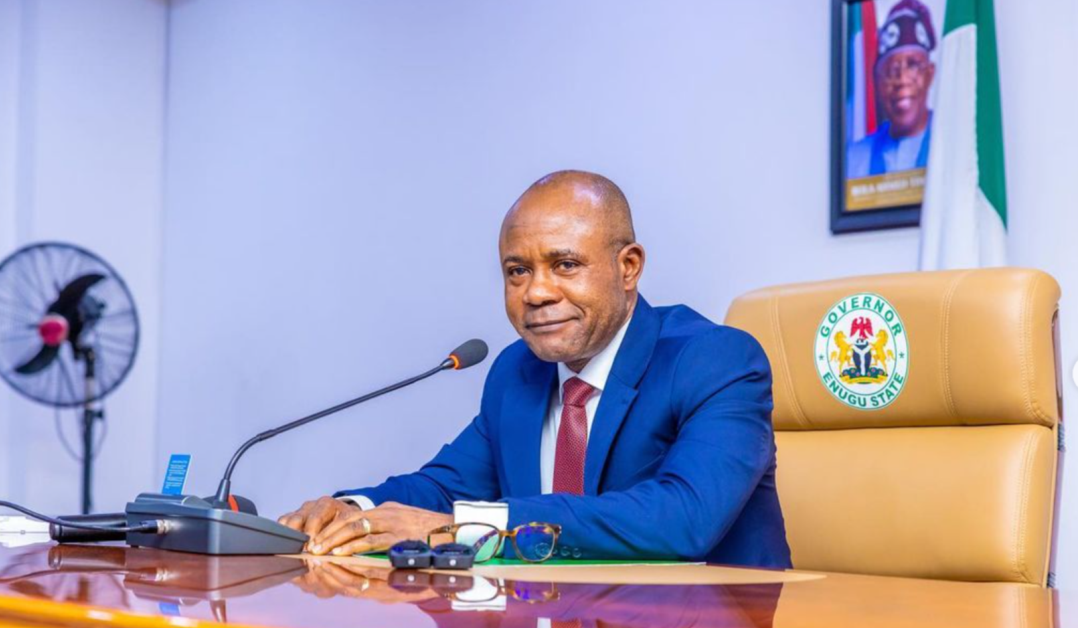
Mbah inaugurates multibillion-naira pharmaceutical company in Enugu
Governor Peter Mbah has inaugurated Anchorage Pharmaceutical Industries Limited, a multibillion-naira pharmaceutical company in Trans-Ekulu, Enugu.

Maiduguri
Shettima arrives in Maiduguri to inaugurate projects
Vice-President Kashim Shettima has arrived in Maiduguri, Borno, to inaugurate Kashim Ibrahim University Teaching Hospital, a hostel, and 104 staff housing units.
Abuja
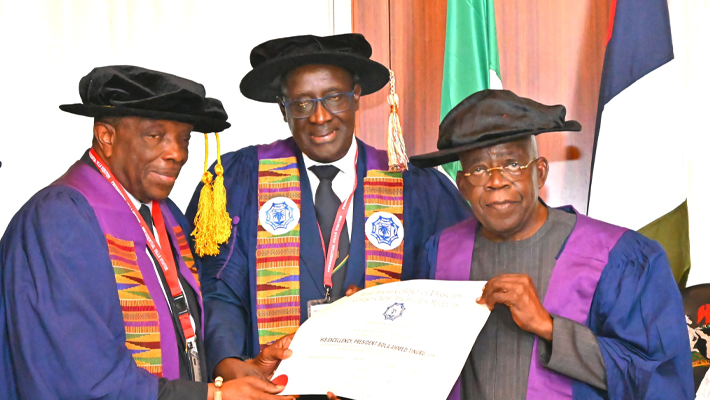
Tinubu receives medical fellowship from WACP
Mr Tinubu said his government was committed to championing comprehensive health sector reforms to make healthcare delivery more accessible and affordable.
Economy
Women-led businesses targeted as DBN, AfDB sign $61 million financing agreement
The Development Bank of Nigeria has signed a $61 million gender-focused financing agreement with the African Development Bank to support women-led businesses.


