

Rights activists, labour leaders seek security, living wage reforms
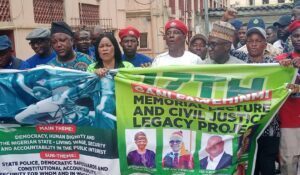
Rights activists, labour leaders and civil society organisations have called for urgent, comprehensive reforms to address insecurity, economic hardship and obstacles to Nigeria’s democratic growth.
They made the call on Saturday at the 17th Gani Fawehinmi Memorial Lecture and Civil Justice Legacy Project in Ikeja.
The lecture had the theme: “Democracy, Human Dignity and the Nigerian State: Living Wage, Security and Accountability in the Public Interest”.
Participants at the event stressed the need to sustain the late Mr Fawehinmi’s struggle for justice, accountability and protection of the oppressed.
Dr Joe Okei-Odumakin, president of Centre for Change and chairman of the occasion, described Fawehinmi as a selfless defender of the oppressed whose ideals must be sustained.
“We are not here just to remember Gani, but to organise for change. He lived for the ordinary Nigerian, and we must continue to amplify and live those ideals,” she said.
Ms Okei-Odumakin said security remained the foundation of all rights, urging governments to strengthen security.
“Life is sacrosanct. Without life, we cannot talk about wage or development.
“Government must provide the necessary support for security agencies to end kidnapping and terrorism,” she said.
She also urged Nigerians to be vigilant and proactive.
“When you see something, say something. We must all work together to preserve human lives,” she said.
Delivering the keynote address, Dr Wahab Azeez, a former provost of the Federal College of Education (Technical), Akoka, Lagos, described Mr Fawehinmi as a symbol of courage and justice.
“Seventeen years after his passing, Gani remains unforgettable, not just because he was brilliant, but because he was consistently right – right about rights,” he said.
Mr Azeez said the memorial lecture was not about nostalgia but reflection, adding that many of the issues Mr Fawehinmi fought against had persisted.
“What is the state of our democracy today? Where is economic justice for workers?” he asked.
He said judicial independence faced growing threats, citing selective prosecution, conflicting court orders, and eroding public trust.
Mr Azeez said the current minimum wage of ₦70,000 was grossly inadequate.
“Seventy thousand Naira can barely buy a bag of rice. A worker cannot feed, clothe or educate a family on such income,” he said.
He called for a significant wage increase and policies that would prioritise the welfare of ordinary Nigerians.
Earlier, the chairman of the Gani Fawehinmi Memorial Organisation, Tunde Agunbiade, said the country recorded little progress in advancing the ideals Fawehinmi stood for.
“Seventeen years after Gani, we cannot say we have made progress,” he said.
Mr Agunbiade regretted what he described as the erosion of multi-party democracy and the dominance of elite interests, saying some political parties had lost ideological direction.
He decried increasing cases of killings, police brutality and insecurity, warning against what he termed normalisation of violence.
“We must end the killings,” he said, urging an end to kidnapping, terrorism and corruption.
Mr Agunbiade called on governments at all levels to do more to protect lives and property.
He also emphasised the need for democratic safeguards in security operations, warning that proposed state policing could be abused without proper legal frameworks.
According to him, security must serve the people, not oppress them.
“Without accountability, such structures risk becoming tools of abuse.”
Mr Agunbiade also described the current wage structure as dissatisfactory.
“The minimum wage has become an instrument of survival, not dignity,” he said, calling for adoption of a ₦300,000 living wage as well as regular wage reviews.
Mr Agunbiade urged Nigerians to organise, engage and demand accountability from leaders.
“A lecture without action is not enough; justice without action is not enough,” he said.
He said proceedings from the lecture, including paper presentations and resolutions, would be documented to guide policymaking and civic engagement.
Olanrewaju Adeleke, a Labour Party governorship aspirant in Lagos, decried the high cost of political participation, saying that the high cost of nomination forms excluded credible candidates.
He said that democracy must reflect improved living conditions and accountability.
“When citizens cannot afford food, rent or education, that cannot be called democracy,” he said.
Another speaker, Rufus Olusesan, described the condition of Nigerian workers as pitiable, saying the earnings were insufficient to sustain basic living.
He stressed that the struggle for better wages was part of a broader fight for human dignity, social justice and economic fairness.
Participants raised concerns about weakening democratic institutions, including internal party democracy and electoral processes, urging reforms.
They emphasised the need for accountability mechanisms, including citizens’ right to assess government performance and initiate recall processes where necessary.
They recommended that September 5 should be recognised annually as a national civil day of remembrance for victims of violence, abduction and injustice.
((NAN)

We have recently deactivated our website's comment provider in favour of other channels of distribution and commentary. We encourage you to join the conversation on our stories via our Facebook, Twitter and other social media pages.

More from Peoples Gazette

States
Independence: NBA urges Nigerians to expect better future
The NBA said that ordinary Nigerians should be deriving benefit from the subsidy removal rather than hardship.

Agriculture
FG tasks ECOWAS on leveraging financing strategies for agroecology
The federal government has urged stakeholders in the agriculture and finance sectors in the West Africa region to leverage financing strategies to enhance agroecology practices

Politics
Katsina youths pledge to deliver over 2 million votes to Atiku
“Katsina State is Atiku’s political base because it is his second home.”

Politics
2027: Fubara playing active role in Rivers political team, says Wike
Mr Wike said Mr Fubara remains an integral and active part of the ruling political team.

Africa
2027 AFCON: Tanzania, Kenya, Uganda plan joint visa for football fans
Kadaga said the proposed arrangement would enable fans to attend matches in different countries and visit tourist attractions.

Hot news Home top
NCC to block cloned, counterfeit phones from Nigerian mobile networks, registers 231 million devices
Mr Ogoh said the checks also apply to other SIM-enabled equipment, including tablets, modems and PoS terminals.

Education
FG assures NASU of continued dialogue on workers’ welfare
The minister urged NASU to sustain dialogue, collective bargaining and tripartite engagement as effective mechanisms for resolving industrial disputes.

States
Yobe govt. donates 160 motorcycles, operational equipment to forest guards
The SSG said the equipment also includes 900 raincoats, 900 rain boots, 900 blankets, 900 torchlights, and 900 mosquito nets.
Health
Marwa seeks provision for mental healthcare in government budgets
Mr Marwa said mental wellbeing cannot thrive where hopelessness and poverty drive people into harm.


