

Sierra Leone’s president decries Africa’s $50 billion annual spending on food importation

The President of Sierra-Leone, Julius Bio, on Wednesday in Ibadan, decried the sum of 50 billion U.S. dollars being expended on food importation annually by African countries.
Mr Bio, while speaking at the International Institute of Tropical Agriculture (IITA) on day three of his visit, said food items being imported by these countries could be grown in the region.
In his remarks during a session tagged “Strategic Dialogue” on Wednesday, Mr Bio urged African leaders to brace up and work towards changing the narrative of dependence on foreign food.
He called on leaders to prioritise food security as a way of alleviating the suffering of Africans.
“Because we must prioritise what is priority, food security is not just about food. It’s about our economy, health, employment and about a lot of things,” the president said.
He pointed out that it has been difficult to get African countries at the highest levels to take agriculture seriously.
Mr Bio said this was, however, with the exception of a few countries like Ethiopia, Rwanda and Tanzania, which have done a great deal in agriculture or food security.
He urged African countries to put in place relevant facilities, such as infrastructure, to attract investors in agriculture, noting that the investment needed to support agriculture was quite huge.
“African governments should mobilise domestic revenue and also work with the private sector. Doing those things can make it easier to finance the agriculture sector.”
Mr Bio also charged African countries to think outside the box for internal resources, “especially in the face of the recent slashing of development funds around the world.
“Even before things started going wrong again in the world, it’s been difficult because the international financial institutions have not made it easy for us to access the requisite funds.”
Hafez Ghanem, the strategic dialogue speaker, a former World Bank vice-president, opined that African countries could never be sovereign if they depended on others to feed them.
Mr Ghanem said the concept of sovereignty was nothing if African countries could not feed themselves.
“So, it is important for Africa to really focus on this issue of food security and agriculture.
“Now, when I look at our continent, Africa is 1.4 billion people, more or less the size of India, but it is divided into 54 countries, whereas India is one country. So, we need to work together.
“I believe, and we’ve learnt a lot from India, one is research and technology in agriculture. If we want to increase yields in agriculture, we have to use better seeds. We have to use better technologies.
“Why don’t we focus, maybe, to let us really develop a more centralised, pan-African agriculture research and technology centre,” he advised.
Mr Ghanem equally urged the continent to produce its own fertilisers if they wanted to increase yields in Africa.
He noted that roughly two-thirds of the fertilisers used in Africa were imported, and their production locally would bring down the cost of fertilisers for farmers.
The speaker also advocated for joint irrigation projects across the continent to enhance all-round farming.
In their respective remarks, Gov. Babagana Zulum of Borno, Gov. Caleb Mutfwang of Plateau and the host governor, Seyi Makinde, shared stories of successful and impactful agri-business initiatives in their states.
Mr Zulum said his administration had invested heavily in mechanised farming apart from the provision of support to small-scale farmers through inputs and the creation of an enabling environment for them.
Mr Mutfwang said his government had started the resuscitation of agriculture institutions, reviving structures and providing leadership to manage the sector.
He added that his government was also subsidising the cost of fertilisers to enhance the production of food in large quantities across the state,
On his part, Mr Makinde said his government focused on fixing infrastructure to attract agriculture investors into the state.
He said the Fashola Agri-business Hub Initiative had really attracted many investors, and the introduction of “tractorisation” subsidy for farmers has really assisted farmers.
Mr Bio’s visit to IITA was aimed at strengthening partnerships, fostering innovation and enhancing mobile investments to accelerate the Feed Salone Programme.
The programme is a major initiative of the Sierra Leonean government to address food insecurity and malnutrition in the country.
(NAN)

We have recently deactivated our website's comment provider in favour of other channels of distribution and commentary. We encourage you to join the conversation on our stories via our Facebook, Twitter and other social media pages.

More from Peoples Gazette

States
Independence: NBA urges Nigerians to expect better future
The NBA said that ordinary Nigerians should be deriving benefit from the subsidy removal rather than hardship.

Agriculture
FG tasks ECOWAS on leveraging financing strategies for agroecology
The federal government has urged stakeholders in the agriculture and finance sectors in the West Africa region to leverage financing strategies to enhance agroecology practices

Politics
Katsina youths pledge to deliver over 2 million votes to Atiku
“Katsina State is Atiku’s political base because it is his second home.”

Politics
While laying foundation for university in 1993, Tinubu was forfeiting $460,000 drug proceeds in U.S.: Atiku
Mr Abubakar dismissed Mr Tinubu’s latest attack on his investment in education as a desperate attempt to distract Nigerians from his administration’s failure.
Sport
Drogba arrives Lagos, to join ex-African soccer stars in legends’ match
Drogba will be in the star-studded encounter alongside Nigeria’s Mobi Oparaku, Emmanuel Amuneke, and Emmanuel Babayaro, among others.
Health
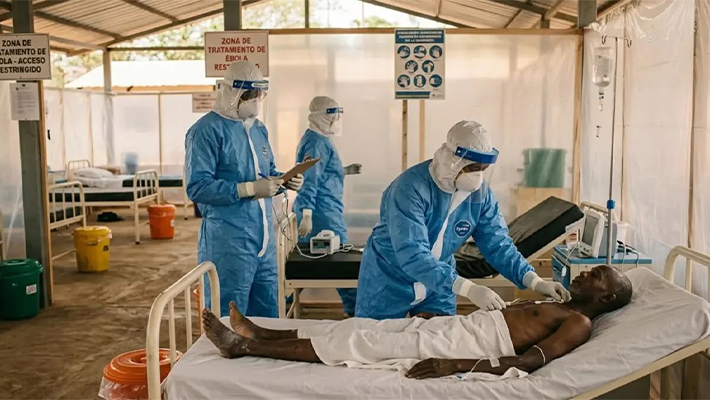
Deaths from Ebola rise to 5,198 in DR Congo
The WHO said in a statement on Saturday that the figure recorded was as of November 3, representing a case fatality ratio of 48.7 per cent.
Health
WHO urges Nigeria to make health services accessible to all
WHO said that health programmes often fail to identify people who are left out of services.

Sport
AFCON 2027 Qualifier: Chelle releases 24-man Super Eagles list for double-header against Tanzania
Nigeria will host the Taifa Stars at the Godswill Akpabio Stadium in Uyo on November 13.

NationWide
Tinubu accuses Atiku of using public funds to build university
Mr Abubakar was yet to respond to the allegation as of the time of filing this report.


