

Stakeholders score Nigeria’s 27 years of unbroken democracy low
![Nigerians in the market going about their daily activities used to illustrate the story. [CREDIT: [Premium Times]](https://gazettengr.com/wp-content/uploads/2020/10/Nigerians-on-the-street.jpg)
Some residents of Bayelsa State have bemoaned the slow pace of Nigeria’s democratic journey from 1999 till date.
The residents spoke on Thursday in Yenagoa, in the build-up to Nigeria’s June 12 Democratic Day celebration.
A political affairs analyst and journalist, Alambo Datonye, said that Nigeria’s democracy has lost ground since 1999, pointing out that basic tenets and principles of democracy were observed more in breach than in compliance.
He said that some key institutions in the country were not fair to political parties, due to interference from politicians in power.
“The judiciary is not independent of executive control and influence, and the media has not developed enough economic power base to hold leaders accountable.
“There is bad governance, vote-buying and corruption on a monumental scale while Nigerians face economic hardship and insecurity. There is an absence of internal democracy in political parties, and the National Assembly has not done well in its oversight functions.
“To entrench genuine democracy in Nigeria, there is a need for politicians, especially the political actors in power, to play by the rules; the institutions must be independent and assertive. INEC should be unbiased, the judiciary must be independent, and the media and political parties should create an environment of internal party democracy,” he said.
Mr Datonye said that ideally, candidates should not be imposed or emerge fraudulently, noting that those in leadership should be accountable to the people and patriotic enough to utilise the nation’s resources for the people.
He said that political leaders ought to provide security and welfare for the people and that anything short of it is not democracy.
“The leaders must go beyond the fanfare of celebrating 27 years of uninterrupted civilian rule to enthrone real democracy, where Nigerians are allowed to genuinely choose who will govern them,” he said.
On his part, a socio-political analyst, Larry Esure, said that Nigeria has had over 30 years of unbroken democratic experience but said it did not erase the fact that her democratic experience is fraught with myriads of challenges.
“The conditions that make a democratic government thrive are under serious attack in Nigeria. Some of the conditions that guarantee a democratic government are the conduct of periodic elections. This doesn’t just mean conducting an election but an election that reflects the wishes of the electorate.
“In a democracy, the outcome of elections must be widely seen as free, fair, transparent and without any form of inducement. This means that citizens should be allowed to vote for candidates of their choice without inducement or intimidation and the wish of the electorate must be translated into reality in terms of such electoral outcomes.
“In the Nigerian experience, election outcomes always serve as breeding grounds for post-election violence and legal contests which, in most cases, do not reflect the wish of the voters. The judicial arm of government must be free from other arms,” he explained.
Mr Esure explained that the capacity of the judiciary to decide on issues without fear is a necessary condition for a democratic government to thrive.
He said, “This is not the reality in Nigeria, as conflicting judicial pronouncements from courts due to inducements and interference from the executive arm explain it.”
Also speaking, a legal practitioner, James Arumoh, said democracy must allow the existence of a truly functional multiparty system.
“Democracy ensures the existence of a formidable opposition to keep ruling parties on their toes, both at state and federal levels. This has not been the case in the Nigeria experience.
“This means that the actions of both the government and the governed must be guided by dictates of the law.
“The Nigerian experience places some few rich individuals and those connected to the corridors of power above the law, while the majority, particularly those in the bottom of the societal pyramid, are under the dictates of the law,” he said.
He stated that the imbalance created a condition similar to an animal kingdom where some are above the law.
Mr Arumoh said the Nigerian democratic experience has not been a successful one but noted that it could be better.
“Press freedom must be guaranteed and not where journalists, especially, those found to be giving unbiased reports about activities of government, must not be incarcerated. There is a need for establishing and strengthening strong institutions of government as a critical factor for democratic consolidation.
“Efforts must be made to promote the existence of vibrant civil society organisations that will act as watchdogs on activities of political actors and institutions of government.
“The place of strong and vibrant civil society organisations in strengthening democratic consolidation cannot be overemphasised. The days of NADECO are a clear pointer to the importance of having a thriving civil society that will act as a bride between the state and citizens,” he said.
A former vice chairman of the Ogbia Local Government Area of Bayelsa, Peter Ologi, said that tackling systemic corruption remained another way to ensure that dividends of democracy translated directly to improved welfare, shared prosperity, and security for all.
He said that when citizens start doing the right thing, it would go a long way to consolidate the Nigerian democracy.
(NAN)

We have recently deactivated our website's comment provider in favour of other channels of distribution and commentary. We encourage you to join the conversation on our stories via our Facebook, Twitter and other social media pages.

More from Peoples Gazette

Agriculture
FG tasks ECOWAS on leveraging financing strategies for agroecology
The federal government has urged stakeholders in the agriculture and finance sectors in the West Africa region to leverage financing strategies to enhance agroecology practices

Politics
Katsina youths pledge to deliver over 2 million votes to Atiku
“Katsina State is Atiku’s political base because it is his second home.”

States
Kaduna LG welcomes NLC delegation on sensitisation tour, recommits to workers’ welfare
Mr Suleiman reaffirmed the union’s commitment to protecting workers’ welfare and promoting industrial harmony across the state.

Uncategorized
Gov. Soludo’s wife urges youths to embrace skills acquisition, continuous learning
Mrs Soludo encouraged youths to embrace continuous learning and never stop acquiring new skills.
Heading 2
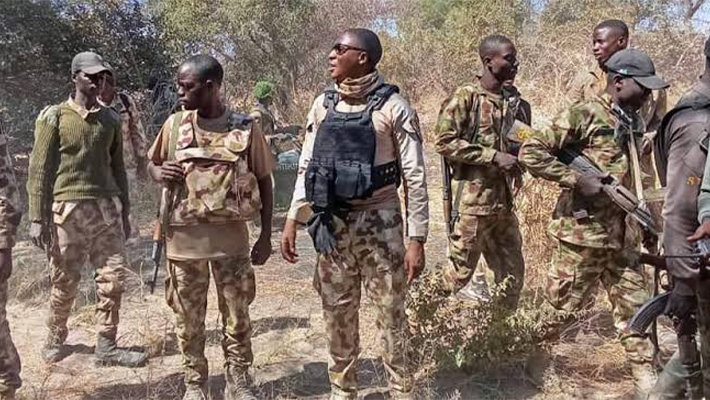
13 victims rescued as troops overpower terrorists in Zamfara gun battle
Mr Danja said the rescue followed intelligence-led operations in the affected areas.

States
Scrap scarcity major challenge in Nigeria’s steel sector: Expert
Mr Madagua described scrap as a key raw material for steel production.

World
UK proposes midnight social media ban for teens
The government also wants features considered addictive such as auto-play and infinite scroll to be disabled by default.
States
EEDL warns customers against illegal electricity connections
The head of communications said every customer had the right to be connected to electricity through a transparent and approved process.


