

Tinubu’s harsh economic policies pushing us into cab driving: Abuja Civil Servants
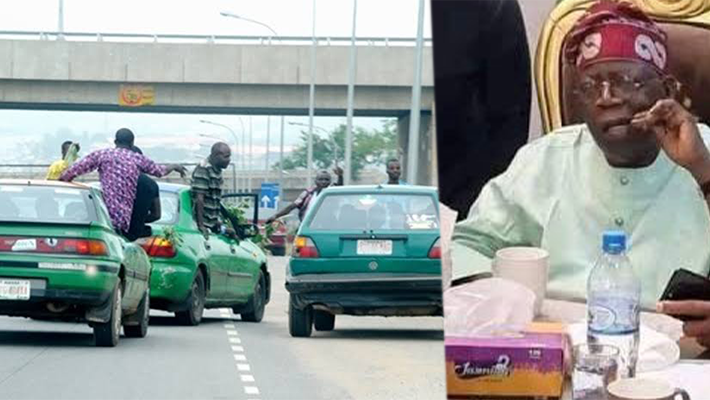
Many private car owners, including civil servants in the Federal Capital Territory, have taken to carrying passengers in their cars, a practice popularly known as ‘kabu-kabu’.
The car owners said the gesture was to make ends meet, as their incomes could no longer cover basic needs.
A survey revealed that private car owners operating along major routes within the city centre had almost taken over the operations of commercial transport drivers.
The drivers, who spoke on Wednesday in Abuja, said the practice had become a vital source of additional income to meet daily expenses.
Babafemi Oguntade, a civil servant, said he picked up passengers from Wuse to Kubwa after work.
“The money I make helps me buy fuel and also support my family,” he said.
Another civil servant, Emeka Odinaka, said he adopted the practice because of the rising cost of living.
“Things are hard, and the extra income helps me buy fuel for my car,” he said.
Many women also embraced the trend.
Rita Chukwu said that since she began conveying passengers to and from work, purchasing fuel had become less burdensome.
“Before now, I was always scared of carrying passengers because of the insecurity and the fear of damaging my car. Since I started, it has helped me to offset the cost of fuel,” she said.
Anita David said she began carrying passengers during peak periods to cope with the increasing cost of living.
“Sometimes I only make enough to buy fuel, but that’s okay because if I don’t do this, my car will remain parked since I can’t afford to fuel it regularly,” she said.
Passengers also welcomed the development, saying it had provided some relief from the high cost of transportation.
Somto Adigwue, a trader who commutes daily from Kubwa to Berger, said she preferred boarding private cars because they were often cheaper and more comfortable than conventional taxis.
“Some private car owners charge less than taxis, especially in the evenings. It really helps people like us who are struggling,” she said.
Some residents, however, expressed concern over safety and regulation.
Effiong Obong, a resident in Bwari, said while the practice was understandable given the current economic situation, it required proper regulation.
“The risk is that we don’t know who is a registered commercial driver and who isn’t. The federal government needs to address this issue to ensure the safety of commuters,” he said.
A transportation consultant and chief executive officer of Green Lunar Nigeria Ltd., Olaniyi Odina, said the rising cost of transportation had driven more Nigerians to embrace informal commercial transportation.
He described the practice as a practical way of reducing commuting expenses.
“Many workers have little choice but to share rides to cushion the financial burden of daily transportation,” he said.
Mr Odina noted that while the trend offered economic benefits, it also posed significant security risks.
According to him, many commuters now board unbranded vehicles, making it difficult to verify drivers’ identities and the vehicles they operate.
He urged the federal government to introduce a system that would enable commuters to easily identify and verify public transportation vehicles.
Mr Odina said that his technology company was exploring digital solutions that would allow commuters to instantly verify the identity of any vehicle they boarded.
Regarding improvements to public transportation, Mr Odina said that expanding intercity rail services might not be feasible in the short term.
Instead, he urged the federal government to deploy more buses and other mass transit vehicles to improve mobility within cities and communities.
In spite of the challenges, Mr Odina said the growing culture of commercial transportation had positive effects, including reducing traffic congestion and lowering the number of vehicles on the roads.
He said that with improved public transportation and technology-driven security measures, informal commercial transportation could continue to serve as a safe and efficient transport alternative.
(NAN)

We have recently deactivated our website's comment provider in favour of other channels of distribution and commentary. We encourage you to join the conversation on our stories via our Facebook, Twitter and other social media pages.

More from Peoples Gazette

States
Independence: NBA urges Nigerians to expect better future
The NBA said that ordinary Nigerians should be deriving benefit from the subsidy removal rather than hardship.

Agriculture
FG tasks ECOWAS on leveraging financing strategies for agroecology
The federal government has urged stakeholders in the agriculture and finance sectors in the West Africa region to leverage financing strategies to enhance agroecology practices

Politics
Katsina youths pledge to deliver over 2 million votes to Atiku
“Katsina State is Atiku’s political base because it is his second home.”
States
Police rescue 29 kidnap victims, arrest 34 foreigners in Benue
The commissioner also disclosed that the command was investigating cases of child abuse, homicide, cult-related violence and defilement.

Politics
2027: Uzodimma launches door-to-door campaign for Tinubu
Mr Uzodimma said the state resolved to lead the crusade after carefully assessing the president’s achievements and the need for continuity.
Diaspora
U.S. authorities deport Prince David Nwabueze convicted of robbery, marijuana possession
A statement by the DHS on Tuesday listed Mr Nwabueze among the worst illegal aliens who have been removed to third countries.

Showbiz
‘Don’t forget your children and me,’ late Toluwasings’ wife says at night of tributes
The event venue, Jogor Centre, Ibadan, was filled with fans and colleagues dressed in white to celebrate the young gospel artiste.

Economy
Data governance gaps can make capital costlier for African firms: NGX
Mr Popoola said businesses with reliable data, strong controls and resilient systems are better positioned to earn investors’ confidence.
Politics
2027: Parties’ high nomination fees preventing us from contesting elections, PWDs say
Mr Zango said most political parties did not provide a platform for persons with special needs during primary elections and appointments.


