

Troops foil ISWAP attack, shield 10,000 households in Borno
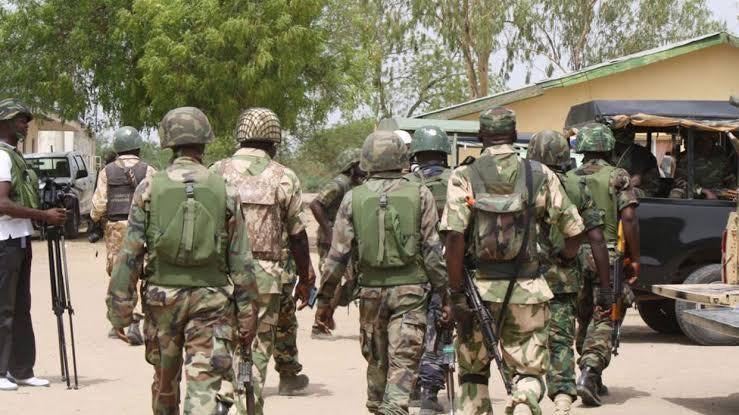
Nigerian Army troops of Operation HADIN KAI (OPHK) subdued a major Islamic State – West Africa Province (ISWAP) assault on Banki in the Bama Local Government Area of Borno and the Bula area of Yobe.
A credible source at army headquarters told journalists that the troops had shielded more than 10,000 resettled households from renewed displacement.
The source said the terrorists launched coordinated attacks on September 18 to overrun the communities and destabilise them.
He said the terrorists were met with stiff resistance from ground troops, backed by precision airstrikes, forcing them into a disorderly retreat with heavy casualties in men and weapons on the enemies’ side.
The military officer said that in Banki, the reinforced troops stood firm to protect women, children, and the elderly.
According to him, in Bula, Yobe, soldiers displayed tactical discipline that foiled repeated enemy attempts to breach security positions.
“Farmers who recently returned to rebuild their livelihoods were also secured.
“During an operational visit on September 19, the Acting General Officer Commanding (GOC) 7 Division and Commander Sector 1 OPHK, Brig.-Gen. Ugochukwu Unachukwu, hailed the troops’ sacrifice.
“He assured residents and humanitarian agencies that the Nigerian army remains resolute in its mandate to protect civilians and secure the recovery of conflict-affected communities,” he said.
The source also dismissed as false some media reports claiming that terrorists overran a military base in the area.
He stated that no army position was captured and that all communities remained firmly under security control.
According to him, one soldier paid the supreme price during the encounters with others wounded in the operation.
He described their sacrifice as a testament to the force’s determination to guarantee peace, dignity, and safety for Nigerians returning home after years of displacement.
The source said the ongoing operations would be sustained under the leadership of the Chief of Army Staff (COAS), Lt.-Gen. Olufemi Oluyede, within a joint and multi-agency framework.
“Nigerians owe the injured gallant troops and fallen heroes a debt of gratitude for keeping hope alive in communities rising from the ashes of war,” he added.
(NAN)

We have recently deactivated our website's comment provider in favour of other channels of distribution and commentary. We encourage you to join the conversation on our stories via our Facebook, Twitter and other social media pages.

More from Peoples Gazette

Agriculture
FG tasks ECOWAS on leveraging financing strategies for agroecology
The federal government has urged stakeholders in the agriculture and finance sectors in the West Africa region to leverage financing strategies to enhance agroecology practices

Politics
Katsina youths pledge to deliver over 2 million votes to Atiku
“Katsina State is Atiku’s political base because it is his second home.”

Heading 4
UK women, partners to get two weeks’ bereavement leave after miscarriage from next year
“From April, women and their partners will be entitled to two weeks off after any pregnancy loss,” Mr Burnham said.
Africa
Climate Change: 32 million West Africans may become refugees by 2050, says ECOWAS
ECOWAS says 32 million West Africans risk being displaced from their communities due to climate change.
States
Navy recovers 182,000 litres of suspected stolen crude oil in Rivers
The Nigerian Navy recovered 182,000 litres of suspected stolen crude oil in Rivers.

Economy
Edible oil tanker drivers suspend planned strike
NUEOTDN President Ilias Aperun said the decision followed interventions by the federal government and the State Security Service (SSS).

States
Lagos APC governorship candidate Hamzat rallies voters for 2027
Mr Hamzat expressed concern about declining voter participation, noting that of the 6.2 million registered voters in Lagos in the last election, only about 1.2 million voted.

Economy
NMDPRA begins consultations on anti-competition regulations in petroleum sector
The proposed regulations are designed to address abuse of dominance and promote fair, non-discriminatory access to essential petroleum infrastructure.


