

Trump plans slashing pharmaceutical prices by 80%
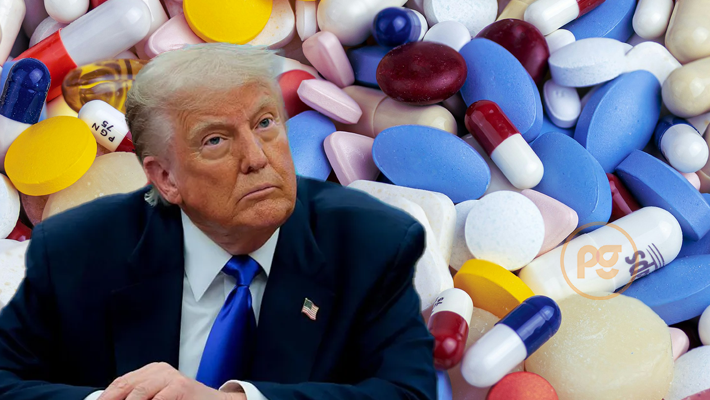
President Donald Trump said he would sign an executive order to lower the prices of prescription drugs and pharmaceutical products.
“Prescription Drug and Pharmaceutical prices will be reduced, almost immediately, by 30 per cent to 80 per cent,” Mr Trump said in a social media post. “They will rise throughout the world in order to equalise and, for the first time in many years, bring fairness to America.”
The U.S. president said he would sign the executive order, which he said would be one of the most consequential in U.S. history, at 9:00 a.m. (1300 GMT) on Monday.
Earlier in the week, Mr Trump had promised an “earth-shattering” announcement.
U.S. media at the time reported the announcement would relate to drug prices.
In the U.S., there is currently no central government price regulation for drugs applying to all medicines.
The pharmaceutical industry plays the most important role in determining how much a drug costs, and government influence is limited.
This leads to sometimes enormously high prices for certain drugs.
Many drugs in the U.S. are particularly expensive compared to other countries.
It was not initially clear how Mr Trump’s order would work, with a pushback expected by pharmaceutical companies.
Mr Trump had attempted to lower drug prices during his first term in office.
The plan at the time was to provide drugs, including insulin and EpiPens, at discounts to people with low incomes, and use lower international prices to pay for some drugs provided under the Medicare state insurance programme for older adults.
The proposal was never implemented due to legal and political opposition.
Mr Trump’s Sunday post said this time he would try to bring down prices by “instituting a most favoured nation’s policy whereby U.S. will pay the same price as the nation that pays the lowest price in the world.”
The American president suggested that the Democrats fought against bringing down prices.
In fact, drug regulation was one of the central issues of Mr Trump’s predecessor, Democrat Joe Biden.
In 2022, Mr Biden signed a major legislative package that also authorised Medicare to negotiate certain drug prices.
Mr Biden’s measure was considered a milestone.
(dpa/NAN)

We have recently deactivated our website's comment provider in favour of other channels of distribution and commentary. We encourage you to join the conversation on our stories via our Facebook, Twitter and other social media pages.

More from Peoples Gazette

States
Independence: NBA urges Nigerians to expect better future
The NBA said that ordinary Nigerians should be deriving benefit from the subsidy removal rather than hardship.

Agriculture
FG tasks ECOWAS on leveraging financing strategies for agroecology
The federal government has urged stakeholders in the agriculture and finance sectors in the West Africa region to leverage financing strategies to enhance agroecology practices

Politics
Katsina youths pledge to deliver over 2 million votes to Atiku
“Katsina State is Atiku’s political base because it is his second home.”

Sport
2027 AFCON Qualifier: Guinea-Bissau beat Madagascar, extend lead over Nigeria in Group L
Guinea-Bissau now have 10 points, Nigeria seven points, while Madagascar and Tanzania have two points each.
Africa
WHO raises concern over rising Bundibugyo Ebola deaths, insecurity in DR Congo
Mr Ghebreyesus said the outbreak, declared six months ago, had spread across 67 health zones in eight provinces in the DR Congo.

Africa
Afreximbank urges industries to boost intra-African trade as alternative to China in global markets
“As global markets look to diversify production beyond China, Africa must position itself as a natural partner of choice,” Mr Maayergi said.

World
Russell Brand faces probe over prison message to supporters
Mr Brand was convicted at Southwark Crown Court of one count of rape and three counts of sexual assault.

Politics
Tinubu admits cost-of-living crisis after APC dismissed widespread hunger claims
According to Mr Tinubu, the 2027 election is about the country’s future and direction.

World
WHO pushes for stronger vaccination, screening, treatment to eliminate cervical cancer
WHO said that expanding HPV vaccination, improving screening access, and ensuring timely treatment are critical to protecting women.


