

U.S.-Iran War: Kenya faces $800 million loss to oil price surge

Kenya is set to lose an estimated $340 million due to elevated oil prices since the start of the U.S.-Iran war and will cost up to $800 million ($770 million – $810 million) in total by the end of the year in case of continued escalation, according to new analysis by climate advocacy group 350.org on Friday.
The analysis showed that even in the case of a swift normalisation of the Strait of Hormuz and the region, higher oil prices would cost the Kenyan people and businesses over half a billion ($ 490 million-$520 million) by the end of the year.
The group said its analysis was based on oil and gas pricing scenarios in the International Monetary Fund’s April 2026 World Economic Outlook, Kenyan consumption data, and observed price averages since the start of the U.S.-Iran war and Hormuz crisis.
“350.org‘s estimates do not yet account for wider knock-on effects, including rising fertiliser and food costs, lower economic output and employment, or rising inflation driven by fossil fuel price volatility. As a result, the true economic damage is likely to be significantly greater than the direct losses from higher oil and gas prices alone,” the group stated.
The group said Kenya, as a net oil importer with no domestic petroleum production, is acutely vulnerable to global fossil fuel price volatility, making direct shocks to its import bill a severe macroeconomic threat.
“Energy and transport inputs ripple across every sector of the Kenyan economy, driving up food and agricultural costs (via fuel and fertiliser), logistics, and baseline retail inflation, while putting intense downward pressure on the Kenyan Shilling and national foreign exchange reserves.
“A projected direct loss of up to $800 million diverts critical capital away from public investment, widening the trade balance and placing an unsustainable cost-of-living strain on households,” it added.
According to the group, this dynamic starkly underscores the economic exposure of importing fossil fuels while global oil majors capture windfall profits, intensifying local calls from climate advocates and civil society for Kenya to accelerate its shift toward decentralised, domestic renewable energy to build long-term economic resilience.
“While international oil corporations record windfall profits from geopolitical instability, nations like Kenya are forced to pay the price,” Ruth Agala, Regional Organiser for 350 East Africa, said.
“This projected $800 million loss isn’t just a statistical headline; it represents immediate, damaging pressure on household budgets, and vital public funds being drained from our national economy. It reinforces the urgent need to break our dependence on fossil fuels and rapidly scale up domestic, community-led renewable energy systems,” she added.
Citing the next round of negotiations on a United Nations Framework Convention on International Tax Cooperation in New York, 350.org said that the UN Tax Convention is an opportunity to correct an unjust global system where profits are increasingly concentrated among multinational corporations.
Clémence Dubois, Campaigns Director at 350.org, noted that every spike in fossil fuel prices acted as an unofficial tax on people: increasing the cost of transport, electricity and food, while governments spend billions responding to disasters and shielding households from high energy prices.
“Yet the companies driving both climate pollution and energy volatility continue to reap extraordinary financial rewards. It’s only fair that they contribute to the solutions,” Ms Dubois stated.
The climate group demanded strong, permanent taxes on extraordinary fossil fuel profits, particularly during periods of war, market disruption and energy price spikes.
It also called for stronger international tax rules that give countries, especially in the Global South, greater rights to tax multinational corporations, stressing the need for investment in renewable energy and climate adaptation.

We have recently deactivated our website's comment provider in favour of other channels of distribution and commentary. We encourage you to join the conversation on our stories via our Facebook, Twitter and other social media pages.

More from Peoples Gazette

Agriculture
FG tasks ECOWAS on leveraging financing strategies for agroecology
The federal government has urged stakeholders in the agriculture and finance sectors in the West Africa region to leverage financing strategies to enhance agroecology practices

Politics
Katsina youths pledge to deliver over 2 million votes to Atiku
“Katsina State is Atiku’s political base because it is his second home.”

States
NCAC, Enugu to host NAFEST 2026
NCAC is collaborating with the Enugu government to host the 2026 National Festival of Arts and Culture to promote national unity and cultural diversity.

Anti-Corruption
Latest list of U.S.-based Nigerian lawyers suspended for fraud, mishandling client money, misrepresentation
Ginikanwa Okedi was indefinitely suspended for mishandling client money or trust accounts, dishonest behaviour, fraud, and misrepresentation.
NationWide
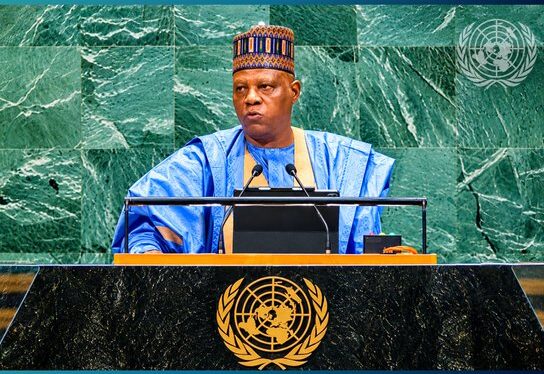
Shettima to address UNGA on Thursday
Nigeria will address the UN General Assembly on Thursday afternoon, with Vice-President Kashim Shettima delivering the country’s national statement for the third consecutive year.

Economy
NUPRC, Indonesia open talks on oil investments as Pertamina eyes 2026 licensing round
NUPRC has opened discussions with Indonesia on petroleum investments, and Indonesian national oil company Pertamina has expressed interest in Nigeria’s 2026 licensing round.

Agriculture
Weather Alert: NiMet warns of strong winds as thunderstorms, rain sweep Nigeria
The Nigerian Meteorological Agency (NiMet) has forecast thunderstorms and rainfall across several parts of Nigeria from Monday to Wednesday.

Rights
NSCDC suspends three more officers over mass killing of Niger miners
The Nigeria Security and Civil Defence Corps has suspended three more officers and ordered three days of half-mast to mourn miners who died in its custody.


