

Uba Sani, defence minister, varsity don, proffer solutions to insecurity in North-West
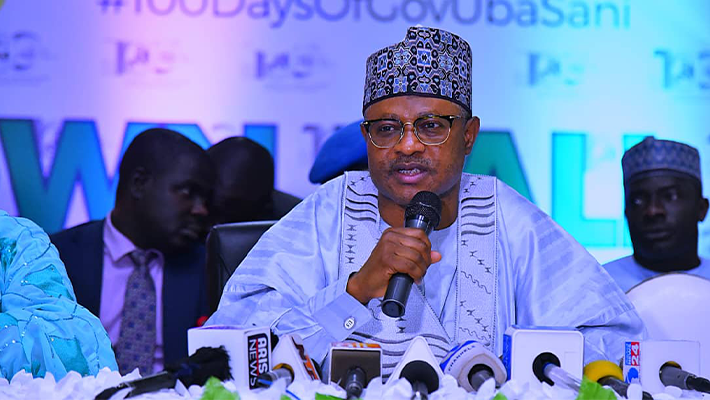
Governor Uba Sani has advocated for an integrated system that balances military strength, community engagement, and long-term development in order to solve the security challenges in the North-West geopolitical zone.
The governor also called for the creation of a North-West Theatre Command, bringing the Nigerian Army’s 1st and 8th Divisions under a unified command structure.
According to him, this will accelerate intelligence sharing, enhance coordinated operations, and dismantle cross-state criminal networks more effectively.
Governor Uba Sani gave these suggestions at the public hearing of the North-West Zonal Security Summit, organised by the Senate Ad Hoc Committee on National Security Summit, in Kaduna on Saturday.
He also suggested the building of a strong security partnership beyond our borders, recommending “the expansion of the Multinational Joint Task Force (MNJTF), which has achieved notable success around the Lake Chad Basin, to cover our borders with the Niger Republic.”
‘’This expansion will disrupt arms trafficking routes, deny criminals cross-border sanctuaries, and weaken the networks that sustain their operations,’’ he added.
Governor Uba Sani, however, warned that military might alone cannot win the battle because community trust and participation are indispensable in containing insecurity.
He proposed the establishment of permanent security committees at the state and local government levels, comprising traditional rulers, religious leaders, women’s organisations, youth groups, civil society, and security agencies.
According to him, these committees “will serve as early-warning systems, conflict-resolution platforms, and bridges of trust between citizens and the state.”
The governor also called for the creation of state police, arguing that Nigeria’s centralised policing model can no longer meet the demands of a nation with over 230 million people and vast ungoverned spaces.
‘’With fewer than 400,000 police officers nationwide, many rural communities are left without meaningful protection,’’ he further argued.
Speaking on the theme “Public Hearing, Building Robust Regional Collaborations To Tackle Insecurity: Pathway for Securing the Future,” the Minister of Defence, Alhaji Mohammed Badaru Abubakar, reiterated President Bola Tinubu’s commitment to end insecurity in the country.
‘’The president’s directive is to establish a strong, yet adaptive, national security architecture to eradicate these threats. Accordingly, we are committed to ensuring that such violations of the rights of our children and threats to our development goals do not occur again,’’ he added.
The minister noted that in spite of the challenges, the present administration has recorded progress compared to the situation before this government came on board.
‘’Joint operations across Kaduna, Zamfara, Katsina, Sokoto, and Kebbi have reopened key routes. Movement on Kaduna-Kachia, Kaduna-Birnin Gwari, Jibia-Gurbin Baure, and parts of the Sokoto-Illela corridor has improved.”
Alhaji Badaru also pointed out that markets in Kaura Namoda, Shinkafi, Batsari, Giwa, and Kajuru now record higher activity, adding that “many villages that were displaced in earlier years have returned.”
‘’Similarly, in the last two years before the recent incidents, many schools that closed due to insecurity have resumed academic activity under strengthened
protection.
“Likewise, farmers in many affected communities are back on their fields with better security support,’’ the Minister of Defence further reiterated.
He, however, acknowledged that “the North-West continues to face lingering threats from bandits, terror cells and organised criminal networks despite the relentless efforts of our troops and other agencies.”
In his keynote presentation, Prof Muhammad Kabir Isa said that the current strategies toward ending insecurity have continued to fail because they are limited.
He added that the strategies are limited by fragmentation, inadequate coordination, overstretched security institutions, inconsistent state policies, weak intelligence systems, humanitarian constraints, and the absence of a comprehensive regional architecture.
According to the Professor of Public Administration at the Ahmadu Bello University, Zaria, “even where tactical gains occur, they fail to translate into sustainable peace because structural drivers of insecurity remain unaddressed.”
‘’These limitations underscore the necessity of building a robust regional collaboration platform capable of harmonising strategies, integrating multi-level actors, and addressing both immediate threats and long-term governance and development challenges,’’ he added.
Prof Isa called for regional collaboration to address the mobility of armed groups, the dispersion of bandit enclaves across forest belts, inconsistent policy environments, fragmented community-security structures, and the complexity of humanitarian and developmental spillovers.
In his welcome address, the chairman of the Organising Committee of the summit, Senator Babangida Hussaini, reminded that the summit was convened “to bring together stakeholders in the zone to frankly discuss the increasing and alarming rates of insecurity in our zone and the nation at large.”
He reiterated that a National Security Summit will come up in Abuja on 1st December “to provide a platform for collating the aggregate views of Nigerians on the pathways for securing our people and the country.”
According to him, the coming National Security Summit is a testament that the president is not leaving any stone unturned in the search for actionable solutions to this national emergency.’’
Senator Hussaini noted that the upper legislative chamber convened the summit “to holistically examine the cross-cutting issues responsible for our peculiar security challenges and to suggest practical solutions to the problems.”
He thanked Governor Uba Sani for the overwhelming support for the success of the historic summit, through personal and official involvement, describing it as unprecedented.

We have recently deactivated our website's comment provider in favour of other channels of distribution and commentary. We encourage you to join the conversation on our stories via our Facebook, Twitter and other social media pages.

More from Peoples Gazette

States
Independence: NBA urges Nigerians to expect better future
The NBA said that ordinary Nigerians should be deriving benefit from the subsidy removal rather than hardship.

Agriculture
FG tasks ECOWAS on leveraging financing strategies for agroecology
The federal government has urged stakeholders in the agriculture and finance sectors in the West Africa region to leverage financing strategies to enhance agroecology practices

Politics
Katsina youths pledge to deliver over 2 million votes to Atiku
“Katsina State is Atiku’s political base because it is his second home.”

Politics
Katsina PDP guber candidate pledges to end unemployment
The candidate said that if elected, he would prioritise policies that would enable young people to secure employment.
States
Zamfara: Abducted children, women rescued after 22 days in bandits’ den
Mr Abubakar said the police, the State Security Service and local hunters swiftly mobilised and carried out a well-coordinated rescue operation.
States
Gov Bago mourns Niger APC welfare secretary
The governor described Mr Wakil’s death as a great loss not only to the state APC but also to the national party structure.

Diaspora
APC youth condemns UK protest against Amupitan, threatens ‘full force’ against attacks on Tinubu
Mr Israel warned in a statement on Saturday that the party’s youth wing will confront citizens attacking the president, his wife, convoy and supporters.

Politics
Makinde flags off campaign in Oyo, pledges to reset Nigeria
Mr Makinde thanked people who attended the programme, assuring them that they would all reap the dividends of democracy.
Anti-Corruption
54 African countries to converge on Abuja for talks on stolen asset recovery
Mr Mohammed said Africa continues to lose resources critical to its development to corruption and illicit channels.


