

Uche Ndumele: Britain’s slavery apology is necessary but not enough

As Commonwealth leaders meet in Antigua and Barbuda, British Prime Minister Andy Burnham’s willingness to consider a formal apology for Britain’s role in the transatlantic slave trade has reopened an important debate about historical responsibility and reparatory justice. Burnham has offered structured dialogue with affected countries and communities but ruled out financial reparations.
The question is not simply whether Britain should apologise, but what an apology would mean beyond symbolism.
British merchants, financial institutions, shipping interests and colonial authorities participated in a system that transported millions of Africans across the Atlantic, denied them their humanity and generated wealth through forced labour. Its consequences included family separation, cultural dispossession and racial hierarchies whose legacies remain subjects of serious debate. Parliament prohibited British participation in the slave trade in 1807, but slavery itself continued in most British colonies until the 1830s. Abolition did not erase the suffering already inflicted.
The legal argument requires particular care. In March 2026, Britain invoked intertemporality and non-retroactivity at the United Nations, arguing against imposing a duty to provide reparation for historical acts that did not violate international law when committed.
This raises a fundamental question of public international law: what did customary international law prohibit at the relevant time?
The international response evolved over centuries. The 1815 Declaration of the Congress of Vienna condemned the slave trade as contrary to humanity and universal morality. Subsequent instruments, including the Berlin Act of 1885 and the Brussels Act of 1890, developed international co-operation for its suppression. The 1926 Slavery Convention established a further treaty framework.
These developments demonstrate an evolving international norm, but condemnation, treaty obligations and a universally binding customary prohibition are distinct legal questions. Each requires examination of the applicable law, state practice and acceptance of that practice as law. The 1817 British admiralty decision in The Louis, concerning interference with foreign shipping suspected of slave trading, illustrates the limitations of Britain’s enforcement powers at the time; it does not settle every legal question concerning slavery throughout the centuries.
The intertemporal rule must therefore be applied to the particular conduct and period under consideration. It would be anachronistic to assume that every contemporary prohibition applied identically centuries ago. Equally, the passage of time should not substitute for examining the historical record. A change of government does not ordinarily extinguish the international legal personality of a continuing state or an established international obligation. Nevertheless, state continuity alone does not establish liability for every historical act; the legal basis for any enforceable remedy must be assessed separately.
Legal liability, however, is not the only question. An apology can serve a moral, historical and diplomatic purpose even where an enforceable obligation to compensate remains disputed.
Present-day British citizens are not personally guilty of their predecessors’ actions. Yet the consequences of history do not disappear with successive generations. Some wealth, institutions and economic advantages accumulated through slavery became part of Britain’s historical development, while enslaved Africans and their descendants bore its human and material costs. This does not mean every contemporary British advantage derives from slavery, but it justifies examining how historical enrichment and deprivation continue to shape the present.
Rejecting financial reparations does not settle the broader question of reparatory justice. Possible measures include education, public health, cultural restoration, institutional reform and development partnerships. Such measures should emerge from genuine dialogue with affected countries and communities, rather than being imposed as substitutes for meaningful redress.
But accountability must not stop at Britain’s shores.
Some African rulers and intermediaries participated in the historical trade in enslaved Africans. Their roles should not be concealed because European participation was extensive or colonialism subsequently inflicted profound damage on African societies. Acknowledging African participation does not absolve Britain of its responsibilities, just as Britain’s responsibility does not absolve African participants of theirs.
The principle also demands scrutiny of contemporary African governments. Corruption, resource exploitation and the diversion of public wealth have deprived citizens across parts of the continent of the benefits of their own natural and human resources. African leaders cannot demand that external powers confront historical injustice while treating their own failures of governance as though nobody should be held accountable.
This is not an argument against reparations. Africa’s historical suffering cannot excuse contemporary misgovernance, just as contemporary misgovernance cannot erase historical responsibility. Both demand honest examination.
Britain should move beyond the question of whether apologising is politically convenient and consider what meaningful acknowledgement, dialogue and practical co-operation require. African governments, in turn, must demonstrate that historical justice goes hand in hand with accountable institutions, responsible resource management and public welfare.
An apology is necessary, but it is not the whole of justice. Britain must confront its past without hiding behind the passage of time; Africa must pursue historical redress without surrendering responsibility for its present and future. Neither history nor an apology can substitute for responsible government. Both, however, can help establish the conditions for a more honest and just relationship.
- Uche Young Ndumele is an international law specialist, legal practitioner and author whose works are catalogued in the eLibrary of the African Court on Human and Peoples’ Rights. He writes from Canada.

We have recently deactivated our website's comment provider in favour of other channels of distribution and commentary. We encourage you to join the conversation on our stories via our Facebook, Twitter and other social media pages.

More from Peoples Gazette

States
Independence: NBA urges Nigerians to expect better future
The NBA said that ordinary Nigerians should be deriving benefit from the subsidy removal rather than hardship.

Agriculture
FG tasks ECOWAS on leveraging financing strategies for agroecology
The federal government has urged stakeholders in the agriculture and finance sectors in the West Africa region to leverage financing strategies to enhance agroecology practices

Politics
Katsina youths pledge to deliver over 2 million votes to Atiku
“Katsina State is Atiku’s political base because it is his second home.”

States
Police capture 103 suspects in crackdown on Borno criminals
The police command in Borno has arrested 103 suspects in a major clampdown on thugs, drug peddlers, and other criminals in the Maiduguri metropolis.

Heading 4
Trump concedes defeat as Democrats gain control of Congress in U.S. midterm elections
The Democrats “did a good job”, Mr Trump admitted in an interview with Fox News, adding, “I’m a little surprised.”
Opinion
Uche Ndumele: Britain’s slavery apology is necessary but not enough
An apology is necessary, but it is not the whole of justice. Britain must confront its past without hiding behind the passage of time.
Diaspora
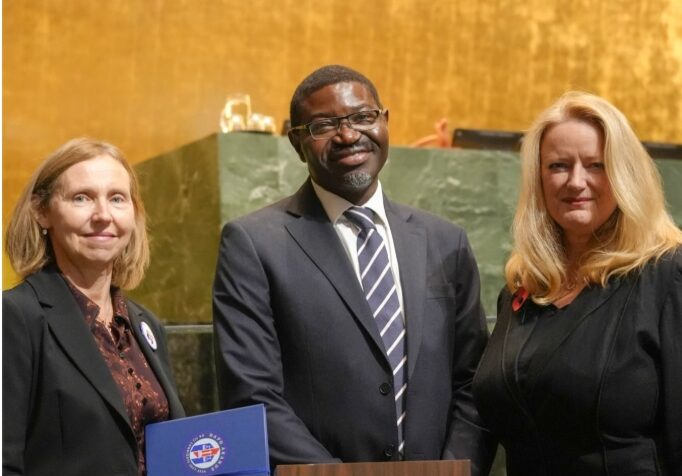
Nigerian-born Dapo Akande elected to International Court of Justice; Burnham, Miliband hail appointment
Mr Akande originally qualified as a lawyer in Nigeria, and is now one of the UK’s foremost international lawyers, with a career of global reach.

Hot news Home top
Kenya-linked alleged international fraudster Muhamed Dieye indicted in $370 million bank fraud captured fleeing U.S.
Mr Dieye is the leader and chief architect of the alleged conspiracy. He was charged with conspiracy to commit wire fraud and bank fraud, wire fraud and identity theft.

Anti-Corruption
U.S. court jails Nigerian building inspector Adebanjo Popoola six years for fraud
Mr Popoola “was so bold as to give 42% of the total funds disbursed under the City’s Stable Communities STL programme to his sister’s and his wife’s companies”, the memo stated.


